

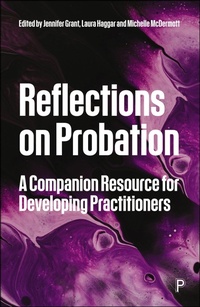
Reflections on Probation
A Companion Resource for Developing Practitioners
Policy Press
1st Edition
Published on 14. October 2025
304 pages
978-1-4473-7265-3 (ISBN)
Description

Reflective practice is at the heart of probation training and the continuing professional development of practitioners. This edited collection provides practitioners with an opportunity to explore and develop their own reflective practice, considering diversity and organisational challenges, with real-world examples of reflection in the probation context.
In addition to probation specialists, its contributors include those from prison, third-sector organisations and mental health perspectives, to consider probation practice in different settings. Each chapter provides prompts for reflective development, so its ideas can be immediately applied in practice. It will equip the reader to develop their reflective practice skills, regardless of their level of experience.
In addition to probation specialists, its contributors include those from prison, third-sector organisations and mental health perspectives, to consider probation practice in different settings. Each chapter provides prompts for reflective development, so its ideas can be immediately applied in practice. It will equip the reader to develop their reflective practice skills, regardless of their level of experience.
Reviews / Votes
'This is not simply a text about reflective practice but an example in itself of reflective writing. The editors are to be congratulated for bringing together such an excellent and diverse group of contributions.' Stephen Collett, University of Liverpool and Liverpool John Moores University 'Reflection is critical to probation practice. However, it is a less well-explored area of practice than other key concepts and so there is a need for a detailed and comprehensive look at what reflection in probation is, and how to do it. This book achieves just that. The chapters engage with the concept of reflective practice from a number of perspectives and with various groups of staff in mind. It will be invaluable reading to anyone currently working or training in the context of probation work.' Jake Phillips, University of Cambridge 'Within its extensive scope this compendium provides an invaluable developmental tool for probation trainees and experienced staff alike.' David Coley, Practice Tutor Assessor and Independent Probation ResearcherMore details
Edition
First Edition
Language
English
Place of publication
Bristol
United Kingdom
Publishing group
Bristol University Press
Target group
Professional and scholarly
Illustrations
Not illustrated
File size
1,66 MB
ISBN-13
978-1-4473-7265-3 (9781447372653)
Copyright in bibliographic data and cover images is held by Nielsen Book Services Limited or by the publishers or by their respective licensors: all rights reserved.
Schweitzer Classification
Other editions
Additional editions
Reflections on Probation
A Companion Resource for Developing Practitioners
Book
10/2025
1st Edition
Policy Press
€31.50
Shipment within 15-20 days
Persons
Jennifer Grant is a Senior Teaching Fellow in Community Justice at the School of Criminology and Criminal Justice, University of Portsmouth.
Laura Haggar is a Senior Lecturer in Criminal Justice and Desistance at the School of Criminology and Criminal Justice, University of Portsmouth.
Michelle McDermott is Principal Lecturer and Subject Area Lead in Community Justice at the School of Criminology and Criminal Justice, University of Portsmouth.
Laura Haggar is a Senior Lecturer in Criminal Justice and Desistance at the School of Criminology and Criminal Justice, University of Portsmouth.
Michelle McDermott is Principal Lecturer and Subject Area Lead in Community Justice at the School of Criminology and Criminal Justice, University of Portsmouth.
Content
IIntroduction
Part 1: Contextualising reflection within probation practice
1. Adrian Needs 'Psychological Perspectives on Reflective Processes in Criminal Justice Contexts'
2. Anne Burrell 'Reflective practice in probation work - sustaining reflexivity in times of turbulence'
3. Dominic Pearson and Daniele Molino 'Probation Staff Reflective Practice: Can it Impact on Outcomes for Clients with Personality Difficulties?'
4. Laura Sibret 'Enhancing professional growth through self-understanding'
Part 2: The organisational space for reflection
5. Jennifer Grant 'Fostering reflective practice as part of leadership'
6. Mike Nash 'Thinking About Safeguarding'
7. Lauren Stevens 'A Relational Role in the Prison Environment'
8. Jennifer Walmsley and Laura Haggar 'Creating space for reflection and connection: Learning from the creative arts and the third sector'
Part 3: Reflections on contemporary issues of diversity in probation practice
9. Ashlea Swinford 'Reflections of racially minoritised staff in the COVID-19 pandemic'
10. Nicole Nyamwiza 'Reflections on Probation'- Co-creating the Probation experience with Black male service users'
11. Michelle McDermott, Laura Haggar & Jennifer Grant 'Reflections of Female probation practitioners: Navigating the challenges of working with male offenders'
12. Kath Wilson, Daniella Nudd, Hollie Neal & Victoria Jones 'Unspoken Journeys: Reflections of Lesbian Probation Practitioners'
Part 4: Teaching, Learning & Professional Development
13. Ben Keysell ''SCOPE' for reflection: A framework of Transformative Outcomes for Probation Officer Training'
14. Julie Eden-Barnard: 'De-mystifying the Mirror: A Framework for the Assessment of Reflective Practice'
15. Ceri Halfpenny 'Critical reflection: key principles for PQiP students and assessors providing feedback'
16. Megan Thomas 'Navigating Trauma in Higher Education; Reflections on Applying Trauma-Informed Approaches to Teaching Criminology and Professional Qualification in Probation (PQiP) Students'
17. Laura Haggar, Michelle McDermott & Amy Meenaghan 'Extended Reality: A new dimension for reflective learning'
Conclusion
Part 1: Contextualising reflection within probation practice
1. Adrian Needs 'Psychological Perspectives on Reflective Processes in Criminal Justice Contexts'
2. Anne Burrell 'Reflective practice in probation work - sustaining reflexivity in times of turbulence'
3. Dominic Pearson and Daniele Molino 'Probation Staff Reflective Practice: Can it Impact on Outcomes for Clients with Personality Difficulties?'
4. Laura Sibret 'Enhancing professional growth through self-understanding'
Part 2: The organisational space for reflection
5. Jennifer Grant 'Fostering reflective practice as part of leadership'
6. Mike Nash 'Thinking About Safeguarding'
7. Lauren Stevens 'A Relational Role in the Prison Environment'
8. Jennifer Walmsley and Laura Haggar 'Creating space for reflection and connection: Learning from the creative arts and the third sector'
Part 3: Reflections on contemporary issues of diversity in probation practice
9. Ashlea Swinford 'Reflections of racially minoritised staff in the COVID-19 pandemic'
10. Nicole Nyamwiza 'Reflections on Probation'- Co-creating the Probation experience with Black male service users'
11. Michelle McDermott, Laura Haggar & Jennifer Grant 'Reflections of Female probation practitioners: Navigating the challenges of working with male offenders'
12. Kath Wilson, Daniella Nudd, Hollie Neal & Victoria Jones 'Unspoken Journeys: Reflections of Lesbian Probation Practitioners'
Part 4: Teaching, Learning & Professional Development
13. Ben Keysell ''SCOPE' for reflection: A framework of Transformative Outcomes for Probation Officer Training'
14. Julie Eden-Barnard: 'De-mystifying the Mirror: A Framework for the Assessment of Reflective Practice'
15. Ceri Halfpenny 'Critical reflection: key principles for PQiP students and assessors providing feedback'
16. Megan Thomas 'Navigating Trauma in Higher Education; Reflections on Applying Trauma-Informed Approaches to Teaching Criminology and Professional Qualification in Probation (PQiP) Students'
17. Laura Haggar, Michelle McDermott & Amy Meenaghan 'Extended Reality: A new dimension for reflective learning'
Conclusion
