

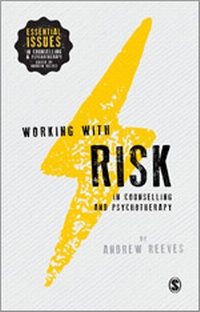
Working with Risk in Counselling and Psychotherapy
1st Edition
Published on 12. January 2015
184 pages
978-1-4739-1688-3 (ISBN)
Description

The wide-ranging contexts in which counselling and psychotherapy is now practiced means clients present with a range of risks that therapists have to respond to. Risk is an ever-present issue for counsellors and psychotherapists and, in an increasingly litigious culture, the need for trainees to develop a sound understanding of how the right tools and the right knowledge can support their practice has never been greater. In this book Andrew Reeves takes trainees, newly qualified practitioners, and more experienced practitioners step-by-step through what is meant by risk, offering practical hints and tips and links to policy and research to inform good ethical practice along the way.
This book tackles:
* The definition of risk and how risk is linked to social, psychological and relational factors
* Working with those who are at risk of suicide, self-injury, self-harm and/or are an endangerment to others
* How therapists should respond to the risk in situations involving child protection, mental health crises, and in the therapeutic process itself
* The positive side of risk-taking
* How counsellors and psychotherapists can work with risk proactively and positively, informed by research.
Filled with case studies, ethical dilemmas, reflective questions, discussion questions and further reading, this book offers counsellors and psychotherapists guidance on how they can work with risk proactively and positively. It is an essential resource for all services, organisations and individual practitioners.
This book tackles:
* The definition of risk and how risk is linked to social, psychological and relational factors
* Working with those who are at risk of suicide, self-injury, self-harm and/or are an endangerment to others
* How therapists should respond to the risk in situations involving child protection, mental health crises, and in the therapeutic process itself
* The positive side of risk-taking
* How counsellors and psychotherapists can work with risk proactively and positively, informed by research.
Filled with case studies, ethical dilemmas, reflective questions, discussion questions and further reading, this book offers counsellors and psychotherapists guidance on how they can work with risk proactively and positively. It is an essential resource for all services, organisations and individual practitioners.
Reviews / Votes
When confronted by risk it is common for us to lose the ability to think. This book offers a broad, realistic and grounded approach to thinking about risk. Risk is looked at from the vantage point of what is risky for the client and also for the therapist. The use of client vignettes and reflective exercises enable the reader to engage directly with their attitudes, feelings and also their responsibilities towards clients exhibiting risky behaviour. The book also embraces issues related to self- harm and risk in the context of mental health. Andrew Reeves has written a compact book that is useful to therapeutic practitioners but also to those teaching others about the nuts and bolts of addressing risk in the counselling room and other helping settings. -- Dr Liz Coldridge In Working with Risk in Counselling and Psychotherapy, Reeves has provided an engaging, lucid and comprehensive exploration of a "multidimensional view of risk", posing critical questions and drawing substantially from clinical material in order to examine the nuances of this crucial concept. An invaluable resource for trainees and seasoned practitioners alike, the book combines a broad range of both practical and philosophical concerns, succinctly addressing a wealth of detail in order to elucidate our understanding.-- Dr Susan Maise Strauss As Andrew Reeves points out, the term 'risk' is often used in our profession but is rarely defined with any clarity or depth. He offers useful definitions for the term and works systematically through a broad range of issues that might arise when working with risk in counselling and psychotherapy. As well as exploring the potential harm represented by risk Reeves also acknowledges the significance of positive risk taking within counselling and psychotherapy. Realistic vignettes along with well structured 'pauses for reflection' are used throughout the book to explore the issues that are discussed. This book is well researched and full of useful links and references for further reading. Overall the book instils confidence about this topic by informing the reader of the many facets of risk in counselling and psychotherapy. -- David Taylor-Jones This is a well-structured book which deals with the following classes of risks: Situational; relational; contextual; professional; and personal... For anyone interested in the area, this is a good resource, fully up-to-date. -- John Rowan Working with Risk is one in a series of books entitled 'Essential Issues in Counselling and Psychotherapy'. It covers the key essential issues around risk and I would strongly recommend it as essential reading, particularly for students in training, recently qualified counsellors and psychotherapists as well as those who are more experienced. -- Julia Denington, lecturer, integrative psychotherapist and supervisor
More details
Series
Language
English
Place of publication
London
United Kingdom
Target group
College/higher education
Professional and scholarly
ISBN-13
978-1-4739-1688-3 (9781473916883)
Copyright in bibliographic data and cover images is held by Nielsen Book Services Limited or by the publishers or by their respective licensors: all rights reserved.
Schweitzer Classification
Other editions
Additional editions
Andrew Reeves
Working with Risk in Counselling and Psychotherapy
Book
01/2015
1st Edition
SAGE Publications Ltd
€75.80
Shipment within 15-20 days
Andrew Reeves
Working with Risk in Counselling and Psychotherapy
Book
01/2015
1st Edition
SAGE Publications Ltd
€172.61
Article exhausted; check different version
Person
Andrew Reeves is a Professor in the Counselling Professions and Mental Health, a Senior BACP Accredited Counsellor/Psychotherapist and a Registered Social Worker. He is a past-Chair of the British Association for Counselling and Psychotherapy, a Fellow of BACP and a Senior Fellow of Advance HE. He has published extensively on working in counselling and psychotherapy, and particularly in working with risk in a range of organisational settings. He is past Editor-in-Chief of Counselling and Psychotherapy Research journal and has a long-standing commitment to ethics in the counselling professions, including in writing and research.
Content
Introduction
What do we mean by risk?
Risk assessment: talking and ticking boxes
Working with a risk of suicide
Working with self-injury and self-harm
The danger of violence and harm to others
Safeguarding and child protection
Mental health crisis: danger and opportunity
Using supervision to manage risks in the therapeutic process
Positive risk taking
Conclusion: bringing it together
What do we mean by risk?
Risk assessment: talking and ticking boxes
Working with a risk of suicide
Working with self-injury and self-harm
The danger of violence and harm to others
Safeguarding and child protection
Mental health crisis: danger and opportunity
Using supervision to manage risks in the therapeutic process
Positive risk taking
Conclusion: bringing it together
