


Mastering the Science of Organizational Change
Description

As the business context evolves more rapidly, driven by accelerating technological, political, and social change, an increasing strategic priority for business leaders is how to enact large-scale organizational change. Even companies that are current industry leaders are vulnerable to disruption. Company leaders need to watch over their shoulder for-and transform the company in anticipation of-the next disruption.
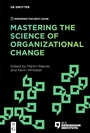
Mastering the Science of Organizational Change summarizes the work of the BCG Henderson Institute and its fellows and ambassadors over several years to develop a more scientific approach to change. Hundreds of companies are analyzed in the book's discussion on how to beat the odds in large-scale change management using an evidence-based approach-a large-scale analysis of what approaches actually work in which circumstances.
Part 1 of the book reviews the imperatives for self-disruption. The second part elaborates on how to manage the process of change. Finally, Part 3 discusses how organizations can take change to the next level.
Events around the book
Link to a De Gruyter online event in which, Martin Reeves, Chairman of the BCG Henderson Institute, will share lessons on how to develop a more scientific approach to change including how to self disrupt, how to manage the process of change, and how organizations can take change to the next level:
https://youtu.be/TfzFllmL4Cg
Reviews / Votes
"The book is well structured, concise and full of good stories that support the theoretical part - and full of ordered list how to start with a successful transformation! In the second section, the book elaborates ways to manage the process of change - I would prefer the process of transformation(!) but at the end of the book exactly that is used. In the following chapters the main reasons why change management fails is explained - Followed by many examples of how to decide when you should transform. The 'always-on' mentality (chapter 13) gave me some insight into the risk of transformation for sustained and long-term growth. The end is well done by having the human-centered approach as topic and not forgotten is the impact of automation and digital transformation. The didactic and content is very good! I'll definitely use some examples in my lectures - and will put it on the reading list!"
--Professor Richard Mischak teaches at the American University of Bulgaria (in Sofia) and was formerly employed at the Salzburg University of Applied Sciences at the Department of Business Management & Strategy.
More details
Other editions
Additional editions
Persons
Martin Reeves is chairman of the BCG Henderson Institute, BCG's think tank dedicated to exploring and developing valuable new insights from business, technology, economics, and science by embracing the powerful technology of ideas. Martin is also a member of the BCG Henderson Institute's Innovation Sounding Board, which is dedicated to supporting, inspiring, and guiding upstream innovation at BCG.
Martin is a regular contributor to HBR, MIT SMR, Fortune and other management journals on business strategy and management.
Kevin Whitaker was the analytics manager at the BCG Henderson Institute, BCG's internal think tank on the future of business strategy, through 2021.
Content
- Intro
- Acknowledgments
- About the BCG Henderson Institute
- Contents
- Introduction
- Part I: Six Steps to Successful Preemptive Change
- Chapter 1. Preemptive Transformation: Fix it Before it Breaks
- Chapter 2. Think Biologically: Messy Management for a Complex World
- Chapter 3. Creating Urgency Amid Comfort
- Chapter 4. Achieving Vitality in Turbulent Times
- Chapter 5. Building Capabilities for Transformation that Lasts
- Chapter 6. Getting Uncomfortable on Purpose
- Chapter 7. Your Change Needs a Strategy
- Part II: Managing the Change Strategy
- Chapter 8. Getting Smart About Change Management
- Chapter 9. The Transformations that Work, and Why
- Chapter 10. The New CEO's Guide to Transformation
- Chapter 11. Turning Around the Successful Company
- Chapter 12. How Bold CEOs Succeed at M&
- A Turnarounds
- Part III: The Next Level of Managing Change
- Chapter 13. A Leader's Guide to Always-On Transformation
- Chapter 14. Free Up your Mind to Free Up your Strategy
- Chapter 15. The Head, Heart, and Hands of Transformation
- Chapter 16. Digital Transformations: Disruptions, Delusions, and Defenses
- Chapter 17. Why Transformations Need a Second Chapter
- List of Figures
- Index
