

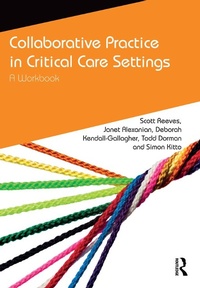
Collaborative Practice in Critical Care Settings
A Workbook
1st Edition
Published on 10. October 2018
138 pages
978-1-351-79866-2 (ISBN)
Description

This practical and evidence-based workbook offers a series of assessment, implementation and evaluation activities for professionals working in critical care contexts. Designed to improve the quality of care delivery, it looks both at collaboration between professionals and between patients and/or family members.
Collaborative Practice in Critical Care Settings:
identifies the issues relating to the "current state" of collaboration in critical care through a series of assessment activities;
provides a series of interventional activities which can address shortfalls of collaboration previously identified; and
offers advice on generating evidence for the effects of any interventions implemented.
The activities presented in this book are based on extensive empirical research, ensuring this book takes into account the everyday work environment of professionals in critical care units. It is suitable for practitioners and educators, as well as patient safety leads and managers.
Collaborative Practice in Critical Care Settings:
identifies the issues relating to the "current state" of collaboration in critical care through a series of assessment activities;
provides a series of interventional activities which can address shortfalls of collaboration previously identified; and
offers advice on generating evidence for the effects of any interventions implemented.
The activities presented in this book are based on extensive empirical research, ensuring this book takes into account the everyday work environment of professionals in critical care units. It is suitable for practitioners and educators, as well as patient safety leads and managers.
More details
Series
Edition
1. Auflage
Language
English
Place of publication
London
United Kingdom
Publishing group
Taylor & Francis Ltd
Target group
College/higher education
Professional and scholarly
Illustrations
10 Tables, black and white; 2 Line drawings, black and white
File size
0,70 MB
ISBN-13
978-1-351-79866-2 (9781351798662)
Copyright in bibliographic data and cover images is held by Nielsen Book Services Limited or by the publishers or by their respective licensors: all rights reserved.
Schweitzer Classification
Other editions
Additional editions
Scott Reeves | Janet Alexanian | Deborah Kendall-Gallagher
Collaborative Practice in Critical Care Settings
A Workbook
Book
09/2018
1st Edition
Routledge
€206.10
Shipment within 10-20 days
Scott Reeves | Janet Alexanian | Deborah Kendall-Gallagher
Collaborative Practice in Critical Care Settings
A Workbook
Book
09/2018
1st Edition
Routledge
€82.30
Shipment within 10-20 days
Persons
Scott Reeves is professor in Interprofessional Research at the Faculty of Health, Social Care and Education, Kingston and St George's, University of London, UK, and Editor-in-Chief of the Journal of Interprofessional Care.
Janet Alexanian is a senior research associate at St Michael's Hospital, Toronto, Canada. She received her doctorate in anthropology at the University of California, Irvine, in 2009.
Deborah Kendall-Gallagher is an adjunct assistant professor at the University of Texas Health Science Center, San Antonio School of Nursing, USA.
Todd Dorman is a critical care physician. He is the Senior Associate Dean for Education Coordination and the Associate Dean for Continuing Medical Education for the Johns Hopkins School of Medicine, USA.
Simon Kitto is a professor in the Department of Innovation in Medical Education and Director of Research in the Office of Continuing Professional Development at the University of Ottawa, Canada.
Janet Alexanian is a senior research associate at St Michael's Hospital, Toronto, Canada. She received her doctorate in anthropology at the University of California, Irvine, in 2009.
Deborah Kendall-Gallagher is an adjunct assistant professor at the University of Texas Health Science Center, San Antonio School of Nursing, USA.
Todd Dorman is a critical care physician. He is the Senior Associate Dean for Education Coordination and the Associate Dean for Continuing Medical Education for the Johns Hopkins School of Medicine, USA.
Simon Kitto is a professor in the Department of Innovation in Medical Education and Director of Research in the Office of Continuing Professional Development at the University of Ottawa, Canada.
Content
Chapter 1. Examining effective collaboration in critical care settings
Chapter 2. Assessing and addressing collaborative practice issues
Chapter 3. Collaboration with patients and family members
Chapter 4. Collaboratively identifying and addressing critical care delivery issues
Chapter 5. Developing and undertaking effective evaluation
Chapter 6. Concluding comments
Appendix 1. An overview of the study which informed this workbook and underpinned the development of its activities and tools.
Appendix 2. Ideas for combining the activities presented in this book (Chapters 3, 4 and 5) with other critical care interventions.
Appendix 3. Methodological and practical guidance on interviewing critical care staff to support the data collection activities in Chapter 2.
Appendix 4. Methodological and practical advice on for gathering observational data to support the activities in Chapter 2.
Appendix 5. Guidance for facilitating the initial staff workshop as described in Chapter 2.
Appendix 6. Guidance for facilitating the family involvement workshop as described in Chapter 3.
Appendix 7. Guidance for facilitating the collaborative critical care workshop as detailed in Chapter 4.
Appendix 8. Checklists recording interprofessional and patient/family issues as described in Chapters 2 and 3.
Appendix 9. General advice on facilitating workshop activities described in Chapters 2, 3 and 4.
Appendix 10. A possible evaluation form that could be used in any of the workshop activities detailed in Chapters 2, 3 and 4.
Appendix 11. A selection of organisations that promote interprofessional collaboration and patient- and familycentred care.
Appendix 12. Further reading on collaboration between critical care professionals, patients, and families.
Chapter 2. Assessing and addressing collaborative practice issues
Chapter 3. Collaboration with patients and family members
Chapter 4. Collaboratively identifying and addressing critical care delivery issues
Chapter 5. Developing and undertaking effective evaluation
Chapter 6. Concluding comments
Appendix 1. An overview of the study which informed this workbook and underpinned the development of its activities and tools.
Appendix 2. Ideas for combining the activities presented in this book (Chapters 3, 4 and 5) with other critical care interventions.
Appendix 3. Methodological and practical guidance on interviewing critical care staff to support the data collection activities in Chapter 2.
Appendix 4. Methodological and practical advice on for gathering observational data to support the activities in Chapter 2.
Appendix 5. Guidance for facilitating the initial staff workshop as described in Chapter 2.
Appendix 6. Guidance for facilitating the family involvement workshop as described in Chapter 3.
Appendix 7. Guidance for facilitating the collaborative critical care workshop as detailed in Chapter 4.
Appendix 8. Checklists recording interprofessional and patient/family issues as described in Chapters 2 and 3.
Appendix 9. General advice on facilitating workshop activities described in Chapters 2, 3 and 4.
Appendix 10. A possible evaluation form that could be used in any of the workshop activities detailed in Chapters 2, 3 and 4.
Appendix 11. A selection of organisations that promote interprofessional collaboration and patient- and familycentred care.
Appendix 12. Further reading on collaboration between critical care professionals, patients, and families.
