

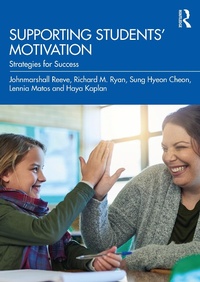
Supporting Students' Motivation
Strategies for Success
1st Edition
Published on 3. May 2022
286 pages
978-1-000-52154-2 (ISBN)
Description

This is a book about teachers' classroom motivating styles. Motivating style is the interpersonal tone and face-to-face behavior the teacher relies on when trying to motivate students to engage in classroom activities and procedures. The over-arching goal of the book is to help teachers work through the professional developmental process to learn how to provide instruction in ways that students will find to be motivationally-enriching, satisfying, and engagement-generating.
To realize this goal, the book features six parts: Part 1: Introduction, introduces what teachers are to support-namely, student motivation; Part 2: Motivating Style, explains what a supportive motivating style is; Part 3: "How to," overviews the recommended motivationally-supportive instructional strategies one-by-one and step-by-step; Part 4: Workshop, walks the reader through the skill-building workshop experience; Part 5: Benefits, details all the student, teacher, and classroom benefits that come from an improved motivating style; and Part 6: Getting Started, discusses
ways to begin using these skills in the classroom.
Based on a successful workshop program run by the authors, teachers successfully improve their classroom motivating style. In doing so, they experience gains in their teaching skill and efficacy, job satisfaction, a renewed passion for teaching, and a more satisfying relationship with their students. This multiauthored book provides teachers with the practical, concrete, step-by-step, skill-based "how to" they need to develop a highly supportive motivating style.
To realize this goal, the book features six parts: Part 1: Introduction, introduces what teachers are to support-namely, student motivation; Part 2: Motivating Style, explains what a supportive motivating style is; Part 3: "How to," overviews the recommended motivationally-supportive instructional strategies one-by-one and step-by-step; Part 4: Workshop, walks the reader through the skill-building workshop experience; Part 5: Benefits, details all the student, teacher, and classroom benefits that come from an improved motivating style; and Part 6: Getting Started, discusses
ways to begin using these skills in the classroom.
Based on a successful workshop program run by the authors, teachers successfully improve their classroom motivating style. In doing so, they experience gains in their teaching skill and efficacy, job satisfaction, a renewed passion for teaching, and a more satisfying relationship with their students. This multiauthored book provides teachers with the practical, concrete, step-by-step, skill-based "how to" they need to develop a highly supportive motivating style.
Reviews / Votes
"Finally a motivation book not based on pushing or pulling the student into the class activity, but based on the premise that students are already motivated and it is more about students answering 'Why do this or that?' Motivation is about direction and striving, about developing deeper levels of autonomy and competence, and the teachers role is to stand in the students shoes to understand their motivations, to be inviting, to show patience, and to create classroom learning activity that provide students with an opportunity to become motivated to learn. Based on the best theory of psychological being, grounded in 20 years of workshops to show how to engage students to thrive and strive, and with a perfect blend of practical and theoretical excellence."- John Hattie, Emeritus Laureate Professor, Director of the Melbourne Education Research Institute, University of Melbourne, Australia
"In this engaging and very accessible book, the authors provide convincing evidence why teachers do well to invest in autonomy-supportive teaching. Importantly, they also go to great lengths to provide specific recommendations how teachers can apply this motivating approach in their daily teaching, to the benefit of their students and themselves."
- Maarten Vansteenkiste, Professor, Department of Developmental Psychology, Personality, and Social Psychology, Ghent University, Belgium
"This is an important and interesting book that should be on the shelf of every teacher who would like to apply recent insights from rigorous research to their everyday practice. We really need such books, and we do not have enough of them."
- Avi Assor, Professor Emeritus, Department of Education, Ben-Gurion University, Israel
More details
Edition
1. Auflage
Language
English
Place of publication
London
United Kingdom
Publishing group
Taylor & Francis Ltd
Target group
College/higher education
Professional and scholarly
Illustrations
37 Tables, black and white; 61 Line drawings, black and white; 12 Halftones, black and white; 73 Illustrations, black and white
ISBN-13
978-1-000-52154-2 (9781000521542)
Copyright in bibliographic data and cover images is held by Nielsen Book Services Limited or by the publishers or by their respective licensors: all rights reserved.
Schweitzer Classification
Other editions
Additional editions
Johnmarshall Reeve | Richard M. Ryan | Sung Hyeon Cheon
Supporting Students' Motivation
Strategies for Success
Book
05/2022
1st Edition
Routledge
€206.70
Shipment within 15-20 days
Johnmarshall Reeve | Richard M. Ryan | Sung Hyeon Cheon
Supporting Students' Motivation
Strategies for Success
Book
05/2022
1st Edition
Routledge
€51.30
Shipment within 15-20 days
Persons
Johnmarshall Reeve is a Professor in the Institute for Positive Psychology and Education, Australian Catholic University, Australia.
Richard M. Ryan is a Professor in the Institute for Positive Psychology and Education, Australian Catholic University, Australia. He is also a Professor Emeritus in the Department of Psychology, University of Rochester, USA. He is the President of the Center for Self-Determination Theory.
Sung Hyeon Cheon is an Associate Professor in the Department of Physical Education, Korea University, South Korea.
Lennia Matos is a Professor in the Department of Psychology, Pontifical Catholic University of Peru, Peru.
Haya Kaplan is a Senior Lecturer and Head of the Center for Motivation and Self-Determination at the Kaye Academic College of Education, Israel.
Richard M. Ryan is a Professor in the Institute for Positive Psychology and Education, Australian Catholic University, Australia. He is also a Professor Emeritus in the Department of Psychology, University of Rochester, USA. He is the President of the Center for Self-Determination Theory.
Sung Hyeon Cheon is an Associate Professor in the Department of Physical Education, Korea University, South Korea.
Lennia Matos is a Professor in the Department of Psychology, Pontifical Catholic University of Peru, Peru.
Haya Kaplan is a Senior Lecturer and Head of the Center for Motivation and Self-Determination at the Kaye Academic College of Education, Israel.
Content
Part 1: Introduction 1. Origins 2. Student Motivation Part 2: Supporting Motivation 3. Motivating and Demotivating Teachers 4. Motivating Style 5. Measuring Motivating Style Part 3: "How to" 6. Take the Students' Perspective 7. Invite Students to Pursue Their Personal Interests 8. Present Learning Activities in Need-Satisfying Ways 9. Provide Explanatory Rationales 10. Acknowledge and Accept Negative Feelings 11. Rely on Invitational Language 12. Display Patience 13. Discipline, Structure, and Behavior Change Part 4: Workshop 14. The Workshop 15. Does the Workshop Work? 16. Why the Workshop Works Part 5: Benefits 17. Student Benefits 18. Classroom Benefits 19. Teacher Benefits Part 6: Getting Started 20. Can All Teachers Become Autonomy Supportive? 21. Must Teachers Do All The Work? 22. Teachers' Professional Development 23. Conclusion
