

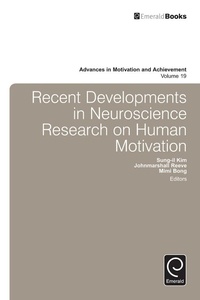
Recent Developments in Neuroscience Research on Human Motivation
Published on 2. November 2016
392 pages
978-1-78635-473-0 (ISBN)
Description

The phenomena of motivation cannot be studied separately as an independent research topic because motivation is highly interrelated to cognition, emotion, learning, and decision-making process. The overarching aim of this volume, therefore, is to provide new insight into a unified grand theory of motivation by integrating noteworthy neuroscience research findings on motivation. This volume is dedicated to advancing our understanding of brain mechanisms of underlying various motivational phenomena, including reward, approach, autonomy, intrinsic motivation, learning, effort, curiosity, and self-control. The volume is divided into four parts: The first part introduces classical but fundamental issues such as reward, approach, and individual differences. The second part deals with intrinsic motivation including autonomy and curiosity. The third one examines recent approaches on the interface between motivation and cognition in learning and decision-making. The last part focuses on practically significant issues pertaining to self-regulation development.
Reviews / Votes
Contributed by researchers from Australia, New Zealand, Israel, Europe, the US, and Asia, the 13 articles in this volume apply neuroscience research to human motivation. They address classical issues in motivation like reward, approach, and individual differences; intrinsic motivation, including autonomy and curiosity; recent approaches to the relationship between motivation and cognition in learning and decision making; and issues related to engagement and self-regulation. -- Annotation (c)2017 * (protoview.com) *More details
Series
Language
English
Place of publication
Bingley
United Kingdom
Publishing group
Emerald Publishing Limited
Target group
Professional and scholarly
College/higher education
File size
1,73 MB
ISBN-13
978-1-78635-473-0 (9781786354730)
Copyright in bibliographic data and cover images is held by Nielsen Book Services Limited or by the publishers or by their respective licensors: all rights reserved.
Schweitzer Classification
Other editions
Additional editions
Sung-il Kim | Johnmarshall Reeve | Mimi Bong
Recent Developments in Neuroscience Research on Human Motivation
Book
12/2016
Emerald Group Publishing Limited
€174.50
Shipment within 10-20 days
Persons
Sung-Il Kim, Korea University, Seoul, Korea
Johnmarshall Reeve, Korea University, Seoul, Korea
Mimi Bong, Korea University, Seoul, Korea
Johnmarshall Reeve, Korea University, Seoul, Korea
Mimi Bong, Korea University, Seoul, Korea
Content
Introduction To Motivational Neuroscience - Sung-il Kim, Johnmarshall Reeve and Mimi Bong
PART I: REWARD AND APPROACH
Neuroscience Of Reward, Motivation, And Drive - Morten L. Kringelbach and Kent C. Berridge
On The Neuroscience Of Approach And Withdrawal Motivation, With A Focus On The Role Of Asymmetrical Frontal Cortical Activity - Douglas Jozef Angus and Eddie Harmon-Jones
Neuroscience Of Motivation And Organizational Behavior: Putting The Reinforcement Sensitivity Theory (RST) To Work - Philip J. Corr, Neil McNaughton, Margaret R. Wilson, Ann Hutchison, Giles Burch and Arthur Poropat
PART II: INTRINSIC MOTIVATION
"Your Choice" Motivates You In The Brain: The Emergence Of Autonomy Neuroscience - Kou Murayama, Keise Izuma, Ryuta Aoki and Kenji Matsumoto
Insular Cortex Activity As The Neural Base Of Intrinsic Motivation - Woogul Lee
Motivated Cognition: Neural And Computational Mechanisms Of Curiosity, Attention, And Intrinsic Motivation - Jacqueline Gottlieb, Manuel Lopes and Pierre-Yves Oudeyer
PART III: MOTIVATION AND LEARNING
The Role Of Feedback In Learning And Motivation - Elizabeth Tricomi and Samantha DePasque
Motivational Influences On Memory - Vishnu P. Murty and Kathryn C. Dickerson
Neurobiology Of Effort And The Role Of Mesolimbic Dopamine - John D. Salamone and Merce Correa
PART IV: SELF-REGULATION
Hormones And Affect In Adolescent Decision Making - Corinna Laube and Wouter van den Bos
Too Much Of A Good Thing: A Neuro-Dynamic Personality Model Explaining Engagement And Its Protective Inhibition - Mattie Tops, Jesus Montero-Marin and Markus Quirin
Children's Inhibitory Control When Facing Negative Emotions - Tali Farbiash and Andrea Berger
Epilogue distinct motivations and their differentiated mechanisms: reflections on
The emerging neuroscience of human motivation - Richard M. Ryan and Stefano I. Di Domenico
PART I: REWARD AND APPROACH
Neuroscience Of Reward, Motivation, And Drive - Morten L. Kringelbach and Kent C. Berridge
On The Neuroscience Of Approach And Withdrawal Motivation, With A Focus On The Role Of Asymmetrical Frontal Cortical Activity - Douglas Jozef Angus and Eddie Harmon-Jones
Neuroscience Of Motivation And Organizational Behavior: Putting The Reinforcement Sensitivity Theory (RST) To Work - Philip J. Corr, Neil McNaughton, Margaret R. Wilson, Ann Hutchison, Giles Burch and Arthur Poropat
PART II: INTRINSIC MOTIVATION
"Your Choice" Motivates You In The Brain: The Emergence Of Autonomy Neuroscience - Kou Murayama, Keise Izuma, Ryuta Aoki and Kenji Matsumoto
Insular Cortex Activity As The Neural Base Of Intrinsic Motivation - Woogul Lee
Motivated Cognition: Neural And Computational Mechanisms Of Curiosity, Attention, And Intrinsic Motivation - Jacqueline Gottlieb, Manuel Lopes and Pierre-Yves Oudeyer
PART III: MOTIVATION AND LEARNING
The Role Of Feedback In Learning And Motivation - Elizabeth Tricomi and Samantha DePasque
Motivational Influences On Memory - Vishnu P. Murty and Kathryn C. Dickerson
Neurobiology Of Effort And The Role Of Mesolimbic Dopamine - John D. Salamone and Merce Correa
PART IV: SELF-REGULATION
Hormones And Affect In Adolescent Decision Making - Corinna Laube and Wouter van den Bos
Too Much Of A Good Thing: A Neuro-Dynamic Personality Model Explaining Engagement And Its Protective Inhibition - Mattie Tops, Jesus Montero-Marin and Markus Quirin
Children's Inhibitory Control When Facing Negative Emotions - Tali Farbiash and Andrea Berger
Epilogue distinct motivations and their differentiated mechanisms: reflections on
The emerging neuroscience of human motivation - Richard M. Ryan and Stefano I. Di Domenico
