

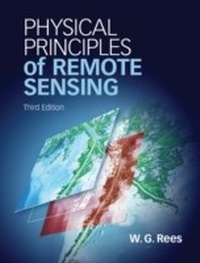
Physical Principles of Remote Sensing
3rd Edition
Published on 8. November 2012
978-1-139-84782-7 (ISBN)
Description

Fully updated and containing significant new material on photography, laser profiling and image processing, the third edition of this popular textbook covers a broad range of remote sensing applications and techniques across the Earth, environmental and planetary sciences. It focuses on physical principles, giving students a deeper understanding of remote sensing systems and their possibilities, while remaining accessible to those with less mathematical training by providing a step-by-step approach to quantitative topics. Boxed examples, additional photos and numerous colour images engage students and show them how the theory relates to the many real-world applications. Chapter summaries, review questions and additional problems allow students to check their understanding of key concepts and practise handling real data for themselves. Supplementary online material includes links to freely available software, animations, computer programs, colour images and other web-based resources of interest.
Reviews / Votes
'This is a welcome new edition of a popular text, with wonderful color illustrations. The author has managed to help students digest the principles by adding useful summaries and review questions. A practical improvement for students and instructors is the addition of the rich suite of online resources, which greatly add to the book's appeal.' Farouk El-Baz, Director, Center for Remote Sensing, Boston University 'Rees' new edition of his popular remote sensing textbook is written in an easy-to-follow style, but doesn't neglect the mathematical underpinnings. It covers principles related to all the key wavelength regions, and such diverse topics as photogrammetry, atmospheric sounding and multispectral imaging. Including coverage of applications on land, in the atmosphere and oceans, it represents an excellent resource for students and practitioners alike.' Martin Wooster, Environmental Monitoring and Modelling Research Group, King's College London 'The third edition of this well known, highly respected and authoritative textbook contains a wealth of new material that captures advances in optical and microwave sensor systems and applications. University teachers will be delighted that the format remains the same; theory and technical detail are explained in clear language and supported by excellent diagrams and figures. The book incorporates good pedagogic principles ... additional text boxes to help guide students not familiar with certain theoretical concepts, and review questions with problems to assist teachers to set extension exercises. [It] uses excellent examples, many of which are new in this edition, that clearly demonstrate why remote sensing data from a very wide range of sensors and platforms has such an impact on science and society today. Every student of remote sensing, whatever their level, and every library should have a copy of this excellent book.' Daniel Donoghue, Durham University 'This is a comprehensive updating of a popular undergraduate and postgraduate text. The wealth of resources, new links and plates support the existing material superbly. The end references have been updated with new papers and sources and all the references are well integrated into the main text. ... this is a superb text book and an excellent reference text. Dr W. G. Rees has done a superb job of updating what was already a well-loved and established text in a way which makes it a worthwhile investment for anyone studying the remote sensing and mapping of our planet.' Mark Nicol, Contemporary PhysicsMore details
Edition
3rd Revised edition
Language
English
Place of publication
Cambridge
United Kingdom
Publishing group
Cambridge University Press
Target group
College/higher education
Professional and scholarly
Edition type
Revised edition
Illustrations
40 Plates, color; 131 Halftones, unspecified; 192 Line drawings, unspecified
File size
35,41 MB
ISBN-13
978-1-139-84782-7 (9781139847827)
Copyright in bibliographic data and cover images is held by Nielsen Book Services Limited or by the publishers or by their respective licensors: all rights reserved.
Schweitzer Classification
Other editions
Additional editions
W. G. Rees
Physical Principles of Remote Sensing
Book
11/2012
3rd Edition
Cambridge University Press
€146.30
Available immediately
W. G. Rees
Physical Principles of Remote Sensing
Book
11/2012
3rd Edition
Cambridge University Press
€231.20
Shipment within 15-20 days
Person
W. G. Rees is a senior lecturer at the Scott Polar Research Institute, University of Cambridge, where he has taught and researched in the field of remote sensing for over twenty years. He has been active in developing and applying remote sensing methods to the mapping and monitoring of the polar regions, having conducted fieldwork in arctic regions of Europe and Asia and in Svalbard. For the past few years he has been joint coordinator of PPS Arctic, a major programme to investigate the characteristics and behaviour of the arctic treeline as part of the International Polar Year, and he is also a member of the ISPRS (International Society for Photogrammetry and Remote Sensing) working group on LiDAR. Dr Rees has published several books on remote sensing, including the first and second editions of Physical Principles of Remote Sensing (1990, 2001, Cambridge University Press), The Remote Sensing Data Book (Cambridge University Press, 1999) and Remote Sensing of Glaciers (with P. Pellikka, Taylor and Francis, 2010). He was made a Fellow of the Institute of Physics in 1996 and is a member of the Photogrammetry and Remote Sensing Society.
Content
Preface; Acknowledgements; 1. Introduction; 2. Electromagnetic waves in free space; 3. Interaction of electromagnetic radiation with matter; 4. Interaction of electromagnetic radiation with the Earth's atmosphere; 5. Photographic systems; 6. Electro-optical systems; 7. Passive microwave systems; 8. Ranging systems; 9. Scattering systems; 10. Platforms for remote sensing; 11. Data processing; Appendix: data tables; Bibliography; Index.
