

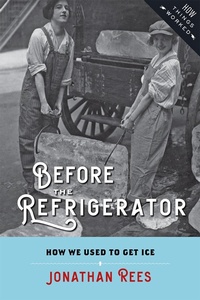
Before the Refrigerator
How We Used to Get Ice
Published on 26. April 2018
136 pages
978-1-4214-2460-6 (ISBN)
Description

How increased access to ice-decades before refrigeration-transformed American life.
During the late nineteenth and early twentieth centuries, Americans depended upon ice to stay cool and to keep their perishable foods fresh. Jonathan Rees tells the fascinating story of how people got ice before mechanical refrigeration came to the household. Drawing on newspapers, trade journals, and household advice books, Before the Refrigerator explains how Americans built a complex system to harvest, store, and transport ice to everyone who wanted it, even the very poor.
Rees traces the evolution of the natural ice industry from its mechanization in the 1880s through its gradual collapse, which started after World War I. Meatpackers began experimenting with ice refrigeration to ship their products as early as the 1860s. Starting around 1890, large, bulky ice machines the size of small houses appeared on the scene, becoming an important source for the American ice supply. As ice machines shrunk, more people had access to better ice for a wide variety of purposes. By the early twentieth century, Rees writes, ice had become an essential tool for preserving perishable foods of all kinds, transforming what most people ate and drank every day.
Reviewing all the inventions that made the ice industry possible and the way they worked together to prevent ice from melting, Rees demonstrates how technological systems can operate without a central controlling force. Before the Refrigerator is ideal for history of technology classes, food studies classes, or anyone interested in what daily life in the United States was like between 1880 and 1930.
During the late nineteenth and early twentieth centuries, Americans depended upon ice to stay cool and to keep their perishable foods fresh. Jonathan Rees tells the fascinating story of how people got ice before mechanical refrigeration came to the household. Drawing on newspapers, trade journals, and household advice books, Before the Refrigerator explains how Americans built a complex system to harvest, store, and transport ice to everyone who wanted it, even the very poor.
Rees traces the evolution of the natural ice industry from its mechanization in the 1880s through its gradual collapse, which started after World War I. Meatpackers began experimenting with ice refrigeration to ship their products as early as the 1860s. Starting around 1890, large, bulky ice machines the size of small houses appeared on the scene, becoming an important source for the American ice supply. As ice machines shrunk, more people had access to better ice for a wide variety of purposes. By the early twentieth century, Rees writes, ice had become an essential tool for preserving perishable foods of all kinds, transforming what most people ate and drank every day.
Reviewing all the inventions that made the ice industry possible and the way they worked together to prevent ice from melting, Rees demonstrates how technological systems can operate without a central controlling force. Before the Refrigerator is ideal for history of technology classes, food studies classes, or anyone interested in what daily life in the United States was like between 1880 and 1930.
More details
Series
Language
English
Place of publication
Baltimore
United States
Target group
College/higher education
Illustrations
10 s/w Abbildungen, 2 Karten
2 Maps; 10 Illustrations, black and white
File size
2,82 MB
ISBN-13
978-1-4214-2460-6 (9781421424606)
DOI
10.56021/9781421424583
Copyright in bibliographic data and cover images is held by Nielsen Book Services Limited or by the publishers or by their respective licensors: all rights reserved.
Schweitzer Classification
Other editions
Additional editions
Book
04/2018
Johns Hopkins University Press
€22.50
Article not available at the moment
Book
04/2018
Johns Hopkins University Press
€59.00
Article not available at the moment
Person
Jonathan Rees is a professor of history at Colorado State University-Pueblo. He is the author of Refrigeration Nation: A History of Ice, Appliances, and Enterprise in America and Refrigerator.
Content
Preface
Introduction
1. How to Harvest Ice
2. How to Manufacture Ice
3. How Ice (and the Perishable Food It Preserved) Made It to Consumers
4. How Ice Changed the American Diet and American Life
5. How Household Refrigerators Changed the Ice Market Forever
Conclusion
Acknowledgments
Notes
Index
Introduction
1. How to Harvest Ice
2. How to Manufacture Ice
3. How Ice (and the Perishable Food It Preserved) Made It to Consumers
4. How Ice Changed the American Diet and American Life
5. How Household Refrigerators Changed the Ice Market Forever
Conclusion
Acknowledgments
Notes
Index
