

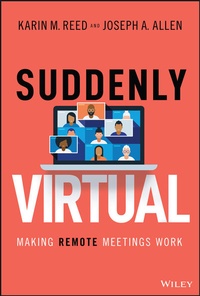
Suddenly Virtual
Description

Supercharge your virtual meetings with evidence-based practices from an award-winning team
The shift to virtual meetings was sudden and often traumatic for businesses across all industries as they responded to the global pandemic. Rather than focusing on what worked best, they focused on what worked now . . . which meant closing up the office and being suddenly virtual in nearly every meeting, often without the tools, the training, or the expertise to optimize the new "kitchen table" office. Thankfully, businesses are beginning to be more purposeful in both the tools they use and the approach they take.
This book seeks to be a definitive guide for businesses looking to make their meetings as effective as possible in the ever-evolving "new normal"-leveraging insights from some of the foremost thought leaders in meeting science and on-camera communication.
This book will:
· Highlight new research insights springing from the rapid and exponential adoption of virtual meeting technology
· Discuss the problems, challenges, and pitfalls of meeting in this new modality
· Provide practical, actionable best practices, backed by meeting research that lead to more productive and effective virtual meetings
Perfect for executives, managers, and employees at companies in all industries and of all sizes, Suddenly Virtual provides practical and actionable best practices that lead to more productive and effective remote meetings.
More details
Other editions
Additional editions
Persons
KARIN M. REED is CEO of Speaker Dynamics. Karin has been teaching business professionals how to be effective on-camera communicators for nearly a decade, translating her experience as an Emmy award-winning broadcast journalist into a methodology based upon the MVPs of On-Camera Success(TM).
JOSEPH A. ALLEN, PHD, is a meeting scientist and Professor of Industrial and Organizational Psychology at the University of Utah. His research focuses on the study of workplace meetings, organizational community engagement, and occupational safety and health.
Content
Preface: The Collision and Convergence of Two Areas of Expertise ix
Acknowledgments xv
SECTION ONE Our New Virtual Reality - A Suddenly Remote Workforce
1 What Happened to Meetings? 3
2 What Happened to Video Communication? 13
SECTION TWO The Science of Meetings
3 Best Practices for Meetings Before Covid-19 33
4 New Best Practices for Meetings as a Result of Covid-19 53
SECTION THREE The Benefits and Challenges of Video Communication
5 The Value of Video in the Corporate World 69
6 Best Practices for On-Camera Communication through a Webcam 85
SECTION FOUR The Biggest Opportunities and Challenges of Virtual Meetings
7 Making Every Virtual Meeting a Video Meeting 107
8 Driving Engagement in a Virtual Meeting 123
9 Remembering Virtual Meeting Etiquette 145
10 Ignoring the Importance of Production Value 161
11 Building Organizational Culture Through Virtual Meetings 183
12 Empowering Employees on the Tech Front 203
13 Managing Virtual Meetings Across Global Cultures 219
SECTION FIVE What's Next in the Suddenly Virtual Meeting World?
14 Embracing the Hybrid Meeting 237
15 Preparing for the Next Normal in Our Suddenly Virtual Meetings 253
Conclusion: Our Own Remote Work Experiment 269
About the Authors 271
Index
