

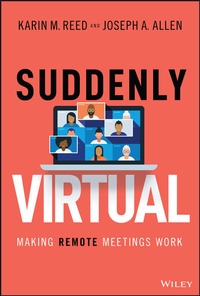
Suddenly Virtual
Description

Supercharge your virtual meetings with evidence-based practices from an award-winning team
The shift to virtual meetings was sudden and often traumatic for businesses across all industries as they responded to the global pandemic. Rather than focusing on what worked best, they focused on what worked now . . . which meant closing up the office and being suddenly virtual in nearly every meeting, often without the tools, the training, or the expertise to optimize the new "kitchen table" office. Thankfully, businesses are beginning to be more purposeful in both the tools they use and the approach they take.
This book seeks to be a definitive guide for businesses looking to make their meetings as effective as possible in the ever-evolving "new normal"-leveraging insights from some of the foremost thought leaders in meeting science and on-camera communication.
This book will:
· Highlight new research insights springing from the rapid and exponential adoption of virtual meeting technology
· Discuss the problems, challenges, and pitfalls of meeting in this new modality
· Provide practical, actionable best practices, backed by meeting research that lead to more productive and effective virtual meetings
Perfect for executives, managers, and employees at companies in all industries and of all sizes, Suddenly Virtual provides practical and actionable best practices that lead to more productive and effective remote meetings.
More details
Other editions
Additional editions
Persons
KARIN M. REED is CEO of Speaker Dynamics. Karin has been teaching business professionals how to be effective on-camera communicators for nearly a decade, translating her experience as an Emmy award-winning broadcast journalist into a methodology based upon the MVPs of On-Camera Success(TM).
JOSEPH A. ALLEN, PHD, is a meeting scientist and Professor of Industrial and Organizational Psychology at the University of Utah. His research focuses on the study of workplace meetings, organizational community engagement, and occupational safety and health.
Content
Preface: The Collision and Convergence of Two Areas of Expertise ix
Acknowledgments xv
SECTION ONE Our New Virtual Reality - A Suddenly Remote Workforce
1 What Happened to Meetings? 3
2 What Happened to Video Communication? 13
SECTION TWO The Science of Meetings
3 Best Practices for Meetings Before Covid-19 33
4 New Best Practices for Meetings as a Result of Covid-19 53
SECTION THREE The Benefits and Challenges of Video Communication
5 The Value of Video in the Corporate World 69
6 Best Practices for On-Camera Communication through a Webcam 85
SECTION FOUR The Biggest Opportunities and Challenges of Virtual Meetings
7 Making Every Virtual Meeting a Video Meeting 107
8 Driving Engagement in a Virtual Meeting 123
9 Remembering Virtual Meeting Etiquette 145
10 Ignoring the Importance of Production Value 161
11 Building Organizational Culture Through Virtual Meetings 183
12 Empowering Employees on the Tech Front 203
13 Managing Virtual Meetings Across Global Cultures 219
SECTION FIVE What's Next in the Suddenly Virtual Meeting World?
14 Embracing the Hybrid Meeting 237
15 Preparing for the Next Normal in Our Suddenly Virtual Meetings 253
Conclusion: Our Own Remote Work Experiment 269
About the Authors 271
Index
CHAPTER 1
What Happened to Meetings?: The Meeting Scientist Perspective
Perhaps an important question to ask is "When did the world change?" Certainly, the world changed quickly, and many workers were either without work or found themselves in a dramatically different work environment. While the change was nearly instantaneous for some, others experienced a more gradual progression as the world tried to navigate the uncharted territory of a global pandemic. The facts on the ground shifted - not just day by day, but also hour by hour. A universal sense of uncertainty bled into every aspect of our lives.
The business world sought to adapt to the changes, but in those early days, ever-changing information meant that plans were scrapped almost as soon as they were written.
In this chapter, we will explore:
- The sequence of events that led to much of the world of work going remote.
- The rise of the virtual meeting.
- How businesses scrambled to adapt to the new virtual reality.
How Did We Get Here?
When did you first really pay attention to what was happening with COVID-19? From your current vantage point, you may find it hard to believe that most of us did not give it a whole lot of thought when it first reared its ugly head in China. Few of us could have imagined then how it would soon turn our world upside down. However, you probably do remember a watershed moment which signaled a shift in mindset. Maybe it was the cancellation of the NBA season or the closure of your college campuses? That's when we were suddenly glued to the TV and felt like we could not keep up with the news or the changes swiftly overtaking every aspect of our lives. The pandemic was a force to be reckoned with, and no one was going to be left unimpacted.
To put what happened to work and workplace meetings into proper context, here's a quick timeline of events.
Timeline of Events from the COVID-19 Pandemic (Kantis, Kiernan, and Bardi 2020) December 8, 2019 A patient in the city of Wuhan sought medical help for pneumonia-like symptoms. January 3, 2020 China officially notifies the WHO of an outbreak. January 21, 2020 United States confirms its first case in Washington state, a man who traveled to the Wuhan area. January 23, 2020 WHO meets again and decides not to declare the outbreak a Public Health Emergency of International Concern (PHEIC). January 24, 2020 Nepal, Vietnam, France, and Malaysia confirm their first cases. Wuhan construction crews are working on two hospitals to treat patients of the outbreak: the first is to be completed on February 3 and the second in early February. February 4, 2020 The U.S. Food and Drug Administration issues an emergency use authorization for CDC's diagnostic test. President Trump pledges to safeguard Americans from the coronavirus in his State of the Union address. February 7, 2020 Total Cases Confirmed Globally: 31,484. February 10, 2020 The United Kingdom declares that the coronavirus constitutes a serious and imminent threat to public health. The Trump administration releases a budget proposal for FY21 that would sharply cut funding for WHO and global health funding. February 13, 2020 U.S. CDC Director says that the coronavirus will likely become a community virus and remain beyond this season. February 15, 2020 The United States announces plans to evacuate nearly four hundred Americans quarantined on the Diamond Princess cruise ship; passengers who test positive for COVID-19 will be treated in Japan. February 25, 2020 U.S. CDC warns that spread to the United States is likely and that people should prepare. February 29, 2020 Australia reports its first death, an evacuee from the Diamond Princess.The United States reports its first death, a man in his fifties with an underlying health condition. Washington state declares a state of emergency. March 7, 2020 Roughly 5,861 coronavirus tests are completed by CDC and public health labs in the United States. New York declares a state of emergency. March 11, 2020 WHO declares the coronavirus outbreak a pandemic. Washington, D.C., declares a state of emergency. United States announces level 3 travel advisory and suspends entry to all foreign nationals traveling from China, Iran, and certain European countries at any point during the 14 days prior to their scheduled travel to the U.S. NBA suspends their season. Italy closes all shops and venues across the country. The United Nations reports that about 20% of students are out of school globally as a result of the pandemic. March 12, 2020 U.S. stocks record their worst day since 1987. New York City declares a state of emergency. Ohio closes all public schools until at least April 3, 2020. France closes all schools. Virginia declares a state of emergency.
As of the writing of this book, more than 81 million people have been infected and over 1.8 million have died from the pandemic worldwide. Cases occurred in 188 countries, with many of them seeing their citizens dying from this disease.
The public health response has varied from country to country, with some shutting down immediately and asking citizens to stay home for weeks (e.g. South Korea) and others simply waiting for herd immunity to be achieved (e.g. Sweden). In the United States and many other countries the world over, the pandemic shut down the economy, the schools, and our favorite restaurants. Essential workers (e.g. some in manufacturing and many in grocery stores, farms, meatpacking, and so on) carried on in their work to feed the population, and so also carried the initial brunt of the burden of the disease.
As this happened, teachers learned how to go fully online, parents learned how to teach kids from home, and many organizations required their employees to work remotely. The kitchen table, bedroom, back porch, or home office became many people's only office. Demand for computers, webcams, headsets, desks, standing desks, monitors, and even "desk treadmills" skyrocketed, making some firms scramble to deal with supply, and with some individuals waiting for weeks for key tools they needed to go fully remote.
For years, organizations danced around the work-from-home issue. Some workers who sought the flexibility of a work-from-home life were denied time and again. Flexible work schedules were a niche area in academic research and even more niche in the actual workplace. Then, COVID-19 hit, and everyone was "suddenly virtual." The organizational sciences refer to this event as an equilibrium shift. Although the world had its challenges in October 2019, the economies were humming along at what might be called equilibrium. Then, a sudden and deep shock to the system occurred and fully unfolded over the following few months. In psychology, key events in one's life might be considered flashbulb moments, such as, in the past, "Where were you when Neil Armstrong landed on the moon?" or "Where were you on 9/11?" Now, we have, "Where were you during the COVID-19 pandemic?"
Like so many knowledge workers, Karin's office became a time capsule of March 2020, with sticky notes on the wall reflecting to-do lists for projects that were either scrapped or put on hold until a later date. One particularly poignant email from that time from Karin to a client read in part, "Let's reschedule the workshop for June. Surely things will be back to normal by then." Hindsight, of course, reveals the level of denial or even folly in those words. Even at the end of 2020, attempting to reschedule large group trainings seems ill-conceived. Luckily, Karin already had been delivering a third of her training virtually for years, but with COVID-19, that third became 100% of her business practically overnight.
Big events such as these flashbulb moments or lengthy world events (e.g. World War I, World War II, etc.) usually mean big changes. And these big changes usually have a lasting effect. For example, following the events of September 11, 2001, in the United States, the experience of getting on a plane in the U.S. changed forever with long lines for screening passengers, waiting areas forbidden for all but those who held tickets, and shoes removed while screening, among other things. Changes like these sometimes last in the name of safety, while others may remain out of convenience or cost savings. If you are in commercial real estate, consider this your warning. Remote work and the virtual office are big changes caused by a big event that will not be going away.
What Happened to Work?
Work changed for many....
