

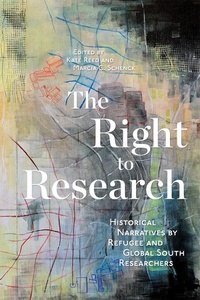
The Right to Research
Historical Narratives by Refugee and Global South Researchers
1st Edition
Published on 15. January 2023
280 pages
978-0-2280-1566-6 (ISBN)
Description

Refugees and displaced people rarely figure as historical actors, and almost never as historical narrators. We often assume a person residing in a refugee camp, lacking funding, training, social networks, and other material resources that enable the research and writing of academic history, cannot be a historian because a historian cannot be a person residing in a refugee camp.
The Right to Research disrupts this tautology by featuring nine works by refugee and host-community researchers from across Africa, Europe, and the Middle East. Identifying the intrinsic challenges of making space for diverse voices within a research framework and infrastructure that is inherently unequal, this edited volume offers a critical reflection on what history means, who narrates it, and what happens when those long excluded from authorship bring their knowledge and perspectives to bear. Chapters address topics such as education in Kakuma Refugee Camp, the political power of hip-hop in Rwanda, women migrants to Yemen, and the development of photojournalism in Kurdistan.
Exploring what it means to become a researcher, The Right to Research understands historical scholarship as an ongoing conversation - one in which we all have a right to participate.
The Right to Research disrupts this tautology by featuring nine works by refugee and host-community researchers from across Africa, Europe, and the Middle East. Identifying the intrinsic challenges of making space for diverse voices within a research framework and infrastructure that is inherently unequal, this edited volume offers a critical reflection on what history means, who narrates it, and what happens when those long excluded from authorship bring their knowledge and perspectives to bear. Chapters address topics such as education in Kakuma Refugee Camp, the political power of hip-hop in Rwanda, women migrants to Yemen, and the development of photojournalism in Kurdistan.
Exploring what it means to become a researcher, The Right to Research understands historical scholarship as an ongoing conversation - one in which we all have a right to participate.
Reviews / Votes
"This ambitious and exciting volume makes a critical intervention in the processes of historical silencing and upsets conventional understandings of historical scholarship. The book reminds us that refugees have not been afforded the right to write history; this is a powerful, poignant, rightfully challenged assertion, and this assertion is timely - if not now, when?" Joanna Tague, Denison University and author of Displaced Mozambicans in Postcolonial Tanzania: Refugee Power, Mobility, Education, and Rural DevelopmentMore details
Series
Language
English
Place of publication
Canada
Target group
Professional and scholarly
Illustrations
22 photos
File size
6,42 MB
ISBN-13
978-0-2280-1566-6 (9780228015666)
Copyright in bibliographic data and cover images is held by Nielsen Book Services Limited or by the publishers or by their respective licensors: all rights reserved.
Schweitzer Classification
Other editions
Additional editions
Kate Reed | Marcia C. Schenck
The Right to Research
Historical Narratives by Refugee and Global South Researchers
Book
01/2023
McGill-Queen's University Press
€142.62
Article not available at the moment
Kate Reed | Marcia C. Schenck
The Right to Research
Historical Narratives by Refugee and Global South Researchers
Book
01/2023
McGill-Queen's University Press
€35.50
Available immediately
Persons
Kate Reed is a PhD student in history at the University of Chicago.
Marcia C. Schenck is professor of global history at the University of Potsdam.
Marcia C. Schenck is professor of global history at the University of Potsdam.
