

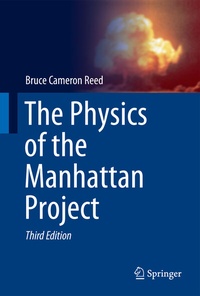
The Physics of the Manhattan Project
Description

The development of nuclear weapons during the Manhattan Project is one of the most significant scientific events of the twentieth century. This revised and updated 3rd edition explores the challenges that faced the scientists and engineers of the Manhattan Project. It gives a clear introduction to fission weapons at the level of an upper-year undergraduate physics student by examining the details of nuclear reactions, their energy release, analytic and numerical models of the fission process, how critical masses can be estimated, how fissile materials are produced, and what factors complicate bomb design. An extensive list of references and a number of exercises for self-study are included. Links are given to several freely-available spread sheets which users can use to run many of the calculations for themselves.
More details
Other editions
Additional editions
Previous edition
Person
Cameron Reed is the Charles A. Dana Professor of Physics at Alma College, where he has been a faculty member since 1992. His teaching experience includes the full spectrum of undergraduate physics classes from freshman-level mechanics to senior-level quantum mechanics. His research interests address primarily the history and physics of nuclear weapons; in 2009 he was elected as a Fellow of the American Physical Society for his contributions to the history and physics of the Manhattan Project. He has also worked extensively on galactic structure (hot, blue stars). In addition to the present book, he has published two textbooks and over 100 papers in peer-reviewed physics and astronomy journals.
Content
Preface.- Energy Release in Nuclear Reactions, Neutrons, Fission, and Characteristics of Fission.- Critical Mass and Efficiency.- Producing Fissile Material.- Complicating Factors.- Miscellaneous Calculations.- Appendices.- Appendix A: Selected D-Values and Fission Barriers.- Appendix B: Densities, Cross-Sections and Secondary Neutron Numbers.- Appendix C: Energy and Momentum Conservation in a Two-Body Collision.- Appendix D: Energy and Momentum Conservation in a Two-Body Collision That Produces a Gamma-Ray.- Appendix E: Formal Derivation of the Bohr-Wheeler Spontaneous Fission Limit.- Appendix F: Average Neutron Escape Probability From Within a Sphere.- Appendix G: The Neutron Diffusion Equation.- Appendix H: Exercises and Answers.- Appendix I: Glossary of Symbols.- Appendix J: Further Reading.- Appendix K: Useful Constants and Conversion Factors.
