

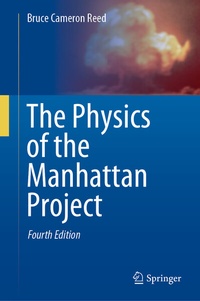
The Physics of the Manhattan Project
Description

The development of nuclear weapons during the Manhattan Project is one of the most significant scientific events of the twentieth century. This revised and updated 4th edition explores the challenges that faced the scientists and engineers of the Manhattan Project. It gives a clear introduction to fission weapons at the level of an upper-year undergraduate physics student by examining the details of nuclear reactions, their energy release, analytic and numerical models of the fission process, how critical masses can be estimated, how fissile materials are produced, and what factors complicate bomb design. An extensive list of references and a number of exercises for self-study are included.
Revisions to this fourth edition include many upgrades and new sections. Improvements are made to, among other things, the analysis of the physics of the fission barrier, the time-dependent simulation of the explosion of a nuclear weapon, and the discussion of tamped bomb cores.New sections cover, for example, composite bomb cores, approximate methods for various of the calculations presented, and the physics of the polonium-beryllium "neutron initiators" used to trigger the bombs.
The author delivers in this book an unparalleled, clear and comprehensive treatment of the physics behind the Manhattan project.
Reviews / Votes
"The volume is targeted at readers with an advanced undergraduate physics background, with the goals of explicating the principles behind the fission bombs completed in 1945, and of using these principles to illuminate more general areas of physics, such as electromagnetism and statistical mechanics. . both physicists and historians might find it most useful as a reference work." (Joseph D. Martin, Metascience, Vol. 30, August 25, 2021)More details
Other editions
Additional editions
Person
Bruce Cameron Reed is the Charles A. Dana Professor of Physics at Alma College (Michigan), emeritus. He has published five textbooks and over 50 journal papers and semi-popular articles on the Manhattan Project; three of the texts are with Springer (one of these is currently in press, a popular treatment of the Project). In 2009, he was elected a Fellow of the American Physical Society in recognition of his contributions to promoting understanding of the history and physics of the Manhattan Project.
Content
Preface.- Preamble: Fundamental Data On Little Boy and Fat Man.- Energy Release in Nuclear Reactions, Neutrons, Fission, and Characteristics of Fission.- Critical Mass, Efficiency, and Yield.- Producing Fissile Material.- Complicating Factors.- Miscellaneous Calculations.- Appendices (A-K).
