

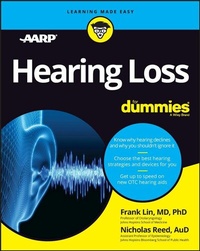
Hearing Loss For Dummies
Description

Improve your hearing, enhance your life
With new advice on just-released over-the-counter hearing aids
Hearing loss can be frustrating, but in fact it’s common and treatable. Hearing Loss For Dummies, written by top experts in the field in collaboration with AARP, walks you through how to get the help you need to clearly hear the sounds of life—whether you’re at home, at work, or out and about. And hearing health is critical: Hearing loss can increase your risk of falls and injuries, isolation and depression, and even cognitive decline and dementia.
Authors Frank Lin and Nicholas Reed at the Johns Hopkins School of Medicine lay out the steps to hearing health:
- Understanding how hearing works—and how it changes as we age
- Finding specialists you can trust
- Determining whether you need testing and, if so, where to turn
- Learning practical solutions for hearing better at home, at work, on the phone, and in restaurants and theaters
- Choosing the right hearing aid, including just-approved over-the-counter hearing aids, and getting them adjusted to work for you
- Exploring the pros and cons of cochlear implants and other surgical options
- Covering the costs of hearing health care
If you’re concerned about your own or a friend or relative’s hearing, this is the one book you’ll need. For what can seem like a complicated, stressful and lengthy process, Hearing Loss For Dummies tackles the topic head-on and provides you with expert guidance to put your mind at ease on the path to better hearing.
Frank R. Lin, MD, PhD, is the Director of the Cochlear Center for Hearing and Public Health.
Nicholas S. Reed, AuD, is a clinical audiologist and an assistant professor at Johns Hopkins University.
More details
Other editions
Additional editions
Content
- Intro
- Title Page
- Copyright Page
- Table of Contents
- Introduction
- About This Book
- Foolish Assumptions
- Icons Used in This Book
- Beyond the Book
- Where to Go from Here
- Part 1 Understanding Hearing Loss
- Chapter 1 Cheers to Your Ears!
- Understanding Why Hearing Loss Happens
- Hearing takes place over two steps
- Hearing loss happens as the inner ear wears out
- Factors that affect your hearing over time
- Putting Hearing Loss in Context
- Hearing loss happens to everyone
- How hearing loss impacts our health and well-being
- The benefits of addressing hearing loss
- What You Can Do about Hearing Loss
- Know your hearing
- Using communication strategies
- Hearing technologies
- Getting the Support You Need
- Chapter 2 Understanding How Hearing Works
- What Is Sound?
- How sound gets its sound
- What sound "looks" like
- To Hear, You Need Your Ear!
- External ear
- Middle ear
- Inner ear
- Hearing with Your Brain
- Two ears are better than one
- It's not just sound - "seeing" what you hear
- Context matters
- Pinpointing Where the System Can Break Down
- When sound quality is poor
- When the sound can't get in
- When the inner ear garbles the encoding of sound
- When the brain struggles to process sound
- Experiencing Trouble Hearing
- Chapter 3 Looking at Types of Hearing Loss and Minimizing Risk
- Discovering Why Hearing Gets Worse Over Time
- Knowing the Causes of Hearing Loss Over Time
- Biological aging processes
- Cardiovascular risk factors
- Genetics
- Minimizing Your Risk for Hearing Loss
- Noise exposure
- Keeping your ear heart-healthy
- Considering Other Conditions That Affect Hearing
- The almighty ear infection
- Earwax - ick!
- Diseases of the ear
- Medications
- Causing Tinnitus
- Tinnitus explained
- Tinnitus triggers
- Chapter 4 Realizing What You Lose When You Can't Hear
- Communicating Is Like a Game of Catch
- Hearing loss affects how well you can play catch
- Why playing catch is sometimes easier or harder
- Communication and hearing loss in critical situations
- Watching for a Reduction in Social Interaction
- Monitoring Mental and Emotional Health
- What is loneliness?
- How loneliness hurts your health
- Looking at hearing loss and loneliness
- Losing Physical Abilities
- How hearing affects your physical abilities
- How hearing affects your balance
- Dealing with a Decline in Cognitive Function
- What are cognition and dementia?
- Hearing loss and dementia - say what?
- Hearing aids to prevent dementia?
- Part 2 Evaluating How You Hear
- Chapter 5 Recognizing Hearing Loss
- Missing the Signs of Hearing Loss
- Barely noticeable changes
- Everyone else is mumbling!
- Compensating until you can't
- Don't know what you're missing
- Sussing Out Whether Your Hearing Has Declined
- Knowing When to Get Your Hearing Tested
- Screening, testing, and diagnostics
- Establishing a baseline
- Getting regular hearing checkups
- Knowing when you should get tested immediately
- Shrugging Off the Stigma of Hearing Loss
- Caring about your hearing above what other people think
- It's okay to wear hearing aids
- The stigma is fading
- Chapter 6 Seeing a Hearing Loss Professional and Getting Tested
- Getting to Know the Hearing Care Team
- Audiologist: Assessing and addressing hearing loss
- Otolaryngologist: Comprehensive medical care for the ear
- Hearing instrument specialist: Focusing on the hearing aid
- The most important team member: You!
- Preparing for the Assessment
- It all starts with history
- To know the ear is to see the ear
- Knowing What to Expect during the First Part of the Diagnostic Hearing Test
- Picking up on pure-tones: "Listen for the beeps"
- Testing your hearing with air and bone conduction
- Checking Out Other Hearing Assessment Measures
- Testing whether sound is getting to the middle and inner ears
- Measuring your speech understanding
- Evaluating how the brain reacts to sound
- Testing when sound is clear but difficult to understand
- One and Done or a Regular Occurrence?
- Chapter 7 Making Sense of Your Hearing Test Results
- Understanding the Importance of Reading Results
- Introducing the Audiogram: What Does That Graph Mean?
- Audiogram 101
- Hearing loss categories on the audiogram
- Defining Hearing Loss with the Audiogram
- The Xs and Os of hearing
- Diving into details of your hearing loss
- Using the audiogram to make sense of how hearing loss affects you
- The Hearing Number: An Easier Way to Make Sense of Your Hearing
- Where the hearing number comes from
- What the hearing number means to you
- Does my hearing number change?
- What to do with your hearing number
- How to get your hearing number
- Guiding Your Hearing Health Journey with Your Results
- Monitor changes in hearing
- Use it or lose it
- Part 3 Taking Charge of Your Hearing
- Chapter 8 Fine-Tuning Your Life to Hearing Loss
- Discovering Where Adjustments Can Be Made
- Finding No-Tech Communication Strategies for Everyday Situations
- Get close
- Be face-to-face
- Summarize and repeat ("Huhs" don't help!)
- Optimizing Your Listening Environment
- Turn down any background sounds
- Avoid reverberation
- Pick the right restaurants
- Using Everyday Technology Strategies
- Closed captioning
- Voice over internet protocol (VOIP) calls and videocalls
- Speaking Up for Yourself
- Ways to identify that you're having trouble hearing
- Giving the speaker a solution
- Practicing self-advocacy
- Reading about others with hearing loss
- Seeking Out Support Groups
- Chapter 9 Looking at How Hearing Aids Work
- Understanding Hearing Aids
- The anatomy of a hearing aid: How hearing aids work
- Hearing aids don't make all sounds louder
- Enhancing clarity of sound with hearing aids
- Checking Out the Different Styles of Hearing Aids
- Behind-the-ear
- In-the-ear
- Weighing the pros and cons of hearing aid styles
- Chapter 10 Understanding Your Hearing Aid Options
- Discovering Where to Start for Your Needs
- Knowing Two Ears Means Two Hearing Aids
- Is using only one hearing aid harmful?
- The exception to the rule
- Choosing a Prescription Hearing Aid
- Working with a professional to purchase hearing aids
- Customizing your hearing aids with a professional
- Navigating the Over-the-Counter Hearing Aid Pathway
- The basics of OTC hearing aids
- Deciding where to buy your OTC hearing aid
- How to choose from too many options
- When to seek professional assistance with OTC hearing aids
- Choosing Basic or Premium Hearing Aids
- Chapter 11 You've Got Hearing Aids: Now What?
- Setting Expectations Is Key
- Getting Used to Your Hearing Aids
- Practice makes perfect
- Activities to get used to hearing aids
- Trust the process
- Adjusting and Manipulating Your Hearing Aids
- Working with batteries
- Putting hearing aids in your ears
- Changing the sound of hearing aids
- Caring for and Maintaining Your Hearing Aids
- Establishing a maintenance routine
- Avoiding situations that are bad for your hearing aids
- Troubleshooting common problems with hearing aids
- Knowing When It's Time to Upgrade Your Hearing Aid to a New Generation
- Chapter 12 Technology That Boosts Hearing and Hearing Aids
- Captioning Your Life
- Using captions on TV
- Obtaining and using captioned phones (They're free!)
- Captioning in video conference calls
- CART for live sessions
- Outfitting Your Home with Hearing-Friendly Tech
- Talking about Integration Technology
- Working with Bluetooth and hearing aids
- Navigating smartphone apps
- Checking Out Hearing Aid Accessories
- Using a remote control
- Trying out a remote microphone
- Connecting to the TV
- Streaming all your devices
- The Mighty Telecoil: Getting a Direct Connection to Sound Signals
- Looping in telecoils in public spaces
- Telecoils and telephones
- Telecoil with FM and infrared systems
- Has Bluetooth replaced telecoils? (No!)
- Sounding Out Personal Amplifiers
- Demystifying PSAPs versus hearing aids
- The reality of using PSAPs
- Navigating the unregulated amplifier marketplace
- Will OTC hearing aids replace PSAPs?
- Chapter 13 Medical and Surgical Treatment of Hearing Loss
- Looking into Medications That Treat Hearing Loss
- Using steroids for sudden hearing loss
- Taking medications for problems with the external or middle ear
- Checking Out Different Surgeries for Hearing Loss
- Surgeries for conductive hearing loss
- Surgery for sensorineural hearing loss
- Other surgically implantable hearing devices
- Part 4 Supporting Hearing Needs
- Chapter 14 Helping Those with Hearing Loss
- Noting How Hearing Loss Influences Relationships
- Understanding Hearing Loss from the Other Side
- Emotions that often accompany hearing loss
- Realizing hearing aids don't cure hearing loss
- Discovering How to Be a Good Communication Partner
- Move close and speak face-to-face
- Repeat and reword
- Speak slowly and clearly
- Get your partner's attention before speaking
- Choose the right environments for conversations
- Using technologies to help communication
- Figuring Out Hearing and Communication Needs
- Noticing non-verbal cues
- Using the hearing number as a guide
- Supporting People on Their Hearing Care Journey
- Chapter 15 Paying for Hearing Care
- Paying for Hearing Services
- Hearing testing
- Medical and surgical evaluation
- Hearing rehabilitative support services
- Breaking Down Hearing Aid Costs
- Weighing out-of-pocket-options
- Checking on insurance coverage options for hearing aids
- Looking to the future: Over-the-counter hearing aids
- Tapping into Veterans Administration benefits
- Seeking charitable foundations
- Using health savings and flexible spending accounts
- Chapter 16 Your Rights as Someone with Hearing Loss
- Looking into Disability and Hearing Loss
- How do you define disability?
- How to follow a social model of disability
- Understanding the Role of the Americans with Disabilities Act
- Discouraging disability discrimination in the workplace
- Accessibility and accommodations in public
- Focusing on telephones and television
- Navigating the Social Security Administration Disability Benefits
- Determining hearing loss for Social Security disability benefits
- Considering Claims for SSDI
- Looking at Supplemental Security Income
- Initiating a claim
- Advocating to Advance Your Hearing Rights
- Advocating for change
- Improving organization policy
- Part 5 The Part of Tens
- Chapter 17 Ten (Plus One) Considerations When Purchasing Hearing Aids
- Paying More Does Not Guarantee Better Outcomes
- Selecting from the Many Styles
- Choosing a Brand
- Seeking Hearing Aids with Telecoils
- Powering Your Hearing Aid with Rechargeable Batteries
- Deciding on Open or Closed Fit
- Insuring Your Hearing Aids with a Trial Period Warranty
- Customizing and Supporting Your Hearing Aids
- Monitoring Health with Hearing Aids
- Accessorizing Your Hearing Aids
- Setting Expectations and Practicing
- Chapter 18 Ten Everyday Strategies to Hear Better
- Get Close and Face-to-Face
- Recognize the Hearing Needs of the People You're Talking With
- Turn Down the Background Sounds
- Don't Just Ask "Huh?"
- Choose Good Listening Environments
- Use Closed Captioning
- Wear Headphones When Listening to Music or Watching Media
- Use Video Calls or VOIP When Calling Others
- Customize the Hearing and Sound Features on Your Smartphone
- Know Your Hearing Number
- Chapter 19 Ten Myths about Hearing Loss
- Hearing Loss Is Just Part of Getting Older so It Can't Be That Important
- My Hearing Is Fine
- It's Just That Everyone Is Mumbling
- Trouble Hearing? Just Have People Shout!
- I'll Wait to Get My Hearing Tested Until I Notice a Problem
- I'll Address My Hearing Loss Later When It Gets Really Bad
- I Have Hearing Loss. Now I Need Hearing Aids?
- Hearing Aids Fix Your Hearing
- I Can Just Put in My Hearing Aids and They'll Work Fine
- A Cochlear Implant Is Only for People Who Are Completely Deaf
- I Should Keep My Hearing Loss to Myself
- Index
- EULA
