

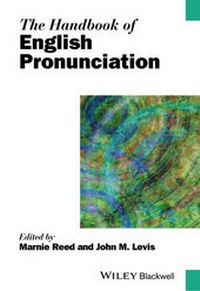
The Handbook of English Pronunciation
Description

More details
Other editions
Additional editions

Persons
Content
Notes on Contributors vii
Introduction xii
Part I The History of English Pronunciation 1
1 The Historical Evolution of English Pronunciation 3
Jeremy Smith
2 Accent as a Social Symbol 19
Lynda Mugglestone
3 History of ESL Pronunciation Teaching 36
John M. Murphy and Amanda A. Baker
Part II Describing English Pronunciation 67
4 Segmentals 69
David Deterding
5 Syllable Structure 85
Adam Brown
6 Lexical Stress in English Pronunciation 106
Anne Cutler
7 The Rhythmic Patterning of English(es): Implications for Pronunciation Teaching 125
Ee-Ling Low
8 English Intonation - Form and Meaning 139
John M. Levis and Anne Wichmann
Part III Pronunciation and Discourse 157
9 Connected Speech 159
Ghinwa Alameen and John M. Levis
10 Functions of Intonation in Discourse 175
Anne Wichmann
11 Pronunciation and the Analysis of Discourse 190
Beatrice Szczepek Reed
12 Fluency 209
Ron I. Thomson
Part IV Pronunciation of the Major Varieties of English 227
13 North American English 229
Charles Boberg
14 British English 251
Clive Upton
15 Australian and New Zealand English 269
Laurie Bauer
16 The Pronunciation of English in South Africa 286
Ian Bekker and Bertus van Rooy
17 Indian English Pronunciation 301
Pramod Pandey
18 Pronunciation and World Englishes 320
Cecil L. Nelson and Seong-Yoon Kang
Part V Pronunciation and Language Acquisition 331
19 Acquisition of the English Sound System 333
Marilyn May Vihman
20 Variables Affecting L2 Pronunciation Development 353
Pavel Trofimovich, Sara Kennedy and Jennifer Ann Foote
Part VI Pronunciation Teaching 375
21 Intelligibility in Research and Practice: Teaching Priorities 377
Murray J. Munro and Tracey M. Derwing
22 The Segmental/Suprasegmental Debate 397
Beth Zielinski
23 Applying Theories of Language and Learning to Teaching Pronunciation 413
Graeme Couper
24 The Pronunciation of English as a Lingua Franca 433
Robin Walker and Wafa Zoghbor
25 Intonation in Research and Practice: The Importance of Metacognition 454
Marnie Reed and Christina Michaud
26 Integrating Pronunciation into the Language Classroom 471
Laura Sicola and Isabelle Darcy
27 Using Orthography to Teach Pronunciation 488
Wayne B. Dickerson
28 Technology and Learning Pronunciation 505
Rebecca Hincks
Index 520
Notes on Contributors
Ghinwa Alameen, PhD, teaches TESL and Arabic at Iowa State University. Her research focuses on the effectiveness of teaching connected speech on L2 perception and production. She has published articles on L2 material design, the integration of technology in language teaching, and the teaching of oral skills.
Amanda A. Baker, PhD, is Coordinator of the TESOL program at the University of Wollongong in Australia. Amanda's research interests focus on the dynamic relationships that exist between second language (L2) teachers' knowledge, beliefs, and practices, especially in the areas of L2 pronunciation, speaking, and listening pedagogy.
Laurie Bauer is Emeritus Professor of Linguistics at Victoria University of Wellington, New Zealand. He has published widely on international varieties of English, especially New Zealand English, and on morphology. Most recently, he is one of the authors of the Oxford Reference Guide to English Morphology (2013).
Ian Bekker, currently at the Potchefstroom campus of the North-West University,?specializes in the sociophonetics of South African English (SAfE), both in terms of contemporary developments as well as the reconstruction of its past genesis and development. His current main research focus is on the role of Johannesburg in the development of SAfE.
Charles Boberg teaches Linguistics at McGill University in Montreal, Canada. His research focuses on variation and change in North American English, particularly Canadian English. His books include The English Language in Canada: Status, History and Comparative Analysis (2010) and, with William Labov and Sharon Ash, The Atlas of North American English (2006).
Adam Brown is the Director of Research at Auckland Institute of Studies, New Zealand. He holds a PhD in phonetics from the University of Edinburgh and has taught in Thailand, Malaysia, and Singapore, as well as his native UK. He has written a dozen books and many articles on aspects of English language teaching, especially pronunciation. His latest publication is Pronunciation and Phonetics: A Practical Guide for English Language Teachers (2014).
Graeme Couper is a senior lecturer at Auckland University of Technology with many years teaching experience in a wide range of countries and contexts, which he applies to his research into the teaching and learning of L2 pronunciation. His classroom-based research brings theory and practice together, finding a significant role for Cognitive Linguistics and other usage-based theories that allow for both the cognitive and social nature of language learning.
Anne Cutler is Emeritus Director of the Max Planck Institute for Psycholinguistics, Professor at the MARCS Institute, University of Western Sydney, and Processing Program leader of the Australian Research Council Centre of Excellence in the Dynamics of Language. Her research (summarized in her 2012 book Native Listening) focuses on how native-language phonological structure shapes the way we listen to speech.
Isabelle Darcy is Associate Professor of second language psycholinguistics in the Department of Second Language Studies at Indiana University. She obtained a PhD in Linguistics and Cognitive Science from the Ecole des Hautes Etudes en Sciences Sociales in Paris (France) and from the Johannes Gutenberg University in Mainz (Germany); her research focuses on the acquisition of second language phonology, pronunciation instruction, native/non-native speech perception, and word recognition.
Tracey M. Derwing is a Professor Emeritus in TESL (Department of Educational Psychology) at the University of Alberta and an Adjunct Professor in the Department of Linguistics at Simon Fraser University. Her research interests include L2 pronunciation, native speaker reactions to accented speech, pragmatics, immigration, settlement, and teacher education. Together with Murray Munro, she conducted a 10-year longitudinal study of naturalistic pronunciation development in two groups of language learners.
David Deterding is a Professor at Universiti Brunei Darussalam, where he teaches phonetics, grammar, research methods, translation, and forensic linguistics. His research?focuses on acoustic phonetics, the pronunciation of Chinese and Malay, the description of Englishes in Southeast Asia, and misunderstandings in English as a lingua franca.
Wayne B. Dickerson is Professor Emeritus in the Department of Linguistics at the University of Illinois at Urbana-Champaign where he taught courses in English phonology for MATESL candidates and ESL pronunciation. His research focuses on pedagogical applications of phonetics and phonology, pronunciation pedagogy, the value of orthography for learners, phonological variability, and pronunciation assessment.
Jennifer Ann Foote is a doctoral student at Concordia University, Montreal, Canada. She has taught English in Canada, Japan, the Czech Republic, and South Korea. She is interested in issues related to teaching pronunciation.
Rebecca Hincks is Associate Professor of English at the KTH Royal Institute of Technology in Stockholm, Sweden. Her doctoral work was done in language-learning applications for speech processing. Her research interests are oriented toward the development of training systems for public speaking in a lingua franca environment.
Seong-Yoon Kang, PhD, is an Associate Director of International Teacher and Government Programs and Curriculum Specialist at Bloomfield College, USA, where he is in charge of Total Immersion Courses for Korean English Teachers (TICKET) as well as intensive English programs. His research focuses on L2 learners' individual differences in language acquisition and sociolinguistic influences on speech acts. Previously he designed, developed, and taught intensive English courses in South Korea.
Sara Kennedy is an Associate Professor of Applied Linguistics in the Department of Education at Concordia University, Montreal, Canada. Her research focuses on intelligibility of second language speech, effects of classroom instruction, particularly the teaching of oral skills, and the role of language experience in the development of speaking ability. She has extensive experience teaching English as a second and foreign language.
John M. Levis is Professor of Applied Linguistics and TESL at Iowa State University. His research interests are English intonation, teacher education for pronunciation, and speech intelligibility. He is the editor of the Journal of Second Language Pronunciation.
Ee-Ling Low PhD (Cambridge, UK) is an Associate Professor of English Language and Literature and concurrently Head of Strategic Planning and Academic Quality at the National Institute of Education, Singapore. She has published widely in the areas of the phonetics of World Englishes and pronunciation for English as an International Language.
Christina Michaud is a Senior Lecturer in the Writing Program at Boston University, where she teaches argument and research writing to native and non-native speakers of English. She has co-authored a supra-segmental pronunciation textbook and a book on lesson planning for TESOL teachers.
Lynda Mugglestone is Professor of History of English at the University of Oxford and a Fellow of Pembroke College, Oxford. She has published widely on the history of English, with special interests in the history of pronunciation, and?in metalexicography and the social, cultural, and ideological issues that dictionary-making can reveal.
Murray J. Munro, a Professor of Linguistics at Simon Fraser University, has published extensively on accent and intelligibility, vowel and consonant acquisition, and the role of age and experience in phonetic learning. His collaborative work with Tracey Derwing focuses on the empirical foundations of pronunciation teaching.
John M. Murphy is a Professor of Applied Linguistics and ESL at Georgia State University (Atlanta).? His research and pedagogic interests span three areas: second language (L2) teacher reasoning (e.g., teachers' knowledge, beliefs, and instructional practices), approaches to L2 teaching, and integrated instruction of ESL listening, speaking, and pronunciation. John also teaches Yoga (twice weekly) in the lineage of Pranakriya Hatha Yoga.
Cecil L. Nelson is the author of Intelligibility in World Englishes (2011) and a co-editor with Braj and Yamuna Kachru of The Handbook of World Englishes (2006).? He was for some years the Review Editor of the journal World Englishes.
Pramod Pandey is Professor of Linguistics, Centre for Linguistics at Jawaharlal Nehru University, New Delhi. His current areas of research interest include phonological interfaces, Indian English, writing systems, speech technology, and multilingualism. His publications include research articles on phonetics-phonology, second language varieties, writing systems, and a recent book, Sounds and Their Patterns in Indic Languages (two volumes).
Marnie Reed is an Associate Professor of Education and affiliated faculty in Applied Linguistics at Boston University. Her research focuses on second language phonology, particularly the role of auditory feedback in the perception and production of connected discourse, the role of metalinguistic feedback in the acquisition of morphosyntax, and metacognition in cross-linguistics awareness of...
