

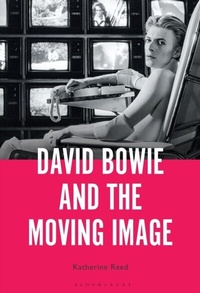
David Bowie and the Moving Image
A Standing Cinema
1st Edition
Published on 15. December 2022
248 pages
978-1-5013-7127-1 (ISBN)
Description

The central image of David Bowie's "Life on Mars?" could have been ripped from his own experience: a child sits "hooked to the silver screen," reliving fantastical scenes played out on film. Throughout his life, Bowie was similarly transfixed by the power of film. From his first film role in The Image to his final music video before his death, "Lazarus," Bowie's musical output has long been intrinsically linked to images.
Analyzing Bowie's music videos, planned film projects, acting roles, and depictions in film, David Bowie and the Moving Image provides a comprehensive view of Bowie's work with film and informs our understanding of all areas of his work, from music to fashion to visual art. It enters the debate about Bowie's artistic legacy by addressing Bowie as musician, actor, and auteur.
Analyzing Bowie's music videos, planned film projects, acting roles, and depictions in film, David Bowie and the Moving Image provides a comprehensive view of Bowie's work with film and informs our understanding of all areas of his work, from music to fashion to visual art. It enters the debate about Bowie's artistic legacy by addressing Bowie as musician, actor, and auteur.
Reviews / Votes
To focus on the music of David Bowie is understandable. But you're only getting half of the story. Bowie the visual artist-actor, director, scenarist, storyboard artist, painter, 'icon'-is just as essential to his work. Katherine Reed's insightful study goes from the Diamond Dogs tour to Bowie's Vittel and Vuitton TV ads to his afterlife in films and shows how intertwined Bowie the rock musician and Bowie the image (and image-maker) always were. * Chris O'Leary, author of Rebel Rebel (2015) and Ashes To Ashes (2019) * David Bowie's chameleonic nature was evidence of a keen sense of not just style but how an image could tell a story - and sometimes the more ambiguous the story, the more compelling the image. This wide-ranging study literally looks at David Bowie across media from stage to screen, a musical performer, an actor, a conceptualist, a figure both avant-garde and commercial, an 'alien' who reflected his audience back to themselves. * Robynn Stilwell, Associate Professor of Music, Georgetown University, USA * David Bowie and the Moving Image is an essential starting point for anyone looking to deepen their understanding of this iconic artist. Reed makes a compelling case that Bowie's entire oeuvre is permeated by an audiovisual and theatrical sensibility, always extending beyond the music through the power of the accompanying images, whether it is the charismatic chameleon that is Bowie himself, music videos that channel his performance personae, films in which brand Bowie is a defining feature, commercial spinoffs in advertising, or elaborate film and stage narratives, some of which disintegrated before they could be realised. Reed's writing is erudite and panoramic in its scope, drawing eclectically from musicology, studies of performance and audiovisuality, cultural theory and semiotics. The value of this book is in how it draws all of this together, offering the reader an approachable overview of Bowie's unrivalled and enigmatic explorations in sound and vision. * John Richardson, Professor of Musicology, University of Turku, Finland, and author of An Eye for Music: Popular Music and the Audiovisual Surreal (2012) *More details
Edition
1. Auflage
Language
English
Place of publication
New York
United States
Publishing group
Bloomsbury Publishing PLC (Digital)
Target group
Professional and scholarly
Illustrations
17 bw illus
ISBN-13
978-1-5013-7127-1 (9781501371271)
Copyright in bibliographic data and cover images is held by Nielsen Book Services Limited or by the publishers or by their respective licensors: all rights reserved.
Schweitzer Classification
Other editions
Additional editions
Book
07/2025
Bloomsbury Academic USA
€55.95
Shipment within 15-20 days
Book
01/2023
Bloomsbury Academic USA
€133.92
Shipment within 15-20 days
Person
Katherine Reed is Assistant Professor of Musicology at California State University, Fullerton, USA. Her research interests include musical semiotics and the use of pre-existing music in film. Reed's work has appeared in Popular Music & Society, Music and the Moving Image, and the Society for American Music's Digital Lecture Series.
Content
List of Figures
1. Introduction: Sons of the Silent Age
Part I: Bowie as Auteur
2. Semiotics and the Creation of "David Bowie"
3. Cracked Actor: The Music Video and Bowie as Moving Image
4. Screen Dreams: Theatrical Staging, Film, and Diamond Dogs
Part II: Bowie as Sign
5. Hollywood Highs: Acting Roles and Bowie's Star Image
6. "Mass Motivation": Advertising, Audience, and the Bowie Star Image
7. Who Can I Be Now?: Fannish Creation and Depictions of Bowie on Film
8. Conclusion: Living On
Bibliography
Media Bibliography
Acknowledgments
Index
1. Introduction: Sons of the Silent Age
Part I: Bowie as Auteur
2. Semiotics and the Creation of "David Bowie"
3. Cracked Actor: The Music Video and Bowie as Moving Image
4. Screen Dreams: Theatrical Staging, Film, and Diamond Dogs
Part II: Bowie as Sign
5. Hollywood Highs: Acting Roles and Bowie's Star Image
6. "Mass Motivation": Advertising, Audience, and the Bowie Star Image
7. Who Can I Be Now?: Fannish Creation and Depictions of Bowie on Film
8. Conclusion: Living On
Bibliography
Media Bibliography
Acknowledgments
Index
