
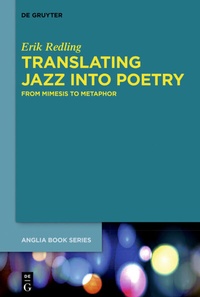
Translating Jazz Into Poetry
Description
Alles über E-Books | Antworten auf Fragen rund um E-Books, Kopierschutz und Dateiformate finden Sie in unserem Info- & Hilfebereich.
The study develops a new theoretical approach to the relationship between two media (jazz music and writing) and demonstrates its explanatory power with the help of a rich sampling of jazz poems. Currently, the mimetic approach to intermediality (e.g., the notion that jazz poetry imitates jazz music) still dominates the field of criticism. This book challenges that interpretive approach. It demonstrates that a mimetic view of jazz poetry hinders readers from perceiving the metaphoric ways poets rendered music in writing. Drawing on and extending recent cognitive metaphor theories (Lakoff, Johnson, Turner, Fauconnier), it promotes a conceptual metaphor model that allows readers to discover the innovative ways poets translate "melody," "dynamics," "tempo," "mood," and other musical elements into literal and figurative expressions that invite readers to imagine the music in their mind's eye (i.e., their mind's ear).
More details
Other editions
Additional editions

Person
System requirements
File format: ePUB
Copy protection: Watermark-DRM (Digital Rights Management)
System requirements:
- Computer (Windows; MacOS X; Linux): Use a reading software that can process the file format ePUB: e.g., Adobe Digital Editions or FBReader – both free (see eBook Help).
- Tablet/Smartphone (Android; iOS): Before downloading, install the free app Adobe Digital Editions (see eBook Help).
- E-reader: Bookeen, Kobo, Pocketbook, Sony, Tolino and many more (not Kindle).
The file format ePUB works well for novels and non-fiction books – i.e., „flowing” text without complex layout. On an e-reader or smartphone, line and page breaks automatically adjust to fit the small displays.
This eBook uses Watermark-DRM, a „soft” copy protection. This means that there are no technical restrictions to prevent illegal distribution. However, there is a personalised watermark embedded in the eBook that can be used to identify the purchaser of the eBook in the event of misuse and to provide evidence for legal purposes.
For more information, see our eBook Help page.