

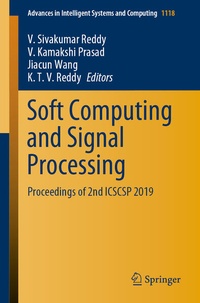
Soft Computing and Signal Processing
Description

This book presents selected research papers on current developments in the fields of soft computing and signal processing from the Second International Conference on Soft Computing and Signal Processing (ICSCSP 2019). The respective contributions address topics such as soft sets, rough sets, fuzzy logic, neural networks, genetic algorithms and machine learning, and discuss various aspects of these topics, e.g. technological considerations, product implementation, and application issues.
More details
Other editions
Additional editions
Persons
V. Sivakumar Reddy is Professor at the Department of Electronics and Communication Engineering, Malla Reddy College of Engineering and Technology. He completed his B.E. in Electronics and Communication Engineering from S.V. University, his M.Tech. in Digital Systems at JNT University and his Ph.D. in Electronics & Communication Engineering at IIT Kharagpur. His areas of research interest include computer networks and communication, video processing, multi-media system design, operating systems and TCP/IP networks & protocols. He has published more than 100 papers in peer-reviewed journals and conference proceedings in these areas. He is a member of several academic bodies, such as IETE, IEEE, ISTE and CSI. He is also a reviewer for several IEEE journals.
V. Kamakshi Prasad completed his Ph.D. in speech recognition at the Indian Institute of Technology Madras and his M.Tech. in Computer Science & Technology at Andhra University in 1992. He has more than 20 years of teachingand research experience. His areas of research and teaching interest include speech recognition and processing, image processing, pattern recognition, ad-hoc networks and computer graphics. He has published several books, chapters, research papers in peer-reviewed journals and conference proceedings. He is also an editorial board member of the International Journal of Wireless Networks and Communications and a member of several academic committees.
Jiacun Wang received a Ph.D. in Computer Engineering from Nanjing University of Science and Technology (NJUST), China, in 1991. He is currently a Professor at the Computer Science and Software Engineering Department at Monmouth University, West Long Branch, New Jersey. From 2001 to 2004, he was a member of scientific staff at Nortel Networks in Richardson, Texas. Prior to joining Nortel, he was a research associate at the School of Computer Science, Florida International University (FIU) at Miami and an Associate Professor atNJUST. He has published numerous books and research papers and is an Associate Editor of several international journals. He has also served as program chair, program co-chair, special sessions chair and program committee member for several international conferences. He is the secretary of the Organizing and Planning Committee of the IEEE SMC Society and has been a senior
member of IEEE since 2000.
