

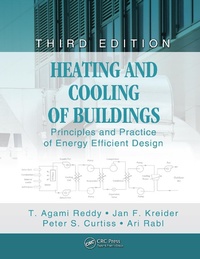
Heating and Cooling of Buildings
Principles and Practice of Energy Efficient Design, Third Edition
3rd Edition
Published on 1. September 2016
900 pages
978-1-315-36291-5 (ISBN)
Description

Heating and Cooling of Buildings: Principles and Practice of Energy Efficient Design, Third Edition is structured to provide a rigorous and comprehensive technical foundation and coverage to all the various elements inherent in the design of energy efficient and green buildings. Along with numerous new and revised examples, design case studies, and homework problems, the third edition includes the HCB software along with its extensive website material, which contains a wealth of data to support design analysis and planning. Based around current codes and standards, the Third Edition explores the latest technologies that are central to design and operation of today's buildings. It serves as an up-to-date technical resource for future designers, practitioners, and researchers wishing to acquire a firm scientific foundation for improving the design and performance of buildings and the comfort of their occupants. For engineering and architecture students in undergraduate/graduate classes, this comprehensive textbook:
Reviews / Votes
"For me, the main advantage of Heating and Cooling of Buildings is its readability. It has been written in a manner that helps my students to understand concepts that they might otherwise have found difficult to understand....Chapter 9 is the most comprehensive coverage of heating and cooling design loads - this chapter is what got me interested in the textbook in the first place. The book can also be used by practicing HVAC engineers as a reference."--Tiyamike Ngonda, Cape Peninsula University of Technology, Cape Town, South Africa
"Theory and governing equations are presented in an organized manner. The flow of text is quite easy to follow, and covers all topics needed to be taught in a design course."
--Hessam Taherian, University of Alabama at Birmingham, Birmingham, Alabama, USA
""I would highly recommend this book and instructor resources to professors for undergraduate or graduate level courses in HVAC design and building energy science, with the expectation that students would keep this book and use it on a day-to-day basis in their careers."
----Andy Walker, National Renewable Energy Laboratory, Golden, Colorado, USA
"The authors have taken great care to update their previous version of this book with the inclusion of several relevant hardware related application chapters and references to current ASHRAE standards."
---Kevin R. Anderson, California State Polytechnic University, Pomona, California, USA
More details
Series
Edition
3rd edition
Language
English
Place of publication
London
United Kingdom
Publishing group
Taylor & Francis Ltd
Target group
College/higher education
Illustrations
158 Tables, black and white; 610 Illustrations, black and white
File size
66,73 MB
ISBN-13
978-1-315-36291-5 (9781315362915)
Copyright in bibliographic data and cover images is held by Nielsen Book Services Limited or by the publishers or by their respective licensors: all rights reserved.
Schweitzer Classification
Other editions
Additional editions
T. Reddy | Jan F. Kreider | Peter S. Curtiss
Heating and Cooling of Buildings
Principles and Practice of Energy Efficient Design, Third Edition
Book
07/2016
3rd Edition
CRC Press
€235.50
Shipment within 15-20 days
Persons
T. Agami Reddy is SRP Professor of Energy and Environment at Arizona State University with joint faculty appointments with the Design School and the School of Sustainable Engineering and the Built Environment. During his 30 year career, he has also held faculty and research positions at Drexel University, Texas A&M University and Princeton University. He teaches and does research in the areas of sustainable energy systems (green buildings, HVAC&R, solar and resiliency/sustainability) and building energy data analytics. He is the author of two textbooks and has close to 200 refereed journal and conference papers, and several book chapters and technical research reports. He is a licensed mechanical engineer and Fellow of both ASME and ASHRAE. He received the ASHRAE Distinguished Service Award in 2008, and was the recipient of the 2014 Yellott Award from the ASME Solar Energy Division.
Jan F. Kreider has served as a professor of engineering at the University of Colorado at Boulder, and is a founding director of its Joint Center for Energy Management. He received his BSME degree (magna cum laude) from Case Western Reserve University, and his postgraduate degrees from the University of Colorado at Boulder. Dr. Kreider is the author of numerous college textbooks and more than 200 technical articles and reports, and has managed numerous building systems research projects. He is a fellow of the ASME, an active member of ASHRAE, and a winner of ASHRAE's E.K. Campbell Award for excellence in building systems education. He is also the president of a consulting company specializing in energy system design and analysis.
Peter Curtiss received his BSCE degree from Princeton University, and his advanced degrees from the University of Colorado at Boulder. He has served as an adjunct professor, and has worked as an engineering consultant. Dr. Curtiss has he author of over 40 technical journal articles, on subjects ranging from neural network modeling and control of building systems to solar radiation measurement. He has worked at research institutes in Israel, Portugal, and France as well as at a number of private engineering firms.
Ari Rabl has served as a research scientist at the Centre d'Energetique of the l'Ecole de Mines in Paris, as well as research professor at the University of Colorado. He received his PhD in Physics from the University of California at Berkeley, and has worked at the Argonne National Laboratory, the Solar Energy Research Institute, and the Center for Energy and Environmental Studies at Princeton University. Dr. Rabl is the author of more than 50 journal articles, numerous technical reports, and holds 10 patents. He is a member of the American Physical Society and ASHRAE.
Jan F. Kreider has served as a professor of engineering at the University of Colorado at Boulder, and is a founding director of its Joint Center for Energy Management. He received his BSME degree (magna cum laude) from Case Western Reserve University, and his postgraduate degrees from the University of Colorado at Boulder. Dr. Kreider is the author of numerous college textbooks and more than 200 technical articles and reports, and has managed numerous building systems research projects. He is a fellow of the ASME, an active member of ASHRAE, and a winner of ASHRAE's E.K. Campbell Award for excellence in building systems education. He is also the president of a consulting company specializing in energy system design and analysis.
Peter Curtiss received his BSCE degree from Princeton University, and his advanced degrees from the University of Colorado at Boulder. He has served as an adjunct professor, and has worked as an engineering consultant. Dr. Curtiss has he author of over 40 technical journal articles, on subjects ranging from neural network modeling and control of building systems to solar radiation measurement. He has worked at research institutes in Israel, Portugal, and France as well as at a number of private engineering firms.
Ari Rabl has served as a research scientist at the Centre d'Energetique of the l'Ecole de Mines in Paris, as well as research professor at the University of Colorado. He received his PhD in Physics from the University of California at Berkeley, and has worked at the Argonne National Laboratory, the Solar Energy Research Institute, and the Center for Energy and Environmental Studies at Princeton University. Dr. Rabl is the author of more than 50 journal articles, numerous technical reports, and holds 10 patents. He is a member of the American Physical Society and ASHRAE.
Content
Background to the Building Sector and Energy Use Patterns. Basic Thermal Science. Human Thermal Comfort and Indoor Air Quality. Solar Radiation. Heat Gains through Windows. Steady State Heat Flows. Transient Heat Flow through Building Elements. Heating and Cooling Design Load Calculations. Simplified Annual Energy Estimation Methods and Inverse Modeling. Description of Typical Building HVAC Systems and Components. Thermal Principles Relevant to Equipment and Systems. Psychrometric Properties and Processes. Chillers and Heat Pump Cycles and Systems. Combustion Heating Equipment and Systems. Pumps, Fans, and System Interactions. Cooling System Equipment. Hydronic Distribution Equipment and Systems. All-Air Systems. Room Air Distribution and Hybrid Secondary System. Lighting and Daylighting. Costing and Economic Analysis. Design for Energy Efficiency.
