

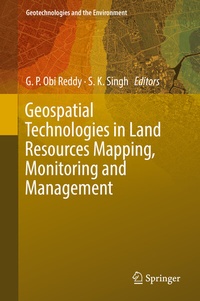
Geospatial Technologies in Land Resources Mapping, Monitoring and Management
Description

This book offers an overview of geospatial technologies in land resources mapping, monitoring and management. It consists of four main sections: geospatial technologies - principles and applications; geospatial technologies in land resources mapping; geospatial technologies in land resources monitoring; and geospatial technologies in land resources management. Each part is divided into detailed chapters that include illustrations and tables. The authors, from leading institutes, such as the ICAR-NBSS&LUP, IIT-B, NRSC, ICRISAT, share their experiences and offer case studies to provide advanced insights into the field. It is a valuable resource for the scientific and the teaching community, extension scientists at research institutes and agricultural universities/colleges as well as those involved in planning and managing land resources for sustainable agriculture and livelihood security.
More details
Other editions
Additional editions
Persons
Dr. G.P. Obi Reddy obtained his doctoral degree in Geography from Sri Krishnadevaraya University, Anantapur, India and presently working as Principal Scientist & Incharge, GIS & Cartography Sections, Division of Remote Sensing Application, ICAR-National Bureau of Soil Survey and Land Use Planning (NBSS&LUP), Nagpur, India. His major research areas are remote sensing and GIS applications in: Applied geomorphology, digital terrain analysis, landform mapping, soil-landscape modelling, land use/land cover studies, watershed development, design and development of soil resource systems and Geoportal. He has published more than 80 research articles in peer-reviewed national and international journals, 3 books, 30 book chapters and 10 technical bulletins. He is the recipient of Indian National Geospatial Award-2007, National Geospatial Award for Excellence-2013 and five best poster presentation awards. He has acted as reviewer for many national and international journals.
Dr. S.K. Singh obtained his doctoral degree in Soil Science from Rajasthan Agriculture University, Bikaner and presently working as Director at ICAR-National Bureau of Soil Survey and Land Use Planning (NBSS&LUP), Nagpur, India. His major research areas are soil resource inventory, soil nutrient mapping, desertification and carbon sequestration, land use planning and remote sensing GIS applications. He significantly contributed in development of GIS based soil nutrient mapping for Eastern Region, development of Farmer's Advisory for the state of West Bengal and soil resource inventory for more than 100 blocks in India on 1:10,000 scale. He is the recipient of Shriram Award (2012) instituted by FAI, New Delhi, India. He has published more than 115 research articles, 4 books, 30 book chapters and 50 technical bulletins. He has acted as reviewer for many national and international journals.