

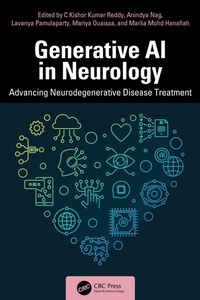
Generative AI in Neurology
Advancing Neurodegenerative Disease Treatment
1st Edition
Published on 28. November 2025
384 pages
978-1-040-45115-1 (ISBN)
Description

This book comprehensively explores the intersection between AI and neurology, focusing on the application of generative models in diagnosing, treating, and managing neurodegenerative diseases. It covers the principles of generative AI and its roles in neuroimaging, biomarker identification, medication development, and tailored treatment options. It examines how advanced AI approaches are leveraged to increase the detection and treatment of neurodegenerative illnesses. The concepts are supported by case studies and examples.
Features:
Focuses on the emerging field of generative models in neurology.
Presents an interdisciplinary approach that bridges AI and medical applications.
Examines the ability of neural diffusion models to generate genuine data to enhance healthcare AI.
Discusses tools for the adaptation and augmentation of medical images and healthcare data domains.
Includes case studies and practical impacts.
This book is aimed at graduate students and researchers in biomedical and computer engineering, artificial intelligence, and health informatics.
Features:
Focuses on the emerging field of generative models in neurology.
Presents an interdisciplinary approach that bridges AI and medical applications.
Examines the ability of neural diffusion models to generate genuine data to enhance healthcare AI.
Discusses tools for the adaptation and augmentation of medical images and healthcare data domains.
Includes case studies and practical impacts.
This book is aimed at graduate students and researchers in biomedical and computer engineering, artificial intelligence, and health informatics.
More details
Edition
1. Auflage
Language
English
Place of publication
London
United Kingdom
Publishing group
Taylor & Francis Ltd
Target group
College/higher education
Professional and scholarly
Illustrations
34 Tables, black and white; 67 Line drawings, black and white; 67 Illustrations, black and white
File size
16,69 MB
ISBN-13
978-1-040-45115-1 (9781040451151)
Copyright in bibliographic data and cover images is held by Nielsen Book Services Limited or by the publishers or by their respective licensors: all rights reserved.
Schweitzer Classification
Other editions
Additional editions
C. Kishor Kumar Reddy | Anindya Nag | Lavanya Pamulaparty
Generative AI in Neurology
Advancing Neurodegenerative Disease Treatment
Book
approx. 11/2025
1st Edition
CRC Press
€208.70
Not yet published
Persons
C Kishor Kumar Reddy is Associate Professor of the Deptartment of Computer Science and Engineering, Stanley College of Engineering and Technology for Women, Hyderabad, India. He has research and teaching experience of more than 12 years. He has published more than 125+ research papers in national and international conferences, book chapters, and journals indexed by Scopus and others. He has authored two textbooks and 20+ edited books. He is the member of ACM, ISTE, CSI, IAENG, UACEE, and IACSIT. His research areas include Bioinformatics, Neuroscience, Remote Sensing, Deep Learning, and Intelligent Systems.
Anindya Nag is Lecturer in the Department of Computer Science and Engineering at the Northern University of Business and Technology in Khulna, Bangladesh. He obtained M.Sc. in Computer Science and Engineering from Khulna University in Khulna, Bangladesh, and B.Tech. in Computer Science and Engineering from Adamas University in Kolkata, India. His research focuses on health informatics, medical Internet of Things, neuroscience, and machine learning. He serves as a reviewer for numerous prestigious journals and international conferences. He has authored and co-authored about 53 publications, including journal articles, conference papers, and book chapters, and has co-edited nine books.
Lavanya Pamulaparty is Professor and Head of the Department of Computer Science and Engineering at Methodist College of Engineering and Technology since 2010. She is a B.E. graduate in Computer Science and Engineering from KITS, Nagpur University. She obtained her M. Tech in Software Engineering from Jawaharlal Nehru and Technological University (JNTUH), Hyderabad and Doctorate degree from JNTUH, Hyderabad in the field of Data Mining. She has over 21 years of experience in the field of academic research and technological education. She has published 20 papers in various international and national journals and IEEE international / national conferences and has two patents. Her papers are indexed in Scopus and SCI. Her area of interest includes Artificial Intelligence and Machine Learning. She is an IEEE, CSI, and ISTE life member. She has organized international conferences ICPET-2016, 2018, and ICAISC-2022.
Mariya Ouaissa is Professor in Cybersecurity and Networks at Cadi Ayyad University and practitioner with industry and academic experience. She completed her Ph.D. in 2019 in Computer Science and Networks, at the Laboratory of Modelisation of Mathematics and Computer Science from ENSAM-Moulay Ismail University, Meknes, Morocco. She is a Networks and Telecoms Engineer, graduated in 2013 from National School of Applied Sciences Khouribga, Morocco. She is a Co-Founder and IT Consultant at IT Support and Consulting Center. She was working for School of Technology of Meknes Morocco as a Visiting Professor from 2013 to 2021. She is member of the International Association of Engineers and International Association of Online Engineering, and since 2021, she is an "ACM Professional Member". She is Expert Reviewer with Academic Exchange Information Centre (AEIC) and Brand Ambassador with Bentham Science. She has served and continues to serve on technical program and organizer committees of several conferences and events and has organized many Symposiums/Workshops/Conferences as a General Chair also as a reviewer of numerous international journals. Dr. Ouaissa has made contributions in the fields of information security and privacy, Internet of Things security, and wireless and constrained networks security. Her main research topics are IoT, M2M, D2D, WSN, cellular networks, and vehicular networks. She has published over 40 papers (book chapters, international journals, and conferences/workshops), 12 edited books, and eight special issue as guest editor.
Marlia Mohd Hanafiah is Professor and Head, Centre for Tropical Climate Change System, Institute of Climate Change, The National University of Malaysia, Malaysia. Her areas of research expertise include Life Cycle Impact Assessment (LCA) and Environmental Foot printing of Green Materials and Energy, Environmental Engineering, Wastewater Treatment and Water Management, Green Technology and Sustainability. She has a total academic teaching experience of 15+ years with more than 170 publications in reputed journals and online book chapter contributions (indexed by: SCI, SCIE, SSCI, Scopus, DBLP). She has received research grant and consultation funding (as project leader and a team member) of more than RM seven million.
Anindya Nag is Lecturer in the Department of Computer Science and Engineering at the Northern University of Business and Technology in Khulna, Bangladesh. He obtained M.Sc. in Computer Science and Engineering from Khulna University in Khulna, Bangladesh, and B.Tech. in Computer Science and Engineering from Adamas University in Kolkata, India. His research focuses on health informatics, medical Internet of Things, neuroscience, and machine learning. He serves as a reviewer for numerous prestigious journals and international conferences. He has authored and co-authored about 53 publications, including journal articles, conference papers, and book chapters, and has co-edited nine books.
Lavanya Pamulaparty is Professor and Head of the Department of Computer Science and Engineering at Methodist College of Engineering and Technology since 2010. She is a B.E. graduate in Computer Science and Engineering from KITS, Nagpur University. She obtained her M. Tech in Software Engineering from Jawaharlal Nehru and Technological University (JNTUH), Hyderabad and Doctorate degree from JNTUH, Hyderabad in the field of Data Mining. She has over 21 years of experience in the field of academic research and technological education. She has published 20 papers in various international and national journals and IEEE international / national conferences and has two patents. Her papers are indexed in Scopus and SCI. Her area of interest includes Artificial Intelligence and Machine Learning. She is an IEEE, CSI, and ISTE life member. She has organized international conferences ICPET-2016, 2018, and ICAISC-2022.
Mariya Ouaissa is Professor in Cybersecurity and Networks at Cadi Ayyad University and practitioner with industry and academic experience. She completed her Ph.D. in 2019 in Computer Science and Networks, at the Laboratory of Modelisation of Mathematics and Computer Science from ENSAM-Moulay Ismail University, Meknes, Morocco. She is a Networks and Telecoms Engineer, graduated in 2013 from National School of Applied Sciences Khouribga, Morocco. She is a Co-Founder and IT Consultant at IT Support and Consulting Center. She was working for School of Technology of Meknes Morocco as a Visiting Professor from 2013 to 2021. She is member of the International Association of Engineers and International Association of Online Engineering, and since 2021, she is an "ACM Professional Member". She is Expert Reviewer with Academic Exchange Information Centre (AEIC) and Brand Ambassador with Bentham Science. She has served and continues to serve on technical program and organizer committees of several conferences and events and has organized many Symposiums/Workshops/Conferences as a General Chair also as a reviewer of numerous international journals. Dr. Ouaissa has made contributions in the fields of information security and privacy, Internet of Things security, and wireless and constrained networks security. Her main research topics are IoT, M2M, D2D, WSN, cellular networks, and vehicular networks. She has published over 40 papers (book chapters, international journals, and conferences/workshops), 12 edited books, and eight special issue as guest editor.
Marlia Mohd Hanafiah is Professor and Head, Centre for Tropical Climate Change System, Institute of Climate Change, The National University of Malaysia, Malaysia. Her areas of research expertise include Life Cycle Impact Assessment (LCA) and Environmental Foot printing of Green Materials and Energy, Environmental Engineering, Wastewater Treatment and Water Management, Green Technology and Sustainability. She has a total academic teaching experience of 15+ years with more than 170 publications in reputed journals and online book chapter contributions (indexed by: SCI, SCIE, SSCI, Scopus, DBLP). She has received research grant and consultation funding (as project leader and a team member) of more than RM seven million.
Content
1. The Power of Generative Models: Theoretical Essentials, Foundations and Applications
2. Overview of Current Technologies in Neurology with AI
3. Unlocking Neural Pathways: Large Language Models Pioneering Innovative Treatments in Neurodegenerative Diseases
4. A Novel Framework for AI-Powered Cognitive Tests for Improved Early Awareness in Alzheimer's Disease
5. Generative AI for Biomarkers Discovery Identifies Early Signs of Disease
6. Improved Early Awareness: Parkinson's Disease, ALS, Alzheimer's Disease
7. Future of Early Diagnosis: Artificial Intelligence's Role in Neurodegenerative Disease Detection
8. Enhancing Seizure Prediction, Diagnosis, and Treatment Using Artificial Intelligence in Epilepsy Intervention
9. Advancing Parkinson's Disease Detection: A Raw Voice Waveform Approach with Generative AI Augmentation
10. Early Alzheimer's Disease Diagnosis Using Generative AI and a Hybrid Capsule Network with Attention Mechanism
11. Custom Deep Neural Network for Early Detection of Neurodegenerative Disorders: A Multimodal Approach
12. Integration of Generative AI with Personalized Medicine in Neurology
13. Using Generative Artificial Intelligence in Neurodegenerative Disease Management
14. Exploring the Role of Generative AI Models in Neurodegenerative Disease Estimation
15. The Generative AI Revolution in Neurodegenerative Disease Research: Navigating Challenges, Embracing Opportunities
2. Overview of Current Technologies in Neurology with AI
3. Unlocking Neural Pathways: Large Language Models Pioneering Innovative Treatments in Neurodegenerative Diseases
4. A Novel Framework for AI-Powered Cognitive Tests for Improved Early Awareness in Alzheimer's Disease
5. Generative AI for Biomarkers Discovery Identifies Early Signs of Disease
6. Improved Early Awareness: Parkinson's Disease, ALS, Alzheimer's Disease
7. Future of Early Diagnosis: Artificial Intelligence's Role in Neurodegenerative Disease Detection
8. Enhancing Seizure Prediction, Diagnosis, and Treatment Using Artificial Intelligence in Epilepsy Intervention
9. Advancing Parkinson's Disease Detection: A Raw Voice Waveform Approach with Generative AI Augmentation
10. Early Alzheimer's Disease Diagnosis Using Generative AI and a Hybrid Capsule Network with Attention Mechanism
11. Custom Deep Neural Network for Early Detection of Neurodegenerative Disorders: A Multimodal Approach
12. Integration of Generative AI with Personalized Medicine in Neurology
13. Using Generative Artificial Intelligence in Neurodegenerative Disease Management
14. Exploring the Role of Generative AI Models in Neurodegenerative Disease Estimation
15. The Generative AI Revolution in Neurodegenerative Disease Research: Navigating Challenges, Embracing Opportunities
