

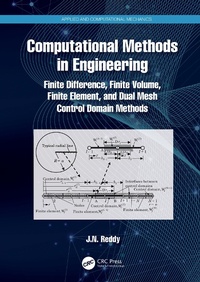
Computational Methods in Engineering
Finite Difference, Finite Volume, Finite Element, and Dual Mesh Control Domain Methods
1st Edition
Published on 19. March 2024
594 pages
978-1-003-83608-7 (ISBN)
Description

Computational Methods in Engineering: Finite Difference, Finite Volume, Finite Element, and Dual Mesh Control Domain Methods provides readers with the information necessary to choose appropriate numerical methods to solve a variety of engineering problems. Explaining common numerical methods in an accessible yet rigorous manner, the book details the finite element method (FEM), finite volume method (FVM) and importantly, a new numerical approach, dual mesh control domain method (DMCDM).
Numerical methods are crucial to everyday engineering. The book begins by introducing the various methods and their applications, with example problems from a range of engineering disciplines including heat transfer, solid and structural mechanics, and fluid mechanics. It highlights the strengths of FEM, with its systematic procedure and modular steps, and then goes on to explain the uses of FVM. It explains how DMCDM embodies useful parts of both FEM and FVM, particularly in its use of the control domain method and how it can provide a comprehensive computational approach. The final chapters look at ways to use different numerical methods, primarily FEM and DMCDM, to solve typical problems of bending of beams, axisymmetric circular plates, and other nonlinear problems.
This book is a useful guide to numerical methods for professionals and students in all areas of engineering and engineering mathematics.
Numerical methods are crucial to everyday engineering. The book begins by introducing the various methods and their applications, with example problems from a range of engineering disciplines including heat transfer, solid and structural mechanics, and fluid mechanics. It highlights the strengths of FEM, with its systematic procedure and modular steps, and then goes on to explain the uses of FVM. It explains how DMCDM embodies useful parts of both FEM and FVM, particularly in its use of the control domain method and how it can provide a comprehensive computational approach. The final chapters look at ways to use different numerical methods, primarily FEM and DMCDM, to solve typical problems of bending of beams, axisymmetric circular plates, and other nonlinear problems.
This book is a useful guide to numerical methods for professionals and students in all areas of engineering and engineering mathematics.
More details
Series
Edition
1. Auflage
Language
English
Place of publication
London
United Kingdom
Publishing group
Taylor & Francis Ebooks
Target group
Professional and scholarly
Illustrations
64 Tables, black and white; 266 Line drawings, black and white; 6 Halftones, black and white; 272 Illustrations, black and white
ISBN-13
978-1-003-83608-7 (9781003836087)
Copyright in bibliographic data and cover images is held by Nielsen Book Services Limited or by the publishers or by their respective licensors: all rights reserved.
Schweitzer Classification
Other editions
Additional editions
J.N. Reddy
Computational Methods in Engineering
Finite Difference, Finite Volume, Finite Element, and Dual Mesh Control Domain Methods
Book
03/2024
1st Edition
CRC Press
€205.40
Shipment within 10-20 days
Person
J. N. Reddy, the O'Donnell Foundation Chair IV Professor in J. Mike Walker '66 Department of Mechanical Engineering at Texas A&M University, is a highly-cited researcher, author of 25 textbooks and over 800 journal papers, and a leader in the applied mechanics field for more than 50 years. He is well-known worldwide for his significant contributions to the field of applied and computational mechanics through the authorship of widely used textbooks on mechanics of materials, continuum mechanics, linear and nonlinear finite element analyses, variational methods, numerical methods, and composite materials and structures. His pioneering works on the development of shear deformation theories of beams, plates, and shells (that bear his name in the literature as the Reddy third-order plate theory and the Reddy layerwise theory), nonlocal and non-classical continuum mechanics have had a major impact, and have led to new research developments and applications. Some of his ideas on shear deformation theories and penalty finite element models of fluid flows have been implemented into commercial finite element software like Abaqus, NISA, and HyperXtrude (Altair).
Recent honors and awards include: 2023 Leonardo da Vinci Award from the European Academy of Sciences, 2023 Michael P. Pa?idoussis Medal from the Royal Society of Canada, 2022 IACM Congress (Gauss-Newton) Medal from the International Association of Computational Mechanics, 2019 Timoshenko Medal from the American Society of Mechanical Engineers, 2018 Theodore von K?arm?an Medal from the American Society of Civil Engineers, 2017 John von Neumann Medal from the U.S. Association of Computational Mechanics, 2016 Prager Medal from the Society of Engineering Science, and 2016 ASME Medal from the American Society of Mechanical Engineers. He is a member of the US National Academy of Engineering and foreign fellow of the Canadian Academy of Engineering, the Chinese Academy of Engineering, the Brazilian National Academy of Engineering, the Indian National Academy of Engineering, the Royal Academy of Engineering of Spain, the European Academy of Sciences (Honorary Member), and the Academia Scientiarum et Artium Europaea (the European Academy of Sciences and Arts).
Recent honors and awards include: 2023 Leonardo da Vinci Award from the European Academy of Sciences, 2023 Michael P. Pa?idoussis Medal from the Royal Society of Canada, 2022 IACM Congress (Gauss-Newton) Medal from the International Association of Computational Mechanics, 2019 Timoshenko Medal from the American Society of Mechanical Engineers, 2018 Theodore von K?arm?an Medal from the American Society of Civil Engineers, 2017 John von Neumann Medal from the U.S. Association of Computational Mechanics, 2016 Prager Medal from the Society of Engineering Science, and 2016 ASME Medal from the American Society of Mechanical Engineers. He is a member of the US National Academy of Engineering and foreign fellow of the Canadian Academy of Engineering, the Chinese Academy of Engineering, the Brazilian National Academy of Engineering, the Indian National Academy of Engineering, the Royal Academy of Engineering of Spain, the European Academy of Sciences (Honorary Member), and the Academia Scientiarum et Artium Europaea (the European Academy of Sciences and Arts).
Content
1. Introduction and Preliminaries
2. The Finite Difference Method
3. The Finite Volume Method
4. The Finite Element Method
5. The Dual Mesh Control Domain Method
6. Nonlinear Problems with a Single Unknown
7. Bending of Straight Beams
8. Bending of Axisymmetric Circular Plates
9. Plane Elasticity and Viscous Incompressible Flows
10. Bending of Flat Plates
2. The Finite Difference Method
3. The Finite Volume Method
4. The Finite Element Method
5. The Dual Mesh Control Domain Method
6. Nonlinear Problems with a Single Unknown
7. Bending of Straight Beams
8. Bending of Axisymmetric Circular Plates
9. Plane Elasticity and Viscous Incompressible Flows
10. Bending of Flat Plates
