

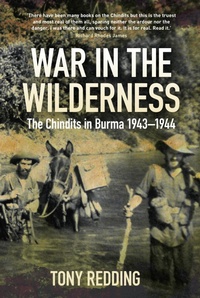
War in the Wilderness
The Chindits in Burma 1943-1944
Published on 1. October 2011
448 pages
978-0-7509-5655-0 (ISBN)
Description

War in the Wilderness is the most comprehensive account ever published of the human aspects of the Chindit war in Burma.
The word 'Chindit' will always have a special resonance in military circles. Every Chindit endured what is widely regarded as the toughest sustained Allied combat experience of the Second World War. The Chindit expeditions behind Japanese lines in occupied Burma 1943-1944 transformed the morale of British forces after the crushing defeats of 1942. The Chindits provided the springboard for the Allies' later offensives.
The two expeditions extended the boundaries of human endurance. The Chindits suffered slow starvation and exposure to dysentery, malaria, typhus and a catalogue of other diseases. They endured the intense mental strain of living and fighting under the jungle canopy, with the ever-present threat of ambush or simply 'bumping' the enemy. Every Chindit carried his kit and weapons (equivalent to two heavy suitcases) in the tropical heat and humidity. A disabling wound or sickness frequently meant a lonely death. Those who could no longer march were often left behind with virtually no hope of survival. Some severely wounded were shot or given a lethal dose of morphia to ensure they would not be captured alive by the Japanese.
Fifty veterans of the Chindit expeditions kindly gave interviews for this book. Many remarked on the self-reliance that sprang from living and fighting as a Chindit. Whatever happened to them after their experiences in Burma, they knew that nothing else would ever be as bad. There are first-hand accounts of the bitter and costly battles and the final, wasteful weeks, when men were forced to continue fighting long after their health and strength had collapsed. War in the Wilderness continues the story as the survivors returned to civilian life. They remained Chindits for the rest of their days, members of a brotherhood forged in extreme adversity.
The word 'Chindit' will always have a special resonance in military circles. Every Chindit endured what is widely regarded as the toughest sustained Allied combat experience of the Second World War. The Chindit expeditions behind Japanese lines in occupied Burma 1943-1944 transformed the morale of British forces after the crushing defeats of 1942. The Chindits provided the springboard for the Allies' later offensives.
The two expeditions extended the boundaries of human endurance. The Chindits suffered slow starvation and exposure to dysentery, malaria, typhus and a catalogue of other diseases. They endured the intense mental strain of living and fighting under the jungle canopy, with the ever-present threat of ambush or simply 'bumping' the enemy. Every Chindit carried his kit and weapons (equivalent to two heavy suitcases) in the tropical heat and humidity. A disabling wound or sickness frequently meant a lonely death. Those who could no longer march were often left behind with virtually no hope of survival. Some severely wounded were shot or given a lethal dose of morphia to ensure they would not be captured alive by the Japanese.
Fifty veterans of the Chindit expeditions kindly gave interviews for this book. Many remarked on the self-reliance that sprang from living and fighting as a Chindit. Whatever happened to them after their experiences in Burma, they knew that nothing else would ever be as bad. There are first-hand accounts of the bitter and costly battles and the final, wasteful weeks, when men were forced to continue fighting long after their health and strength had collapsed. War in the Wilderness continues the story as the survivors returned to civilian life. They remained Chindits for the rest of their days, members of a brotherhood forged in extreme adversity.
More details
Language
English
Place of publication
Stroud
United Kingdom
File size
25,25 MB
ISBN-13
978-0-7509-5655-0 (9780750956550)
Copyright in bibliographic data and cover images is held by Nielsen Book Services Limited or by the publishers or by their respective licensors: all rights reserved.
Schweitzer Classification
Other editions
Additional editions
Book
10/2011
The History Press Ltd
€50.95
Article not available at the moment
Person
Tony Redding's career was in business journalism and media communications. He specialised in media response to crises - major accidents, including fires, ship casualties, oil spills and other severe incidents. He has written widely and lectured extensively on WW2 military history, and has participated in various TV
programmes, including the "Narrow Escapes" series. In 2022 he obtained a Doctorate from King's College, London on he British Nuclear Deterrent and is a
lecturer for U3A on military history and other topics. His non-military books cover subjects ranging from marine salvage to growing up in the 1950s.
Content
- Intro
- Cover
- Half Title
- Title
- Copyright
- Contents
- Foreword by Alice Wingate
- Acknowledgements
- Preface
- Introduction
- 1 An Exceptional Man . an Extraordinary Personality
- 2 Operation Longcloth: an Experiment in Chindit Warfare
- 3 Behind Japanese Lines
- 4 Getting Out: the Struggle to Survive
- 5 A Costly Yet Convincing Demonstration
- 6 Operation Thursday Takes Shape
- 7 The Men Who Became the Chindits
- 8 Training for War in the Wilderness
- 9 The Toughest March
- 10 When Sunday Became Thursday
- 11 The Fly-in Continues
- 12 White City: Establishing the Block
- 13 Aberdeen Garrisoned . White City Held
- 14 Engaging the Enemy
- 15 Reinforcing Success
- 16 The First Phase Ends
- 17 Attacking Supply Lines
- 18 A Shift of Emphasis
- 19 Moving North to Blackpool Block
- 20 111 Brigade Under Siege
- 21 Isolated and Overwhelmed
- 22 Mokso Sakan - the Rallying Point
- 23 Saving the Wounded and Sick
- 24 Calvert Continues
- 25 Taking Mogaung
- 26 New Objectives
- 27 Point 2171 and Hill 60
- 28 Coming Back From Hell
- 29 Aftermath
- 30 Remembering
- Postscript
- Appendix 1 Column Composition
- Appendix 2 American K-Rations
- Glossary and Acronyms
- Awards
- Bibliography
