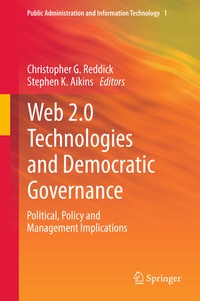
Web 2.0 Technologies and Democratic Governance
Description

Web 2.0 has become the buzz word for describing social media available on the Internet, such as blogs, photo and file sharing systems and social networking sites. These Web 2.0 applications are rapidly transforming citizen-citizen and citizen-government interactions in a manner not seen before. In recognition of these trends, governments are already taking a very close look at Web 2.0 and online communities in order to leverage them for designing products and services and for providing citizen services. This book brings together international scholars to provide the theoretical and practical contexts for understanding the nature of Web 2.0 technologies and their impact on political, public policy and management processes, and to explore how best Web 2.0 applications can be leveraged and aligned with the strategic goals of government organizations to add value and ensure effective governance. Drawing from experiences from countries around the globe, the book provides the theoretical context of the potential for Web 2.0 applications to transform government services, as well as practical examples of leading public sector institutions that have attempted to use Web 2.0 applications to enhance government operations, policy making and administration. There are three parts to the book, namely 1) Perspectives on Web 2.0 and Democratic Governance, 2) The Political, Policy and Management Impacts of Web 2.0 in Government, and 3) Leveraging Web 2.0 Applications for Effective Governance. This book differs from existing edited books on Web 2.0 technologies that focus primarily on politics and e-democracy because it examines the impact of the applications on politics, policy and public management. The book contributes toward the literature by filling the existing void and expanding knowledge in the field of public administration and policy, making it of interest to both academics and policy-makers.
More details
Other editions
Additional editions