

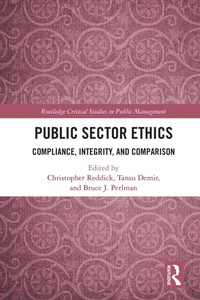
Public Sector Ethics
Compliance, Integrity, and Comparison
1st Edition
Published on 31. March 2025
256 pages
978-1-040-33725-7 (ISBN)
Description

Public Sector Ethics: Compliance, Integrity, and Comparison presents a comprehensive treatment of the subject of ethics in the public sector. What structural elements are necessary and how to create organizations that make ethics their priority are the questions that this edited book addresses. It focuses on ethics management in public organizations and includes national case studies from select low- to middle-income countries.
Taken together, the chapters in this book cover the mechanisms, activities, and approaches that public organizations employ in ethics management. These are of utmost importance because the actions of public organizations affect citizens' lives, liberties, and property, and their ethical character affects citizens' faith in government. Numerous factors are at play in each instance of ethics management in public organizations, and controlling ethical behavior is difficult. This book suggests that effective ethics management requires a comprehensive approach. Traditional approaches such as ethics codes, policies and legislation, training, incentives, sanctions, monitoring, and compliance reviews are tools to achieve ethical conformity. Yet, they are effective only if leadership, values, and cultural transformation support them. This edited volume is a cohesive treatment of the subject, covering traditional approaches to ethics management, such as monitoring and compliance, and more contemporary approaches, like integrity building through ethical leadership and organizational values, as well as how to skillfully and effectively combine them to change organizational ethical contexts.
This book exposes readers to new approaches and emerging issues in public sector ethics, aids in understanding the challenges of creating ethical organizations, and helps to develop a deeper understanding of ethics management in government organizations. It will be of interest to researchers, academics, and advanced students in the fields of business ethics, public administration and management, leadership, and organizational studies.
Taken together, the chapters in this book cover the mechanisms, activities, and approaches that public organizations employ in ethics management. These are of utmost importance because the actions of public organizations affect citizens' lives, liberties, and property, and their ethical character affects citizens' faith in government. Numerous factors are at play in each instance of ethics management in public organizations, and controlling ethical behavior is difficult. This book suggests that effective ethics management requires a comprehensive approach. Traditional approaches such as ethics codes, policies and legislation, training, incentives, sanctions, monitoring, and compliance reviews are tools to achieve ethical conformity. Yet, they are effective only if leadership, values, and cultural transformation support them. This edited volume is a cohesive treatment of the subject, covering traditional approaches to ethics management, such as monitoring and compliance, and more contemporary approaches, like integrity building through ethical leadership and organizational values, as well as how to skillfully and effectively combine them to change organizational ethical contexts.
This book exposes readers to new approaches and emerging issues in public sector ethics, aids in understanding the challenges of creating ethical organizations, and helps to develop a deeper understanding of ethics management in government organizations. It will be of interest to researchers, academics, and advanced students in the fields of business ethics, public administration and management, leadership, and organizational studies.
More details
Series
Edition
1. Auflage
Language
English
Place of publication
London
United Kingdom
Publishing group
Taylor & Francis Ltd
Target group
College/higher education
Illustrations
11 Tables, black and white; 5 Line drawings, black and white; 5 Illustrations, black and white
File size
34,49 MB
ISBN-13
978-1-040-33725-7 (9781040337257)
Copyright in bibliographic data and cover images is held by Nielsen Book Services Limited or by the publishers or by their respective licensors: all rights reserved.
Schweitzer Classification
Other editions
Additional editions
Christopher Reddick | Tansu Demir | Bruce J. Perlman
Public Sector Ethics
Compliance, Integrity, and Comparison
Book
approx. 07/2026
1st Edition
Routledge
€57.50
Not yet published

Christopher Reddick | Tansu Demir | Bruce J. Perlman
Public Sector Ethics
Compliance, Integrity, and Comparison
Book
05/2025
Routledge
Unfortunately, price unknown
Available (delivery time upon request)
Christopher Reddick | Tansu Demir | Bruce J. Perlman
Public Sector Ethics
Compliance, Integrity, and Comparison
Book
03/2025
1st Edition
Routledge
€206.50
Shipment within 10-20 days
Persons
Christopher Reddick is a professor in the Department of Public Administration at the University of Texas at San Antonio (UTSA), USA.
Tansu Demir is an associate professor in the Department of Public Administration at the University of Texas at San Antonio (UTSA), USA.
Bruce J. Perlman is Regents' Professor in the School of Public Administration at the University of New Mexico, USA.
Tansu Demir is an associate professor in the Department of Public Administration at the University of Texas at San Antonio (UTSA), USA.
Bruce J. Perlman is Regents' Professor in the School of Public Administration at the University of New Mexico, USA.
Content
List of Figures
List of Tables
List of Contributors
Introduction
Christopher Reddick, Tansu Demir, and Bruce Perlman
Chapter 1: What is Compliance? The Coercive Approach to Ethics Management
Danny Carr
Chapter 2: Ethics Codes, Codes of Conduct: Definitions, Applications, and Effectiveness
Diane L. Odeh and Jessica Homer
Chapter 3: Ethics Training and Employee Development
Brett Sharp
Chapter 4: Sanctions and Incentives
Nevbahar Ertas
Chapter 5: What is Integrity: A High-Road Approach to Ethics Management
Edgar Karssing and Alain Hoekstra
Chapter 6: Does Leadership Matter? Why and How?
Rusi Sun and Yahong Zhang
Chapter 7: The Power of Organizational Values: Communication, Conflict, and Alignment in Shaping Employee Behavior and Decision Making
Chevanese Samms Brown and Karen D. Sweeting
Chapter 8: Public Sector Ethics in the Americas: The Brazilian Public Ethics Management Case Study
Temistocles Murilo de Oliveira Junior and Joaquim Manuel Croca Caeiro
Chapter 9: Preconditions for Anti-Corruption Reform: The post-1989 Italian experience and lessons
Daniel L. Feldman and Jason Rivera
Chapter 10: Public Integrity Compliance in Thailand
Amporn Tamronglak, Patthara Limsira, and Tass Pongpisit
Chapter 11: Political Leadership and Public Sector Ethics in Africa: A Comparative Study of Ghana and Rwanda
George Babington Amegavi and Zechariah Langnel
Index
List of Tables
List of Contributors
Introduction
Christopher Reddick, Tansu Demir, and Bruce Perlman
Chapter 1: What is Compliance? The Coercive Approach to Ethics Management
Danny Carr
Chapter 2: Ethics Codes, Codes of Conduct: Definitions, Applications, and Effectiveness
Diane L. Odeh and Jessica Homer
Chapter 3: Ethics Training and Employee Development
Brett Sharp
Chapter 4: Sanctions and Incentives
Nevbahar Ertas
Chapter 5: What is Integrity: A High-Road Approach to Ethics Management
Edgar Karssing and Alain Hoekstra
Chapter 6: Does Leadership Matter? Why and How?
Rusi Sun and Yahong Zhang
Chapter 7: The Power of Organizational Values: Communication, Conflict, and Alignment in Shaping Employee Behavior and Decision Making
Chevanese Samms Brown and Karen D. Sweeting
Chapter 8: Public Sector Ethics in the Americas: The Brazilian Public Ethics Management Case Study
Temistocles Murilo de Oliveira Junior and Joaquim Manuel Croca Caeiro
Chapter 9: Preconditions for Anti-Corruption Reform: The post-1989 Italian experience and lessons
Daniel L. Feldman and Jason Rivera
Chapter 10: Public Integrity Compliance in Thailand
Amporn Tamronglak, Patthara Limsira, and Tass Pongpisit
Chapter 11: Political Leadership and Public Sector Ethics in Africa: A Comparative Study of Ghana and Rwanda
George Babington Amegavi and Zechariah Langnel
Index
