

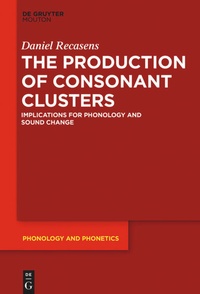
The Production of Consonant Clusters
Description

The book analyzes the articulatory motivation of several adaptation processes (place assimilations, blending, coarticulation) involving consecutive consonants in heterosyllabic consonant sequences within the framework of the degree of articulatory constraint model of coarticulation. It also shows that the homorganic relationship between two heterosyllabic consonants contributes to the implementation of manner assimilations, while heterorganicity as well as sonorancy and voicing in the syllable-onset C2 are key factors in the weakening of the syllable-coda C1. Experimental and descriptive evidence is provided with production, phonological and sound change data from several languages, and more especifically with tongue-to-palate contact and lingual configuration data for Catalan consonant sequences. The book also reviews critically research on the c-center effect in tautosyllabic consonant sequences which has been carried out during the last thirty years.
More details
Other editions
Additional editions
Person
Content
- Intro
- Table of contents
- 1. Introduction
- 2. Production constraints and articulatory adaptation mechanisms
- 3. Homorganic clusters
- 4. Heterorganic articulators
- 5. Manner assimilation and weakening
- 6. Recapitulation and discussion
- References
- Index of languages and dialects
