

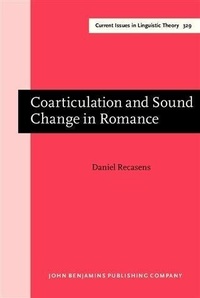
Coarticulation and Sound Change in Romance
How Mapmakers Frame the World and Chart Environmental Change
1st Edition
Published on 23. April 2014
XI, 207 pages
978-90-272-7038-2 (ISBN)
Description

This volume should be of great interest to phoneticians, phonologists, and both historical and cognitive linguists. Using data from the Romance languages for the most part, the book explores the phonetic motivation of several sound changes, e.g., glide insertions and elisions, vowel and consonant insertions, elisions, assimilations and dissimilations. Within the framework of the DAC (degree of articulatory constraint) model of coarticulation, it clearly demonstrates that the typology and direction of these sound changes may very largely be accounted for by the coarticulatory effects occurring between adjacent or neighbouring phonetic segments, and by the degrees of articulatory constraint imposed by speakers on the production of vowels and consonants. The phonetically-based explanations presented here are formulated on the basis of coarticulation data from speech production and perception research carried out during the last fifty years and are complemented with data on the co-occurrence of phonetic segments in lexical forms of the languages being considered. Attention is also paid to the role that positional and prosodic factors play in sound change implementation, as well as to the cognitive and peripheral strategies involved in segmental replacements, elisions and insertions.
More details
Other editions
Additional editions
Daniel Recasens
Coarticulation and Sound Change in Romance
Book
04/2014
John Benjamins Publishing Co
€111.30
Shipment within 10-15 days
Person
Content
- COARTICULATION AND SOUND CHANGE IN ROMANCE
- Editorial page
- Title page
- LCC data
- Table of contents
- Preface and acknowledgments
- List of abbreviations
- 1. Introduction
- 1.1 Theories of coarticulation and the degree of articulatory constraint model
- 1.2 Segmental articulation and coarticulation: General concepts
- 1.2.1 Articulatory constraints for vowels and consonants
- 1.2.2 Coarticulatory sensitivity, aggressiveness and directionality
- 1.3 Segmental insertion and elision
- 1.4 Assimilation and dissimilation
- 1.5 Organization of the monograph
- 1.6 Background information on the Romance languages
- 1.6.1 Languages and dialects
- 1.6.2 Evolution of Latin linguistic sounds into Romance
- 2. Consonant-dependent processes involving target vocalic segments
- 2.1 Articulatory and coarticulatory characteristics of consonants
- 2.1.1 Alveolars [?] and [r], and the bilabiovelar [w]
- 2.1.1.1 Typology and syllabic allophones
- 2.1.1.2 Production
- 2.1.1.3 Coarticulation
- 2.1.2 (Alveolo)palatals, palatalized consonants and velars
- 2.1.2.1 Production
- 2.1.2.2 Coarticulation
- 2.1.3 Dentals and clear alveolars
- 2.1.4 Labial and nasal consonants
- 2.2 Segmental insertion and elision
- 2.2.1 General considerations
- 2.2.1.1 Glide insertion and elision mechanisms
- 2.2.1.2 Glide insertion and segmental complexity
- 2.2.1.3 Vowel insertion and elision mechanisms
- 2.2.2 Glide insertion and elision processes
- 2.2.2.1 Alveolars [?] and [r], and the bilabiovelar [w]
- 2.2.2.2 (Alveolo)palatals and palatalized consonants
- 2.2.2.3 Dentals and alveolars
- 2.2.2.4 Velars
- 2.2.2.5 Labials
- 2.2.2.6 Nasalized vowels
- 2.2.3 Vowel insertion and elision processes
- 2.2.3.1 Word-initial position
- 2.2.3.2 Word-final position
- 2.2.3.3 Word-medial position
- 2.2.4 Summary
- 2.2.4.1 Glide insertion and elision
- 2.2.4.2 Vowel insertion and elision
- 2.2.4.3 Towards a reinterpretation of vowel diphthongization processes in Romance
- 2.3 Assimilation and dissimilation
- 2.3.1 Database of the analysis
- 2.3.2 Assimilation
- 2.3.2.1 Alveolar lateral [?] and trill [r]
- 2.3.2.2 (Alveolo)palatals
- 2.3.2.3 Dentals and alveolars
- 2.3.2.4 Velars
- 2.3.2.5 Labials
- 2.3.2.6 Nasality
- 2.3.3 Dissimilation
- 2.3.3.1 Back consonants and labials
- 2.3.3.2 (Alveolo)palatals
- 2.3.4 Summary
- 2.3.4.1 Assimilatory and dissimilatory direction
- 2.3.4.2 Word position
- 2.3.4.3 Interactive contextual effects
- 3. Vowel-dependent processes
- 3.1 Articulatory and acoustic properties of vowels
- 3.2 Consonant insertion and elision
- 3.2.1 Alveolar lateral [?]
- 3.2.2 (Alveolo)palatal consonants
- 3.2.2.1 Insertion
- 3.2.2.2 Elision
- 3.2.3 Velar consonants
- 3.2.3.1 Insertion
- 3.2.3.2 Elision
- 3.2.4 Labial consonants
- 3.2.4.1 Insertion
- 3.2.4.2 Elision
- 3.2.5 Nasal consonants
- 3.2.5.1 Contextual insertion
- 3.2.5.2 Spontaneous insertion
- 3.3 Assimilation and dissimilation (V-to-C)
- 3.3.1 Labialization
- 3.3.2 Velarization
- 3.3.3 Dentalization and alveolarization
- 3.3.4 Palatalization
- 3.3.4.1 Labials
- 3.3.4.2 Dentals and alveolar
- 3.3.4.3 Velars
- 3.3.5 Manner of articulation
- 3.4 Assimilation and dissimilation (V-to-V)
- 3.4.1 Assimilation
- 3.4.1.1 Mid vowel raising
- 3.4.1.2 Low vowel raising
- 3.4.1.3 Front vowel lowering
- 3.4.1.4 Vowel backing and rounding
- 3.4.1.5 Back rounded vowel fronting and unrounding
- 3.4.2 Dissimilation
- 3.4.2.1 Vowel raising
- 3.4.2.2 Vowel lowering
- 3.4.2.3 Back rounded vowel fronting and unrounding
- 3.5 Summary
- 3.5.1 Consonant insertion and elision
- 3.5.2 Consonant replacement
- 3.5.3 Vowel assimilation and dissimilation
- 4. Consonant-dependent processes involving target consonants
- 4.1 Consonant insertion and elision
- 4.1.1 Insertion
- 4.1.1.1 Word-final consonants
- 4.1.1.2 CV and VC sequences
- 4.1.1.3 Consonant clusters
- 4.1.2 Elision
- 4.1.2.1 Syllable-initial consonant clusters
- 4.1.2.2 Heterosyllabic two-consonant clusters
- 4.1.2.3 Word-final clusters
- 4.1.2.4 Three-consonant clusters
- 4.2 C-to-C adaptation processes
- 4.2.1 Place of articulation
- 4.2.1.1 Independent articulators
- 4.2.1.2 Adjacent articulators
- 4.2.2 Manner of articulation
- 4.2.2.1 Voicing
- 4.2.2.2 Nasality
- 4.2.2.3 Laterality and rhoticity
- 4.2.2.4 Lenition
- 4.2.2.5 Generalized assimilation
- 4.3 Summary
- 4.3.1 Insertions and elisions
- 4.3.1.1 Gestural and acoustic similarity
- 4.3.1.2 Gestural incompatibility
- 4.3.2 Adaptation processes
- 5. General discussion
- 5.1 Sound change mechanisms
- 5.2 Regressive and progressive direction of sound changes
- 5.3 Stress and word position
- 5.4 Interactive role of vowels and consonants
- 5.5 Predicting sound change patterns in other language families
- 6. Conclusions and outlook
- References
- Index of subjects and terms
