

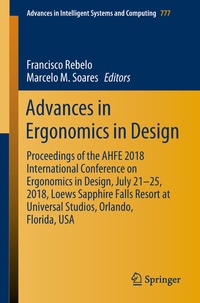
Advances in Ergonomics in Design
Description

This book provides readers with a timely snapshot of ergonomics research and methods applied to the design, development and prototyping - as well as the evaluation, training and manufacturing - of products, systems and services. Combining theoretical contributions, case studies, and reports on technical interventions, it covers a wide range of topics in ergonomic design including: ecological design; educational and game design; cultural and ethical aspects in design; user research and human-computer interaction in design; as well as design for accessibility and extreme environments, and many others. The book particularly focuses on new technologies such as virtual reality, state-of-the-art methodologies in information design, and human-computer interfaces. Based on the AHFE 2018 International Conference on Ergonomics in Design, held on July 21-25, 2018, in Orlando, Florida, USA, the book offers a timely guide for both researchers and design practitioners, including industrial designers, human-computer interaction and user experience researchers, production engineers and applied psychologists.
More details
Other editions
Additional editions
Content
- Intro
- Advances in Human Factors and Ergonomics 2018
- Preface
- Contents
- Design Applications and User Research
- The Attentional Perspective on Smart Devices: Empirical Evidence for Device-Specific Cognitive Ergonomics
- Abstract
- 1 Introduction
- 2 Methods
- 2.1 Participants
- 2.2 Apparatus and Stimuli
- 2.3 Procedure
- 2.4 Design
- 3 Results
- 3.1 RT Data Analysis
- 3.2 ER Data Analysis
- 3.3 Analysis of Subjective Task Load Indices
- 4 Discussion
- 5 Conclusion and Application
- Acknowledgments
- References
- Head Sensitivity for Designing Bicycle Helmets with Improved Physical Comfort
- Abstract
- 1 Introduction
- 2 Methods
- 3 Results and Discussion
- 4 Conclusions
- References
- Effect of Body Mass Index on Sitting Pressure Distribution on Seat Cushion
- Abstract
- 1 Introduction
- 2 Methodology
- 2.1 Materials
- 2.2 Participants
- 2.3 Equipment
- 2.4 Experimental Procedure
- 3 Results and Discussion
- 3.1 Pressure Magnitude
- 3.2 Pressure Area
- 3.2.1 Effective Contact Area
- 3.2.2 High-Pressure Area
- 3.2.3 IT Pressure Area
- 3.3 Pressure Uniformity
- 4 Conclusion
- Acknowledgments
- References
- Spark: Promoting Well-Being by Social Media-Triggered Routine Breaks
- Abstract
- 1 Introduction
- 2 Mobile Media and Mental Well-Being
- 3 Concept Probe
- 4 Interviews
- 5 Research Insights
- 6 Final Product
- 7 Conclusions
- Acknowledgements
- References
- Efficiency of Cycling Pads in Reducing Seat Pressure During Cycling
- Abstract
- 1 Introduction
- 2 Methods
- 3 Results
- 4 Discussion
- 5 Conclusions
- References
- Effects of Luminous Intensity and Color of LED Light on Ocular Movement Characteristics
- Abstract
- 1 Introduction
- 2 Method
- 2.1 Participants
- 2.2 Apparatus
- 2.3 Experiment Design
- 2.4 Procedure
- 2.5 Dependent Variables
- 3 Results
- 3.1 Blink Duration
- 3.2 Blink Frequency
- 3.3 PERCLOS70
- 4 Discussion
- 5 Conclusion
- References
- An Evaluation Method of Temporal Change on Mental Model
- Abstract
- 1 Introduction
- 2 A Basic Consideration
- 3 A New Evaluation Method of Mental Model
- 4 Examination
- 5 Examining Structural Model and Functional Model of Mental Model Using Pre-evaluation and Ex-Post E ...
- 6 Conclusion
- Acknowledgments
- Reference
- Effectiveness of Balance Seat on Vibration Comfort
- Abstract
- 1 Introduction
- 2 Methodology
- 2.1 Seat Cushion Materials
- 2.2 Vibration Measurement Tools
- 2.3 Experiment Participants
- 2.4 Experimental Procedure
- 2.5 Analysis Methods
- 3 Results and Discussion
- 3.1 Vibration Result by Weight
- 3.2 SEAT Index Results by Weight
- 4 Conclusion
- Acknowledgments
- References
- Analysis and Designs on Human-Oriented Sanitation Workers Overall
- Abstract
- 1 Introduction
- 2 Research Overview
- 3 Data Extraction and Analysis
- 3.1 Style Structure Analysis
- 3.2 The Fabric Analysis
- 3.3 Colour Analysis
- 3.4 Accessories Analysis
- 4 The Solution
- 4.1 Improvement of Style Structure
- 4.2 Fabric Selection
- 4.3 Colour Selection
- 4.4 Accessories Optimization
- 5 Conclusion
- References
- Study on Human - Machine Interface Design of Construction Machinery
- Abstract
- 1 Introduction
- 2 Human-Machine Interface of Construction Machinery
- 3 Analysis of Human-Machine Interface Design of Construction Machinery
- 3.1 Cognitive Psychology Model
- 3.2 Design of Human-Machine Interface Interaction Element
- 4 Conclusions
- Acknowledgments
- References
- Virtual Reality and Digital Environments in Design
- Evaluation of 3D Crosswalks Design
- Abstract
- 1 Introduction
- 2 Methodology
- 2.1 Experimental Conditions and Stimuli
- 2.2 Participants
- 2.3 Tools
- 2.4 Procedures
- 3 Results
- 4 Discussion and Conclusions
- References
- Affordances on Route Selection in an Emergency Situation: A Study with Children
- Abstract
- 1 Introduction
- 2 Methodology
- 2.1 Experimental Conditions
- 2.2 Participants
- 2.3 Tools
- 2.4 Procedures
- 3 Results
- 4 Conclusions
- References
- Alternative Realities in Interstellar Storytelling: Viewer Cognitive Reading and Screen Depiction
- Abstract
- 1 Introduction
- 2 Interstellar as Study Case
- 2.1 Interstellar: Scientific and Knowledge Foundation
- 2.2 Interstellar: Metaphysical Foundation
- 2.3 Interstellar: Mind/Dream Foundation
- 3 Conclusions
- References
- Digital Ergonomics: Understanding the Bridges to the Digital World
- Abstract
- 1 Introduction
- 2 The Video Game as an Interface
- 2.1 The Hyper-modern Body
- 2.2 The Body as Interface
- 2.3 User Centered Design - Playability
- 2.4 Customization
- 2.5 Character Design
- 2.6 Fashion Design
- 3 Conclusions
- Acknowledgments
- References
- A Framework to Use Virtual Reality for Behavior Change to Promote Safety and Health at Work
- Abstract
- 1 Introduction
- 2 Related Work
- 2.1 Virtual Reality for Behavior Change
- 2.2 Individual Characteristics
- 3 Virtual Reality for Behavior Change
- 3.1 Some Definitions
- 3.2 Hardware Devices and Software Systems Requirements
- 4 VR Framework Model for Behavior Change
- 4.1 Understand the Work Situation
- 4.2 Create the Concepts for the Virtual Reality Setup
- 4.3 Design the VR Setup in an UCD Perspective
- 4.4 Field Implement the VR Setup
- 4.5 Evaluation of the VR Setup
- 5 Conclusions
- Acknowledgements
- References
- Emotions Appraisal with Face Reading in a Touristic Virtual Environment Prototype
- Abstract
- 1 Introduction
- 1.1 Goals
- 2 Methodology
- 2.1 Participants
- 2.2 Game Apparatus
- 2.3 Measures
- 2.4 Procedures
- 2.5 Results and Discussion
- 3 Conclusion
- Acknowledgments
- References
- Design and Applied Anthropometry
- Development of a Design Protocol for Customized Swimming Goggles Using 2D Facial Image Data
- Abstract
- 1 Introduction
- 2 Methods
- 3 Discussion
- Acknowledgments
- References
- Garment Sizing in Portuguese Children's Fashion Brands
- Abstract
- 1 Introduction
- 2 Garment Sizing
- 2.1 Anthropometry for Garment Construction
- 3 Methodology
- 4 Results
- 5 Conclusions
- Acknowledgments
- References
- Design and Development of the Plus Size Bra
- Abstract
- 1 Introduction
- 2 Analysis of the Portuguese Market
- 2.1 Analysis of the Range of Sizes in the Portuguese Market
- 3 Analysis of the International Market
- 3.1 Analysis of the Range of Sizes in the International Market
- 4 Conclusion
- Acknowledgments
- References
- Design Requirements of Mastectomy Bra for Formal Dress
- Abstract
- 1 Introduction
- 2 Research Process
- 3 Data Analysis
- 3.1 Based on the Theoretical Needs of X
- 3.2 Based on the Theoretical Needs of Y
- 3.3 Fabric Requirements
- 3.4 Color Requirements
- 3.5 Cup Style
- 3.6 Page Numbering and Running Heads
- 4 Conclusion
- References
- Foot Anthropometric Data for Young Chinese Population
- Abstract
- 1 Introduction
- 2 Data Collection
- 3 Summary Statistics
- 4 Anova
- 4.1 Assumptions Verification
- 4.2 Analysis
- 5 Conclusion
- Acknowledgments
- References
- Anthropometric Evaluation and Operation Room Design Analysis for Laparoscopic Surgeries in Cuenca, Ecuador
- Abstract
- 1 Introduction
- 2 Operation Room Design and Anthropometrics in Laparoscopic Surgeries: A Brief Overview
- 3 A Study of the Surgeons' Anthropometric Characteristics and Its Relationship with the Design of the Operating Room in Cuenca
- 3.1 Analysis of Operating Room Design
- 3.2 Anthropometric Evaluation and Its Measurement Variables
- 4 Experimental Results
- 4.1 Operating Room Design
- 4.2 Anthropometric Assessment
- 4.3 Anthropometric Measures
- 5 Discussion
- Acknowledgments
- References
- Application of Digital Infrared Thermography for Emotional Evaluation: A Study of the Gestural Interface Applied to 3D Modeling Software
- Abstract
- 1 Introduction
- 2 Digital Infrared Thermography
- 3 Emotional Measurement with Thermography
- 4 Gestural Interface Evaluated
- 5 Field Study - Stress Level Assessment
- 5.1 Reported Experience
- 5.2 Felt Experience
- 6 Analysis of the Results Obtained in the Study
- 7 Conclusions
- References
- Bra Fitting - A Brazilian Mastectomized Women Experience
- Abstract
- 1 Introduction
- 2 A Bra that Fits
- 3 Brazilian Bra Fitting
- 4 Cups of Bras for Mastectomized Women
- 5 The Wings of Bras for Mastectomized Women
- 6 The Myth of Elastics
- 7 Asymmetry of the Band
- 8 Discussion - The Gym Top is the New Bra
- 9 Conclusions
- Acknowledgments
- References
- Head and Face Investigation of Chinese Adults and Analysis of Influencing Factors
- Abstract
- 1 Introduction
- 2 Research Background
- 3 Sampling of Subject Group
- 3.1 Overall Sampling Principles
- 3.2 Age Distribution
- 3.3 Geographical Distribution
- 3.4 Occupational Distribution
- 4 Measurement Methods
- 4.1 Definitions of Measurement Items
- 4.2 Measurement Equipment
- 4.3 Manual Measurement Steps
- 5 Data Analysis
- 5.1 Difference Between Male and Female
- 5.2 Difference of Data Between 1988 and 2017
- 5.3 Difference Between Age Groups
- 5.4 Difference Between Age Groups
- 5.5 Difference Between Different Occupations
- 6 Conclusions
- Acknowledgments
- References
- A Study on Young Men's Upper Body Characteristic Indexes in China Considering Human Ergonomics
- Abstract
- 1 Introduction
- 2 Method
- 2.1 Design
- 2.2 Cluster Analysis
- 2.3 Multiple Linear Regression
- 2.4 Best Subsets Regression
- 3 Discussion and Conclusion
- Acknowledgments
- References
- The Effects of Weight on Comfort of Virtual Reality Devices
- Abstract
- 1 Introduction
- 2 Materials and Methods
- 2.1 Apparatus
- 2.2 Experimental Environment
- 2.3 Subjective Comfort Evaluation
- 2.4 Pre-experiments
- 2.5 Subjects of Main Experiment
- 2.6 Page Numbering and Running Heads
- 3 Results
- 3.1 Overall Subjective Discomfort Evaluation
- 3.2 Pressure Load Datum
- 3.3 Relationship Analysis
- 4 Discussion
- 4.1 Weight
- 4.2 Wearing Ways
- 4.3 Pressure Load
- 4.4 Recommendation
- 5 Conclusions
- Acknowledgments
- References
- Development and Methodology Issues in Design
- The Musculoskeletal Contribution in Wheelchair Propulsion Systems: Numerical Analysis
- Abstract
- 1 Introduction
- 2 Method
- 2.1 Mechanical and Kinematic Study
- 2.2 Biomechanical Musculoskeletal Study
- 3 Results and Discussion
- 4 Conclusion
- Acknowledgments
- References
- Design, a Ready-Made Object or an Object Ready to Be Made
- Abstract
- 1 Introduction
- 2 Form
- 3 Function
- 4 Context
- Acknowledgments
- References
- Maglev Technology Review for Improving Urban Mobility
- Abstract
- 1 Introduction
- 2 Literature Review
- 2.1 The Maglev Train Systems
- 3 Results and Discussion
- Acknowledgments
- References
- China Design Development Based on Trend-Driven Innovation Strategy Under the Belt and Road Initiative
- Abstract
- 1 Introduction
- 2 Trend-Driven Innovation Strategy
- 3 Research on China Design Development Under the Belt and Road Initiative Context
- 3.1 Research Scope and Description
- 3.2 The Asian Consumer Trend Canvas
- 4 Conclusion and Prospects
- Acknowledgments
- References
- Accessible Packaging: A Study for Inclusive Models for Visual Impairment People
- Abstract
- 1 Introduction - Research Context
- 2 Theoretical Framework
- 2.1 The Person with Visual Impairment
- 2.2 Standards and Criteria for Packaging
- 2.3 Usability: Efficiency, Efficiency and Satisfaction
- 3 Research Methods and Procedure
- 3.1 Research Protocol and Data Collection Procedures
- 4 Results
- 5 Final Conclusions
- Acknowledgments
- References
- Terrestrial Autonomous Vehicles: Exploratory Study and Perspectives of the Interaction of Blind Peop ...
- Abstract
- 1 Introduction
- 2 Research Method
- 3 Intelligent Autonomous Vehicles and Assistive Technology
- 4 Results of the Interview with Blinded People and Expert
- 4.1 Interviews with Blinded Possible Users
- 4.2 Interview with Expert
- 5 Final Considerations
- Acknowledgments
- References
- Establishment of Indexes System for Bookcases Ergonomic Evaluation Based on Delphi Method
- Abstract
- 1 Introduction
- 2 Methods
- 2.1 The Usability Testing
- 2.2 The Filtration of Indexes
- 3 Conclusion
- Acknowledgments
- References
- The Effects of Center of Mass on Comfort of Soft Belts Virtual Reality Devices
- Abstract
- 1 Introduction
- 2 Methods and Experiments
- 2.1 Apparatus
- 2.2 Subjective Comfort Evaluation
- 2.3 Pre-experiment
- 2.4 Main Experiment
- 2.4.1 Subjects of Main Experiment
- 2.4.2 Position of Latten Loading
- 2.4.3 Procedure of Main Experiment
- 3 Results
- 3.1 Subjective Discomfort Rating
- 3.2 Physical Load Data
- 3.3 Relationship Analysis
- 4 Discussion
- 4.1 Center of Mass
- 4.2 Physical Load
- 4.3 Wearing Ways
- 4.4 Limitations of the Approach
- 4.5 Recommendation
- 5 Conclusion
- Acknowledgments
- References
- DESIGNLAB4U: A Laboratory of Knowledge, Experimentation and Practical Action
- Abstract
- 1 Introduction
- 2 Problem
- 3 Objectives
- 4 Methodology
- 5 Methodology
- 6 Conclusions
- References
- Attention of Viewers While Viewing Paintings Depends on Different Types of Exhibition Light: A Quantitative Approach with Eye-Tracking Method
- Abstract
- 1 Introduction
- 2 Methodology
- 2.1 Experimental Design
- 2.2 Procedure
- 3 Results
- 3.1 Effect of Two Types of Light on Viewers' Attention While Viewing Watercolor Paintings
- 3.2 Effect of Two Types of Light on Viewers' Attention While Viewing Oil Paintings
- 4 Discussion
- References
- Proposal and Evaluation of "Cariño Index" -A New Coordination Index Based on Weather Conditions
- Abstract
- 1 Introduction
- 2 Design of the Cariño Index
- 3 Observation Experiment
- 3.1 Observation Method
- 3.2 Experimental Results
- 4 Cariño Equation
- 5 Evaluation Experiment
- 5.1 Methods
- 5.2 Experimental Results
- 5.3 Discussion
- 6 Conclusion
- References
- Ergonomic Hazards Associated with Freshwater Aquaculture and Possible Mitigation Measures
- Abstract
- 1 Introduction
- 2 Materials and Methods
- 3 Results and Discussions
- Acknowledgments
- References
- Analysis Using Linkograph to Identify Product Features for Innovation: A Human Centered Usability Engineering Approach
- Abstract
- 1 Introduction
- 1.1 Design and Its Role in Product Innovation
- 1.2 UCD and Usability as an Innovation Metrics
- 2 Design Experiment to Measure Relative Innovation Index of Same Family of Products Through a Case Study
- 2.1 Multipurpose Openers-3 Types of Different Openers as Opener A, Opener B, Opener C
- 2.2 Fish Bone Diagram of Opener
- 2.3 Usability Audit of Multipurpose Opener
- 3 Linkograph an Overview
- 3.1 Linkograph Generation for the Design Experiment
- 3.2 Results and Discussion
- 4 Conclusion
- References
- Eye Tracking Based Objective Evaluation of Visual Aesthetics: A Review
- Abstract
- 1 Introduction
- 1.1 Objective Evaluation of Aesthetics
- 2 Psychomorphology of Aesthetic Experience
- 2.1 Structural Model
- 2.2 Functional Model
- 3 Eye Tracking and Visual Exploration
- 3.1 Cognitive Process During Aesthetic Perception
- 3.2 Eye Movements and Its Relation with Eye Tracking Variables
- 4 Discussion
- 4.1 Complexity
- 4.2 Contrast
- 4.3 Composition
- 5 Conclusion
- References
- Research on the Optimal Control-Display Ratio of Smart Phone Touch Screen
- Abstract
- 1 Introduction
- 2 Methods
- 2.1 Experimental Design
- 2.2 Subjects
- 2.3 Apparatus
- 2.4 Procedure
- 3 Data Analysis
- 4 Results
- 5 Conclusion
- Acknowledgments
- References
- Redesign and Improvement of the System of Signaling and Visual Communication for the Rectory of the Federal Institute of Maranhão that Meets the Needs of Visually Impaired People
- Abstract
- 1 Introduction
- 2 What Is Disability?
- 2.1 Visual Deficiency
- 3 Ergonomics and Accessibility
- 4 The Universal Design
- 4.1 Signalling Design Elements
- 5 Signaling Design Methodology
- 5.1 Current Situation Diagnosis: Analysis of Routes
- 6 Similar Analysis
- 7 Redesign
- 8 Final Considerations
- References
- User Experience and Learning Environments
- User Experience Analysis Based on Physiological Data Monitoring and Mixed Prototyping to Support Human-Centre Product Design
- Abstract
- 1 Introduction
- 2 Related Works
- 3 The Experimental Approach
- 4 The Industrial Case Study
- 5 Conclusions
- Acknowledgments
- References
- Design Methodologies for Continuous Improvement
- Abstract
- 1 Implement a Glossary-Based Audit System
- 2 Leverage Knowledge Management (KM) to Improve Quality Management
- 3 Utilize Technology-Assisted Collaboration
- 4 Conclusion
- References
- Design for (Inter)Actions: A Teaching Experience in Graphic Design
- Abstract
- 1 Introduction
- 2 Understanding Interaction in Print Design
- 3 Practice-Based
- 4 Graphic Design Projects Developed by Students
- 4.1 About the Method
- 4.2 Project
- 4.3 Communication Design II
- 4.4 Project Monitoring
- 4.5 Observation
- 4.6 Samples Description
- 5 Conclusions
- Acknowledgments
- References
- Interaction and Digital Infographics in Portuguese Media: When News Are Made of Things We Cannot See
- Abstract
- 1 Introduction
- 2 Interactive Information and Graphic News
- 3 An Infinite Book: Practice-Based Research
- 4 Usability Tests
- 5 Conclusion
- References
- User Experience Design and Architecture of IoT Ecosystem Employed in Students' Activities Tracking
- Abstract
- 1 Introduction
- 2 Related Work
- 3 User-Centered Design Approach
- 3.1 Identification of Factors for Academic Success
- 3.2 User Experience Research
- 3.3 System Requirements
- 4 The IoT Ecosystem Architecture Proposal
- 5 The IoT Ecosystem Mobile Application Design
- 6 Conclusion
- Acknowledgments
- References
- The Italic Style: Getting It Straight
- Abstract
- 1 Introduction
- 2 Research Motivation
- 3 Historical Writing Systems and Styles
- 4 The Italic Style, Getting It Straight
- 5 Conclusion
- Acknowledgments
- References
- Project Decisions in Magazine Design
- Abstract
- 1 The Magazine - Historical Evolution and Essential Concepts
- 2 Magazines Nowadays - Active Investigation of Reference Cases
- 3 Project Decisions in Magazine Design
- 3.1 Definition of the Concept and Identity
- 3.2 Structure and Content Organization
- 3.3 Evaluation and Iteration
- 4 Final Remarks
- Acknowledgments
- References
- Communication Design Against Child Sexual Violence
- Abstract
- 1 Introduction
- 2 Child Sexual Abuse and the Work of the CARE/APAV Organization in Lisbon
- 2.1 Underlying Principles and Contextualization
- 2.2 Definition of Child Sexual Violence
- 3 The CARE Organization's Work in Therapy
- 3.1 CARE's Therapeutic Support Materials and Experience as a Base for the Project
- 3.2 Conceptual Basis of Design Work in Progress/Active Research
- 4 A Communication Design Response to Support Therapy Sessions
- 4.1 Socially-Oriented Graphic Design Responds to a Specific Program
- 4.2 Three Card-Based Games and a Diary for Child Therapy
- 5 Conclusion
- References
- The Contribution of Information Design to Age-Friendly Cities: A Case Study on Coimbra and Public Transport
- Abstract
- 1 Introduction
- 1.1 Cities as Public Space
- 1.2 Aging and Age-Friendly Cities
- 1.3 Information Design, Wayfinding Systems, and Inclusive Design
- 2 Method
- 2.1 Categorization of Coimbra
- 2.2 Case Study
- 3 Results and Discussion
- 4 Conclusions
- References
- The Influence of Infographics in Accessing Information: Multidimensionality in Visual Representation and Configuration of Different Media
- Abstract
- 1 Introduction
- 2 Information Design
- 2.1 Creating Information Graphics
- 3 Different Types of Information Design
- 3.1 Print-Based Information Design
- 3.2 Interactive Information Design
- 3.3 Environmental Information Design
- 3.4 Other Possible Categorizations
- 3.5 What Makes a Good Graphic?
- 4 The Difference Between Print and Digital
- 5 Methodology
- 6 Findings and Conclusions
- References
- Comprehensive Evaluation Method of Interface Elements Layout Aesthetics Based on Improved AHP
- Abstract
- 1 Introduction
- 2 Comprehensive Evaluation of Interface Layout Aesthetics Based on AHP and Grey Theory
- 2.1 The Theory of Comprehensive Evaluation
- 2.2 The Comprehensive Evaluation Process
- 3 Interface Elements Layout Aesthetics Analysis and the Aesthetic Evaluation System
- 3.1 Analysis of the Aesthetic Properties
- 3.2 Aesthetics Analysis Based on AHP
- 4 Evaluation Model
- 4.1 Judging Matrix
- 4.2 Test of Satisfaction Consistency
- 5 Comprehensive Evaluation Method
- 5.1 Evaluation Criteria
- 5.2 Optimal Indexes
- 5.3 Evaluation Matrix
- 5.4 Weight Coefficient of Evaluation Indexes
- 6 Evaluation System and Application
- 7 Conclusion
- References
- An Ergonomic Analysis on the Viewing Distance and Angles of the UP Film Institute Videotheque
- Abstract
- 1 Introduction
- 1.1 Background of the Study
- 1.2 Rationale of the Study
- 1.3 Problem
- 1.4 Objectives
- 1.5 Scope and Limitations
- 2 Review of Related Literature
- 2.1 Standards and Guidelines
- 2.2 Procedures
- 3 Methodology
- 3.1 Determine the Line of Sight
- 3.2 Measure the Following Relative to the Determined Line of Sight
- 3.3 Assess the Current Layout Using Standards
- 3.4 Recommend Improvements on the Layout
- 4 Results and Discussion
- 4.1 Horizontal Viewing Angles
- 4.2 Vertical Viewing Angles
- 4.3 Viewing Distance
- 5 Conclusion
- 6 Recommendations
- 6.1 Avoid Occupying the Unsatisfactory Seats
- 6.2 Seat Heights
- 6.3 Increase Room Dimensions
- References
- The Classroom Built Environment as an Inclusive Learning Process for the Deaf Students: Contribution of Ergonomics in Design
- Abstract
- 1 Introduction
- 2 Cognitive Development of the Deaf
- 3 The Deaf and His Perception of the Classroom Built Environment
- 4 The Ergonomics Aspects to be Considered in an Inclusive Classroom Design
- 4.1 Accessibility
- 4.2 Layout
- 5 Conclusion
- References
- Comparison of Posture, Comfort and Satisfaction Between a Dynamic Seat and a Seat with Ergonomic Criteria
- Abstract
- 1 Introduction
- 2 Materials and Methods
- 2.1 Participants
- 2.2 Design
- 2.3 Instruments
- 3 Results
- 3.1 Postural Analysis
- 3.2 General Comfort
- 4 Discussion
- 4.1 Postural Analysis
- 4.2 General Comfort
- References
- The Teaching Curriculum in Product Design
- Abstract
- 1 Introduction
- 2 Design Education - Portuguese Case
- 3 The Teaching of Materials in Design - An Approach to Digital Platform
- 4 Final Considerations
- Acknowledgments
- References
- The Hard Life: A Pedagogical Experience in Industrial Design
- Abstract
- 1 Introduction
- 2 Design Approaches
- 2.1 Evolutive
- 2.2 Functional
- 2.3 Form
- 2.4 Processual
- 3 Conclusion
- Acknowledgments
- References
- Different Wheelchairs Designs Influence Emotional Reactions from Users and Non-users?
- Abstract
- 1 Introduction
- 2 Methods
- 2.1 Sample
- 2.2 Survey Instrument
- 2.3 Experimental Settings
- 2.4 Procedure
- 2.5 Data Analysis
- 3 Results
- 4 Discussion and Conclusion
- Acknowledgement
- References
- Design Specifications for a New Equipment to Be Used by Workers in Aircraft Industry Maintenance
- Abstract
- 1 Introduction
- 1.1 Problem Under Study
- 1.2 Goals
- 2 Methods
- 2.1 First Objective
- 2.1.1 Participants and Main Company Sector Information
- 2.1.2 Instruments
- 2.1.3 Procedures
- 2.2 Second Objective
- 2.2.1 Participants
- 2.2.2 Instruments
- 3 Results
- 3.1 First Objective
- 3.2 Second Objective
- 4 Conclusions
- References
- A Review on Thermal Comfort Evaluation of Head-Worn Devices
- Abstract
- 1 Introduction
- 2 Methods
- 3 Results and Discussion
- 3.1 Characteristics of the Reviewed Articles
- 4 Method for Thermal Comfort Evaluation
- 5 Factors that Impact on Thermal Comfort or Performance
- 6 Conclusion
- Acknowledgments
- References
- Human Interaction, Emotion and Sustainability: Designing Wooden Children's Furniture
- Abstract
- 1 Introduction
- 2 Case Study - Wooden High Chairs
- 3 Wood
- 3.1 Human Interaction with Wood
- 3.2 Wood and Sustainability
- 4 Conclusions
- Acknowledgements
- References
- Graphical Environment for Application Interfaces Accessible by Seniors
- Abstract
- 1 Introduction
- 1.1 Use of Mobile Devices for the Third Age
- 1.2 Usability
- 1.3 Communicability
- 1.4 Characteristics of Older Persons in Relation to the Aspects of Application Interface
- 2 Objective
- 3 Methodology
- 4 Results
- 5 Discussion
- 6 Conclusion
- References
- Correction to: Human Interaction, Emotion and Sustainability: Designing Wooden Children's Furniture
- Correction to: Chapter "Human Interaction, Emotion and Sustainability: Designing Wooden Children's Furniture" in: F. Rebelo and M. M. Soares (Eds.): Advances in Ergonomics in Design, AISC 777, https://doi.org/10.1007/978-3-319-94706-8_63
- Author Index
