


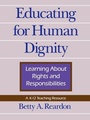
Educating for Human Dignity
Learning About Rights and Responsibilities
1st Edition
Published on 3. August 2010
256 pages
978-0-8122-0018-8 (ISBN)
Description

Issues of universal human rights are critically important topics in education today. Educators, scholars, and activists urge schools to promote awareness and understanding of human rights in their curricula from the earliest levels.
Written by by Betty A. Reardon, one of the foremost scholars on human rights education for the primary and secondary levels, Educating for Human Dignity is designed for both teachers and teacher educators. It is the first resource offering both guidance and support materials for human rights education programs from kindergarten through high school. It opens possibilities for an holistic approach to human rights education that directly confronts the values issues raised by human rights problems in a context of global interrelationships.
Written by by Betty A. Reardon, one of the foremost scholars on human rights education for the primary and secondary levels, Educating for Human Dignity is designed for both teachers and teacher educators. It is the first resource offering both guidance and support materials for human rights education programs from kindergarten through high school. It opens possibilities for an holistic approach to human rights education that directly confronts the values issues raised by human rights problems in a context of global interrelationships.
Reviews / Votes
"This book is an essential tool for implementation of the goals set by the United Nations and the People's Decade for Human Rights Education."-Human Rights Education NewsletterMore details
Series
Language
English
Place of publication
Pennsylvania
United States
Target group
College/higher education
Illustrations
3 illus.
3 illus.
ISBN-13
978-0-8122-0018-8 (9780812200188)
Copyright in bibliographic data and cover images is held by Nielsen Book Services Limited or by the publishers or by their respective licensors: all rights reserved.
Schweitzer Classification
Other editions
Additional editions
Book
09/1995
University of Pennsylvania Press
€33.00
Shipment within 10-20 days
Content
- Cover
- Contents
- Preface and Acknowledgments
- 1. Introduction: Purposes and Approaches
- The Purposes of This Book
- Education for Civic Responsibility and Political Efficacy
- Human Rights and Peace Education
- An Holistic Values Approach
- An Historical Approach
- An International Standards and Institutions Approach
- A Reconstructionist Approach
- Selected References
- 2. A Developmental Sequence for Presentation of the Core Concepts
- Childhood and the Early Grades
- Later Childhood and the Middle Grades
- Early Adolescence and Junior High School
- Youth, Young Adulthood, and High School
- 3. The Early Grades: Laying the Foundation for an Appreciation of Human Dignity-Kindergarten to Grade Three
- Sample 1. Kindergarten: What Is a Human Being?-Reverence for Life
- Sample 2. Kindergarten: Human Beings Are Alike and Different
- Sample 3. First Grade: Rules Are for Protection and Fairness
- Sample 4. First Grade: Respecting the Rules-Making a Compact
- Sample 5. Second Grade: Wishing a World Fit for Children-Understanding Human Needs
- Sample 6. Second Grade: Taking Responsibility to Stop Hurt and Harm
- Sample 7. Third Grade: Learning to Value Global Diversity
- Sample 8. Third Grade: Expectations and Obligations-Responsibilities Go with Rights
- 4. The Middle Grades: Introducing Standards and Principles-Grades Four to Six
- Sample 9. Fourth Grade: The Convention on the Rights of the Child-The Metaphor of the Tree of Life
- Sample 10. Fourth Grade: Confronting Prejudice
- Sample 11. Fifth Grade: The United Nations-Establishing Rights
- Sample 12. Fifth Grade: Making a Difference-Your Right to Action
- Sample 13. Sixth Grade: Children and Hunger-A Violation of Equity Rights
- Sample 14. Sixth Grade: Apartheid Is a Crime-The African Freedom Charter
- 5. Junior High School: Reflecting and Valuing-Grades Seven to Nine
- Sample 15. Seventh Grade: Why Study Human Rights-Presenting a Rationale
- Sample 16. Seventh Grade: The Relationship Between Rights and Responsibilities-The Universal Declaration of Human Rights
- Sample 17. Eighth Grade: Refugees and Racism-The Problem of Discrimination
- Sample 18. Eighth Grade: Learning About Human Rights Through Creative Dramatics
- Sample 19. Ninth Grade: An Appreciation of Civil and Political Rights
- Sample 20. Ninth Grade: Recognizing Responsibility-Protecting Human Rights
- 6. Senior High School: Confronting the Problems, Taking Responsibility-Grades Ten to Twelve
- Sample 21. Tenth Grade: Is There a Human Right to Food?
- Sample 22. Tenth Grade: Actions for the Fulfillment of Human Rights
- Sample 23. Eleventh Grade: Crimes Against Humanity-Genocide
- Sample 24. Eleventh Grade: Regional Human Rights Regimes
- Sample 25. Twelfth Grade: Comparing National and International Standards
- Sample 26. Twelfth Grade: Moral Development-From Awareness to Commitment, the Making of Human Rights Heroes
- Sample 27: Twelfth Grade: Global Issues-Human Rights and Responsibilities
- 7. Resources for Human Rights Education
- Educational Resource Organizations
- Advocacy Organizations
- Curriculum Resources-General
- Annotated Lists and Bibliographies
- General Curriculum Resources for All Levels
- Teacher Background Materials
- Other Background Materials
- Materials on the Convention on the Rights of the Child
- Curriculum Resources by Grade Level
- The Early Grades, K-3
- The Middle Grades, 4-6
- Junior High School, Grades 7-9
- Senior High School, Grades 10-12
- Selected Films
- Appendix: Selected Human Rights Documents
- List of Major Human Rights Instruments
- Universal Declaration of Human Rights
- Convention on the Elimination of All Forms of Discrimination Against Women
- Convention on the Rights of the Child
- Index
- A
- B
- C
- D
- E
- F
- G
- H
- I
- J
- K
- L
- M
- N
- O
- P
- R
- S
- T
- U
- V
- W
- Y
