
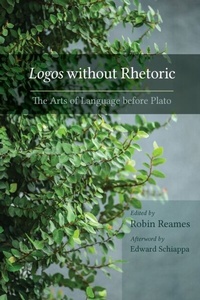
Logos without Rhetoric
Description
Alles über E-Books | Antworten auf Fragen rund um E-Books, Kopierschutz und Dateiformate finden Sie in unserem Info- & Hilfebereich.
A germinal examination of rhetoric's beginnings through pre-fourth-century Greek texts
How did rhetoric begin and what was it before it was called "rhetoric"? Must art have a name to be considered art? What is the difference between eloquence and rhetoric? And what were the differences, if any, among poets, philosophers, sophists, and rhetoricians before Plato emphasized-or perhaps invented-their differences? In Logos without Rhetoric: The Arts of Language before Plato, Robin Reames attempts to intervene in these and other questions by examining the status of rhetorical theory in texts that predate Plato's coining of the term rhetoric (c. 380 B.C.E.). From Homer and Hesiod to Parmenides and Heraclitus to Gorgias, Theodorus, and Isocrates, the case studies contained here examine the status of the discipline of rhetoric prior to and therefore in the absence of the influence of Plato and Aristotle's full-fledged development of rhetorical theory in the fourth century B.C.E.
The essays in this volume make a case for a porous boundary between theory and practice and promote skepticism about anachronistic distinctions between myth and reason and between philosophy and rhetoric in the historiography of rhetoric's beginning. The result is an enlarged understanding of the rhetorical content of pre-fourth-century Greek texts.
Edward Schiappa, head of Comparative Media Studies/Writing and the John E. Burchard Professor of Humanities at the Massachusetts Institute of Technology, provides an afterword.
All prices
More details
Other editions
Additional editions
Person
Robin Reames is an assistant professor of English at the University of Illinois at Chicago.
Content
- Cover
- Logos without Rhetoric
- Title
- Copyright
- Contents
- Series Editor's Preface
- Preface and Acknowledgments
- A Note on Translations
- Introduction
- Unity, Dissociation, and Schismogenesis in Isocrates
- Theodorus Byzantius on the Parts of a Speech
- Gorgias' "On Non-Being": Genre, Purpose, and Testimonia
- Parmenides: Philosopher, Rhetorician, Skywalker
- Heraclitus' Doublespeak: The Paradoxical Origins of Rhetorical Logos
- Rhetoric and Royalty: Odysseus' Presentation of the Female Shades in Hades
- Metis, Themis, and the Practice of Epic Speech
- It Takes an Empire to Raise a Sophist: An Athens-Centered Analysis of the Oikonomia of Pre-Platonic Rhetoric
- Afterword: Persistent Questions in the Historiography of Early Greek Rhetorical Theory
- Appendix A: A Timeline of the Life of Gorgias of Leontini
- Appendix B: A Summary of Gorgias' Work and Activity
- Appendix C: A New Testimonium of Theodorus Byzantius
- Notes
- Bibliography
- Contributors
- Index

System requirements
File format: ePUB
Copy protection: Adobe-DRM (Digital Rights Management)
System requirements:
- Computer (Windows; MacOS X; Linux): Install the free reader Adobe Digital Editions prior to download (see eBook Help).
- Tablet/smartphone (Android; iOS): Install the free app Adobe Digital Editions or the app PocketBook before downloading (see eBook Help).
- E-reader: Bookeen, Kobo, Pocketbook, Sony, Tolino and many more (not Kindle).
The file format ePub works well for novels and non-fiction books – i.e., „flowing” text without complex layout. On an e-reader or smartphone, line and page breaks automatically adjust to fit the small displays.
This eBook uses Adobe-DRM, a „hard” copy protection. If the necessary requirements are not met, unfortunately you will not be able to open the eBook. You will therefore need to prepare your reading hardware before downloading.
Please note: We strongly recommend that you authorise using your personal Adobe ID after installation of any reading software.
For more information, see our ebook Help page.
File format: PDF
Copy-Protection: Adobe-DRM (Digital Rights Management)
System requirements:
- Computer (Windows; MacOS X; Linux): Install the free reader Adobe Digital Editions prior to download (see eBook Help).
- Tablet/smartphone (Android; iOS): Install the free app Adobe Digital Editions or the app PocketBook before downloading (see eBook Help).
- E-reader: Bookeen, Kobo, Pocketbook, Sony, Tolino and many more (only limited: Kindle).
The file format PDF always displays a book page identically on any hardware. This makes PDF suitable for complex layouts such as those used in textbooks and reference books (images, tables, columns, footnotes). Unfortunately, on the small screens of e-readers or smartphones, PDFs are rather annoying, requiring too much scrolling.
This eBook uses Adobe-DRM, a „hard” copy protection. If the necessary requirements are not met, unfortunately you will not be able to open the eBook. You will therefore need to prepare your reading hardware before downloading.
Please note: We strongly recommend that you authorise using your personal Adobe ID after installation of any reading software.
For more information, see our eBook Help page.
File format: ePUB
Copy protection: Watermark-DRM (Digital Rights Management)
System requirements:
- Computer (Windows; MacOS X; Linux): Use a reading software that can process the file format ePUB: e.g., Adobe Digital Editions or FBReader – both free (see eBook Help).
- Tablet/Smartphone (Android; iOS): Before downloading, install the free app Adobe Digital Editions (see eBook Help).
- E-reader: Bookeen, Kobo, Pocketbook, Sony, Tolino and many more (not Kindle).
The file format ePUB works well for novels and non-fiction books – i.e., „flowing” text without complex layout. On an e-reader or smartphone, line and page breaks automatically adjust to fit the small displays.
This eBook uses Watermark-DRM, a „soft” copy protection. This means that there are no technical restrictions to prevent illegal distribution. However, there is a personalised watermark embedded in the eBook that can be used to identify the purchaser of the eBook in the event of misuse and to provide evidence for legal purposes.
For more information, see our eBook Help page.
