

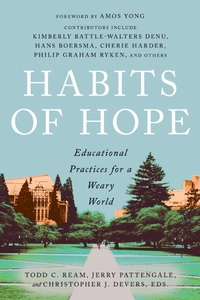
Habits of Hope
Description

In the world of education, disorientation and uncertainty has been increasing for several decades, with the Covid-19 pandemic only exacerbating preexisting challenges. Christians called to academic vocations need authentic hope tosustain them in their work-and they need to be able to share that hope with a weary world.
Habits of Hope explores a Christian understanding of hope and how it applies to the work of educators, administrators, scholars, and others inacademia. Essays by master practitioners focus on six key educational practices and describe how these practices can cultivate hope within educators as well as among their students and everyone they serve:
- integration
- conversation
- diversity
- reading
- writing
- teaching
Contributors include Hans Boersma; Kimberly Battle-Walters Denu; Kevin G. Grove, CSC; Cherie Harder; Jon S. Kulaga; Philip Graham Ryken; David I. Smith; and Jessica HootenWilson.
Christian hope, these thinkers are convinced, has two fundamental characteristics: it's tied inextricably to the world to come, inaugurated by the life, death, and resurrection of Jesus Christ; and it's active in its very nature. Habits of Hope combines theology and practical application to help educators find hope and infuse it throughout every area of their work.
More details
Other editions
Additional editions
Persons
Christopher J. Devers is assistant professor of education at Johns Hopkins University and a senior fellow for the Lumen Research Institute.
Amos Yong (PhD, Boston University) is professor of theology and mission and director of the Center for Missiological Research at Fuller Theological Seminary in Pasadena, California. He is the author or editor of over two dozen books, including Spirit of Love: A Trinitarian Theology of Grace, Afro-Pentecostalism: Black Pentecostal and Charismatic Christianity in History and Culture (coedited with Estrelda Alexander), Science and the Spirit: A Pentecostal Engagement with the Sciences (coedited with James K. A. Smith), and The Spirit Poured Out on All Flesh: Pentecostalism and the Possibility of Global Theology.
Todd C. Ream serves at Indiana Wesleyan University as university professor, executive director of faculty scholarship, and a senior fellow for the Lumen Research Institute.
Content
Foreword by Amos Yong
Introduction: An Expectation of the World to Come
Todd C. Ream, Jerry Pattengale, and Christopher J. Devers
1. The Cross Our Hope: The Hope of Education
Kevin G. Grove, C.S.C.
2. Past, Present, and Future: Integration as a Hopeful Educational Practice
Philip Graham Ryken
3. The Way of Words: Conversation as a Hopeful Educational Practice
Cherie Harder
4. Inclusive Excellence: Diversity as a Hopeful Educational Practice
Kimberly Battle-Walters Denu
5. Reading for Deification: Maximus the Confessor's Hopeful Pedagogy
Hans Boersma
6. Prophets and Poets at the Apocalypse: Writing as a Hopeful Educational Practice
Jessica Hooten Wilson
7. "Arduous and Difficult to Obtain": Teaching as a Hopeful Educational Practice
David I. Smith
Conclusion: The Habitat of Hope
Jon S. Kulaga
Contributors
Index
