

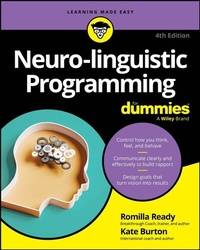
Neuro-linguistic Programming For Dummies
Description

Change your behavior with neuro-linguistic programming
Neuro-linguistic programming (NLP) is a psychological, practical, results-focused approach to understanding the relationship between thoughts, feelings, and behavior, and how they shape the everyday reality that people experience.
Neuro-linguistic Programming For Dummies walks you through the fundamentals of NLP, helping you gain insights into how and why you-and others-think, communicate (both verbally and non-verbally), and behave; often the result of early experiences, emotional conditioning, and unconscious beliefs formed over time.
Understanding the patterns that you operate daily enables you to consciously do more of what works for you to create the results you want in your life and less of what gets in the way of your success. With this deeper understanding about yourself, your goals become more tailored to who you truly are-and more achievable as a result.
By understanding how others operate, you can adjust the way you communicate to create deeper rapport and exercise greater trust, influence, and clarity.
Inside:
- Effective, straightforward strategies to increase self-awareness, build confidence, and become a clearer communicator
- Techniques that, when combined with other forms of health- and self-care, can help you find relief from phobias, anxiety, and depression
- Clear descriptions of the central models and assumptions that underpin NLP
Perfect for therapists, business coaches, counselors, and other helping professionals, Neuro-linguistic Programming For Dummies is also a must-read for busy executives, managers, entrepreneurs, and employees doing their best to navigate contemporary life.
More details
Other editions
Additional editions
Persons
Romilla Ready is a Breakthrough Coach, trainer, and author. Her flagship programs help people transform stress into strength and build empowering, fulfilling relationships.
Kate Burton is a recognized international executive coach who works with senior leaders at companies like HP, KPMG, and Microsoft.
Content
Introduction 1
Part 1: Getting Started with NLP 5
Chapter 1: Getting to Know Neuro-linguistic Programming 7
Chapter 2: Identifying Some Basic NLP Assumptions 19
Chapter 3: Discovering Who's Directing Your Life 37
Chapter 4: Taking Charge of Your Life 59
Part 2: Winning Friends and Influencing People 81
Chapter 5: Seeing, Hearing, and Feeling Your Way to Better Communication 83
Chapter 6: Creating Rapport 103
Chapter 7: Understanding to Be Understood 125
Chapter 8: Pushing the Communication Buttons 147
Part 3: Opening the Toolkit 163
Chapter 9: Dropping Anchors 165
Chapter 10: Sliding the Controls of Your Experience 181
Chapter 11: Working with the Logical Levels 197
Chapter 12: Driving Habits: Uncovering Your Secret Programs 215
Chapter 13: Traveling in Time to Improve Your Life 233
Chapter 14: Ensuring Smooth Running Below Decks 249
Part 4: Using Words to Captivate 261
Chapter 15: Getting to the Heart of the Matter: The Meta Model 263
Chapter 16: Unleashing the Power of Hypnosis 277
Chapter 17: Telling Tales to Reach the Unconscious: Stories, Fables, and Metaphors 291
Chapter 18: Asking the Right Questions 307
Part 5: Integrating Your Learning 325
Chapter 19: Dipping into Modeling 327
Chapter 20: Making Change Easier 345
Part 6: The Part of Tens 367
Chapter 21: Ten Applications of NLP 369
Chapter 22: Ten Books to Add to Your Library 381
Chapter 23: Ten Films and TV Series That Demonstrate NLP in Action 385
Index 397
Chapter 1
Getting to Know Neuro-linguistic Programming
IN THIS CHAPTER
Setting out on an neuro-linguistic programming journey
Exploring the key themes of neuro-linguistic programming
Getting the most out of neuro-linguistic programming
Here's a little Sufi tale about a man and a tiger.
A man being followed by a hungry tiger, turned in desperation to face it and cried, "Why don't you leave me alone?" The tiger answered, "Why don't you stop being so appetizing?"
In any communication between two people, or in this case between human and beast, more than one perspective always exists. Sometimes people just can't grasp that fact because they don't know they need to change their behavior to communicate in a way that gets them what they want.
Neuro-linguistic programming (NLP) is one of the most sophisticated and effective methodologies currently available to help you communicate effectively. NLP centers on communication and change. NLP teaches about sensory awareness (more about this in Chapter 5), which, put simply, is paying attention to the cues people display when they communicate with you, such as a raised eyebrow, a sudden pause, or a change in voice tone. Communication isn't just about what you say; it's also about how others respond. By noticing those responses, you can adapt in the moment and build stronger connections. You also become more aware of your own habits and responses, which means you can focus on what helps you succeed and let go of what holds you back. In today's climate of rapid change, flexibility is essential. It gives you more choices in how you respond to people and situations, which in turn enables you to exert greater influence over the outcomes you create (see Chapter 2 for more on presuppositions and flexibility).
So welcome to the start of the journey. We start by giving you a quick taster of the key NLP themes in this chapter.
Introducing NLP
All able-bodied humans are born with the same basic neurological system.
Your neurological system transmits the information you receive from your environment through your senses to your brain. Your environment, in this context, is everything external to you but also includes your organs, such as your eyes, ears, skin, stomach, and lungs. Your brain processes the information and transmits messages back to your organs. In response, your eyes, for example, may blink. The information can also create emotions, and you may cry or laugh. In short, your thought processes make you behave in a certain way.
Your ability to do anything in life - whether swimming the length of a pool, cooking a meal, or reading this book - depends on how you respond to the stimuli on your nervous system. Therefore, much of NLP is devoted to discovering how to think and communicate more effectively within yourself and with others.
The term neuro-linguistic programming breaks down as follows:
-
Neuro concerns your neurological system. NLP is based on the idea that you experience the world through your senses and translate sensory information into thought processes, both conscious and unconscious. Thought processes activate the neurological system, which affects your physiology, emotions, and behavior.
- Linguistic refers to the way you use language to make sense of the world, capture, and conceptualize experience and communicate that experience to others. In NLP, linguistics is the study of how the words you speak and your body language influence your experience.
- Programming draws heavily from learning theory and addresses how you code or mentally represent your experiences. Your personal programming consists of your internal processes and strategies (thinking patterns) that you use to make decisions, solve problems, learn, evaluate, and get results. NLP shows you how to recode your experiences and organize your internal programming so that you can get the outcomes you want.
To see this process in action, begin to notice how you think. Imagine a hot summer day. You're standing in your kitchen and holding a lemon you've taken from the fridge. Look at the outside of it - its yellow, waxy skin with green marks at the ends. Feel how cold it is in your hand. Raise it to your nose and smell it. Mmmm. Press it gently and notice the weight of the lemon in the palm of your hand. Now take a knife and cut it in half. Hear the juices start to run and notice that the smell is stronger now. Bite deeply into the lemon and allow the juice to swirl around in your mouth.
Words have the power to trigger your salivary glands. Hear the word lemon, and your brain kicks into action. The word tells your brain that you have a lemon in your hand. You may think that words only describe meanings, but in fact, they create your reality - a concept we explore throughout this book.
Providing a few quick definitions
NLP can be described in various ways. The formal definition is that NLP is "the study of the structure of your subjective experience." Here are a few more ways of answering the elusive question of "What is NLP?"
- The art and science of communication
- The key to learning
- The way to understand what makes you and other people tick
- The route to getting the results you want in all areas of your life
- The way to influence others with integrity
- The manual for your brain
- The secret of successful people
- The method of creating your own future
- The way to help people make sense of their reality
- The toolkit for personal and organizational change
Considering where NLP started and where it's going
NLP began in California in the early 1970s at the University of Santa Cruz. Richard Bandler, a master's level student of information sciences and mathematics, and Dr. John Grinder, a professor of linguistics, studied people who they considered to be excellent communicators and brilliant at helping their clients change. They were fascinated by how some people defied the odds to get through to so-called difficult or very ill people where others failed miserably to connect.
Thus, NLP has its roots in a therapeutic setting thanks to three world-renowned psychotherapists studied by Bandler and Grinder: Virginia Satir (developer of Conjoint Family Therapy), Fritz Perls (the founder of gestalt psychology), and Milton H. Erickson (largely responsible for the advancement of clinical hypnotherapy). In their work, Bandler and Grinder also drew upon the skills of linguists Alfred Korzybski and Noam Chomsky, social anthropologist Gregory Bateson, and psychotherapist Paul Watzlawick. Bandler and Grinder's work was happening at the time as their computer science contemporaries Steve Jobs and Steve Wozniak were setting up Apple Inc., so programming concepts were gaining people's awareness.
In the 1980s, Grinder became dissatisfied with some early coding work done in collaboration with Bandler, which he now refers to as Classic Code. Together with Judith DeLozier, Grinder initiated some new models known as New Code (documented in his book Whispering in the Wind [J&C Enterprises, 2001]) and he continues this work today with his partner Carmen Bostic St. Clair.
Since those early days 50 years ago, the field of NLP has exploded to encompass many disciplines in many countries around the world. New great teachers and practitioners in NLP are still emerging today to build on the work of the founders. Established teachers are collaborating with colleagues in other disciplines, such as neuroscience, education, and medicine to further the application of their work.
So what's next for NLP? The discipline has certainly traveled a long way from Santa Cruz in the 1970s, and since we wrote the first edition of this book, the interest in NLP shows no sign of waning. Some of the early pioneers of NLP, such as Robert Dilts, are now celebrating 50 years of working to transform the lives of with thousands of people worldwide. New neuroscientific knowledge offers some scientific explanation for many ideas that NLP practitioners have developed more intuitively. In particular, the world of coaching is heavily influenced by NLP. Today, NLP applications are being used by doctors, nurses, taxi drivers, salespeople, therapists, coaches, accountants, teachers, animal trainers, parents, workers, retired people, and teenagers alike. In Chapter 21, we list just a few such practical applications.
Each generation takes current ideas, sifts through and refines them, adds knowledge discovered through its own experiences, and communicates it in its own way. Information about NLP is now shared across social media platforms and apps such as LinkedIn, YouTube, X (formerly Twitter), and Facebook - channels that were unheard of in the 1970s and are constantly evolving. The explosion of artificial intelligence (AI) will no doubt bring change to NLP that we cannot yet envisage.
Much of the development of NLP today focuses on the applications rather than the core models; people who are experts in one field incorporate NLP tools and take them into their own field. Collaboration is key to generating new ideas and applications. Given that NLP encourages new thinking and new choices and acknowledges the positive intention underlying all action, all we can say is the future remains bright with possibilities....
