

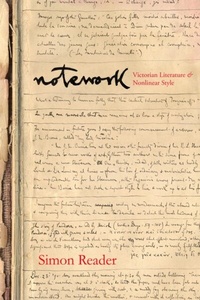
Notework
Victorian Literature and Nonlinear Style
Published on 22. June 2021
256 pages
978-1-5036-2797-0 (ISBN)
Available for download
Description

Notework begins with a striking insight: the writer's notebook is a genre in itself. Simon Reader pursues this argument in original readings of unpublished writing by prominent Victorians, offering an expansive approach to literary formalism for the twenty-first century. Neither drafts nor diaries, the notes of Charles Darwin, Oscar Wilde, Gerard Manley Hopkins, Vernon Lee, and George Gissing record ephemeral and nonlinear experiences, revealing each author's desire to leave their fragments scattered and unused.
Presenting notes in terms of genre allows Reader to suggest inventive new accounts of key Victorian texts, including The Picture of Dorian Gray, On the Origin of Species, and Hopkins's devotional lyrics, and to reinterpret these works as meditations on the ethics of compiling and using data. In this way, Notework recasts information collection as a personal and expressive activity that comes into focus against large-scale systems of knowledge organization. Finding resonance between today's digital culture and its nineteenth-century precursors, Reader honors our most disposable, improvised, and fleeting written gestures.
Presenting notes in terms of genre allows Reader to suggest inventive new accounts of key Victorian texts, including The Picture of Dorian Gray, On the Origin of Species, and Hopkins's devotional lyrics, and to reinterpret these works as meditations on the ethics of compiling and using data. In this way, Notework recasts information collection as a personal and expressive activity that comes into focus against large-scale systems of knowledge organization. Finding resonance between today's digital culture and its nineteenth-century precursors, Reader honors our most disposable, improvised, and fleeting written gestures.
Reviews / Votes
"Encountering writers' notebooks on their own terms, Simon Reader carves out fresh and rewarding territory in the landscape of Victorian studies. Notework offers brilliant, wide-ranging commentary on little-studied archival materials in dialogue with, but not subordinated to, well-known works of the period."-Andrew Stauffer, University of Virginia "Written in an energetic, witty, and clear style, Notework is full of interest and fresh insight-an unexpected and provocative view on material that has wider implications for how we read."-Kathryn Sutherland, University of Oxford "Contrasting with the disjointed fragments he quotes, Reader's own fluent and energetic style guides us through discussions of formalism generally, and Formalism in particular, into the direct engagement that he promises."-Jacqueline Banerjee, Times Literary Supplement "Notework offers a major contribution to the genre theory and the history of reading because it makes valuable, really for the first time, an absolutely ubiquitous practice... Reader's approach can return us to the archive and attune us beyond the canon because it so profoundly values formal multiplicity."-Elisha Cohn, Modern Philology "Critics often view authorial notes as adjunct to the study of major works, and this purpose is still central. However, Reader contends, in addition to providing insight into the creative process, notes serve as a distinct body of literary work... Incidentally, his observations about the disconnected nature of communication in social media (think Twitter) lead one to wonder how these instances of "note work" might figure as a genre to future readers."-L. A. Brewer, CHOICE "As a study in how to interpret those primary sources that make up much of nineteenth-century literary history, Notework is an engaging reimagining of the Victorian information landscape and an important reconsideration of how literary studies treats ephemera in the nineteenth century and beyond.... Notework promises to be a cornerstone in the aesthetics of information and in the ongoing reassessment of the parts of the long nineteenth century that carry into our present."-Sierra Eckert, Modern Language Quarterly "Simon Reader's 'notework,' a new and happily-coined literary term, avoids the book in 'notebook' while evoking the dream in 'dreamwork' and the art in 'artwork.' In other words, the term itself does a lot of work for this excellent study of important noteworks in Victorian literature. By conceptualizing and naming it, Reader's term will generate further work on this novel genre."-Carolyn Williams, Prose Studies "Reader's elegantly written study is full of insight, framing the note-taking of his chosen authors-Charles Darwin, George Gissing, Gerard Manley Hopkins, Oscar Wilde, and Vernon Lee-in consistently original and insightful ways."-Josephine M. Guy, Victorian StudiesMore details
Series
Edition
New edition
Language
English
Place of publication
Palo Alto
United States
Target group
Professional and scholarly
Edition type
New edition
Illustrations
10 halftones
ISBN-13
978-1-5036-2797-0 (9781503627970)
Copyright in bibliographic data and cover images is held by Nielsen Book Services Limited or by the publishers or by their respective licensors: all rights reserved.
Schweitzer Classification
Other editions
Additional editions
Book
06/2021
Stanford University Press
€76.00
Shipment within 15-20 days
Person
Simon Reader is Assistant Professor of English at the College of Staten Island, City University of New York.

