

Power versus Liberty
Description
Alles über E-Books | Antworten auf Fragen rund um E-Books, Kopierschutz und Dateiformate finden Sie in unserem Info- & Hilfebereich.
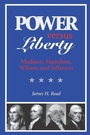
Does every increase in the power of government entail a loss of liberty for the people? James H. Read examines how four key Founders--James Madison, Alexander Hamilton, James Wilson, and Thomas Jefferson--wrestled with this question during the first two decades of the American Republic.
Power versus Liberty reconstructs a four-way conversation--sometimes respectful, sometimes shrill--that touched on the most important issues facing the new nation: the Constitution, the Bill of Rights, federal authority versus states' rights, freedom of the press, the controversial Bank of the United States, the relation between nationalism and democracy, and the elusive meaning of "the consent of the governed."
Each of the men whose thought Read considers differed on these key questions. Jefferson believed that every increase in the power of government came at the expense of liberty: energetic governments, he insisted, are always oppressive. Madison believed that this view was too simple, that liberty can be threatened either by too much or too little governmental power. Hamilton and Wilson likewise rejected the Jeffersonian view of power and liberty but disagreed with Madison and with each other.
The question of how to reconcile energetic government with the liberty of citizens is as timely today as it was in the first decades of the Republic. It pervades our political discourse and colors our readings of events from the confrontation at Waco to the Oklahoma City bombing to Congressional debate over how to spend the government surplus. While the rhetoric of both major political parties seems to posit a direct relationship between the size of our government and the scope of our political freedoms, the debates of Madison, Hamilton, Wilson, and Jefferson confound such simple dichotomies. As Read concludes, the relation between power and liberty is inherently complex.
All prices
More details
Other editions
Additional editions

Person
James H. Read is Associate Professor of Political Science at the College of St. Benedict and St. John's University of Minnesota.
Content
- 00Read fin (i-xiv)
- 01Read fin (1-23)
- 02Read fin (24-53)
- 03Read fin (54-87)
- 04Read fin (88-117)
- 05Read fin (118-156)
- 06Read fin (157-176)
- 07Read fin (177-192)
- 08Read fin (193-198)
- 09Read fin (199-202)

System requirements
File format: ePUB
Copy protection: Adobe-DRM (Digital Rights Management)
System requirements:
- Computer (Windows; MacOS X; Linux): Install the free reader Adobe Digital Editions prior to download (see eBook Help).
- Tablet/smartphone (Android; iOS): Install the free app Adobe Digital Editions or the app PocketBook before downloading (see eBook Help).
- E-reader: Bookeen, Kobo, Pocketbook, Sony, Tolino and many more (not Kindle).
The file format ePub works well for novels and non-fiction books – i.e., „flowing” text without complex layout. On an e-reader or smartphone, line and page breaks automatically adjust to fit the small displays.
This eBook uses Adobe-DRM, a „hard” copy protection. If the necessary requirements are not met, unfortunately you will not be able to open the eBook. You will therefore need to prepare your reading hardware before downloading.
Please note: We strongly recommend that you authorise using your personal Adobe ID after installation of any reading software.
For more information, see our ebook Help page.
File format: PDF
Copy-Protection: Adobe-DRM (Digital Rights Management)
System requirements:
- Computer (Windows; MacOS X; Linux): Install the free reader Adobe Digital Editions prior to download (see eBook Help).
- Tablet/smartphone (Android; iOS): Install the free app Adobe Digital Editions or the app PocketBook before downloading (see eBook Help).
- E-reader: Bookeen, Kobo, Pocketbook, Sony, Tolino and many more (only limited: Kindle).
The file format PDF always displays a book page identically on any hardware. This makes PDF suitable for complex layouts such as those used in textbooks and reference books (images, tables, columns, footnotes). Unfortunately, on the small screens of e-readers or smartphones, PDFs are rather annoying, requiring too much scrolling.
This eBook uses Adobe-DRM, a „hard” copy protection. If the necessary requirements are not met, unfortunately you will not be able to open the eBook. You will therefore need to prepare your reading hardware before downloading.
Please note: We strongly recommend that you authorise using your personal Adobe ID after installation of any reading software.
For more information, see our eBook Help page.
File format: ePUB
Copy protection: without DRM (Digital Rights Management)
System requirements:
- Computer (Windows; MacOS X; Linux): Use a reader that can handle the file format ePUB, such as Adobe Digital Editions or FBReader – both free (see eBook Help).
- Tablet/Smartphone (Android; iOS): Install the free app Adobe Digital Editions or the app PocketBook (see eBook Help).
- E-reader: Bookeen, Kobo, Pocketbook, Sony, Tolino and many more (not Kindle).
The file format ePUB works well for novels and non-fiction books – i.e., 'flowing' text without complex layout. On an e-reader or smartphone, line and page breaks automatically adjust to fit the small displays.
This eBook does not use copy protection or Digital Rights Management
For more information, see our eBook Help page.
