

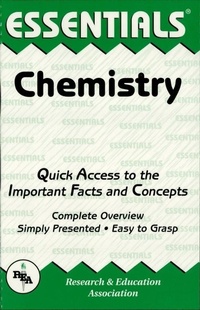
Chemistry Essentials
Published on 1. January 2013
110 pages
978-0-7386-7023-2 (ISBN)
Description

REA's Essentials provide quick and easy access to critical information in a variety of different fields, ranging from the most basic to the most advanced. As its name implies, these concise, comprehensive study guides summarize the essentials of the field covered. Essentials are helpful when preparing for exams, doing homework and will remain a lasting reference source for students, teachers, and professionals. Chemistry includes stoichiometry, atomic structure and the periodic table, bonding, chemical formulas, chemical reactions, gases, liquids, solids, phase changes, solutions, acids and bases, chemical equilibrium, acid-base equilibrium in aqueous solutions, chemical thermodynamics, and oxidation and reduction.
More details
Other editions
Additional editions

Editors of Rea
Chemistry
Book
09/1987
Research & Education Association,U.S.
€26.13
Article exhausted; check different version
Content
- Intro
- These "Little Books" have rescued lots of grades and more!
- Title Page
- Copyright Page
- What REA's Essentials® Will Do for You
- Table of Contents
- CHAPTER 1 - Introduction
- 1.1 Matter and Its Properties
- 1.2 Conservation of Matter
- 1.3 Laws of Definite and Multiple Proportions
- 1.4 Energy and Conservation of Energy
- 1.5 Measurement
- CHAPTER 2 - Stoichiometry, Chemical Arithmetic
- 2.1 The Mole
- 2.2 Atomic Weight
- 2.4 Equivalent Weight
- 2.5 Balancing Chemical Equations
- 2.6 Calculations Based on Chemical Equations
- 2.7 Limiting-Reactant Calculations
- 2.8 Theoretical Yield and Percentage Yield
- 2.9 Percentage Composition
- CHAPTER 3 - Atomic Structure and the Periodic Table
- 3.1 Atomic Spectra
- 3.2 The Bohr Theory of the Hydrogen Atom
- 3.3 Electric Nature of Atoms
- 3.4 The Wave Mechanical Model
- 3.5 Subshells and Electron Configuration
- 3.6 Isotopes
- 3.7 Transition Elements and Variable Oxidation Numbers
- 3.8 Periodic Table
- 3.9 Properties Related to the Periodic Table
- CHAPTER 4 - Bonding
- 4.1 Types of Bonds
- 4.2 Intermolecular Forces of Attraction
- 4.3 Double and Triple Bonds
- 4.4 Resonance Structures
- 4.5 Electrostatic Repulsion and Hybridization
- 4.6 Sigma and Pi Bonds
- 4.7 Properties of Ionic Substances
- 4.8 Properties of Molecular Crystals and Liquids
- CHAPTER 5 - Chemical Formulas
- 5.1 Chemical Formulas
- 5.2 Naming Compounds
- 5.3 Writing Formulas
- 5.4 Empirical and Molecular Formulas
- CHAPTER 6 - Types and Rates of Chemical Reactions
- 6.1 Types of Chemical Reactions
- 6.2 Measurements of Reaction Rates
- 6.3 Factors Affecting Reaction Rates
- 6.4 The Arrhenius Equation: Relating Temperature and Reaction Rate
- 6.5 Activation Energy
- 6.6 Reaction Rate Law
- 6.7 Collision Theory of Reaction Rates
- CHAPTER 7 - Gases
- 7.1 Volume and Pressure
- 7.2 Boyle's Law
- 7.3 Charles' Law
- 7.4 Dalton's Law of Partial Pressures
- 7.5 Law of Gay-Lussac
- 7.6 Ideal Gas Law
- 7.7 Combined Gas Law
- 7.8 Avogadro's Law (The Mole Concept)
- 7.9 Real Gases
- 7.10 Graham's Law of Effusion and Diffusion
- 7.11 The Kinetic Molecular Theory
- CHAPTER 8 - Liquids, Solids, and Phase Changes
- 8.1 Liquids
- 8.2 Heat of Vaporization and Heat of Fusion
- 8.3 Raoult's Law and Vapor Pressure
- 8.4 Boiling Point and Melting Point
- 8.5 Solids
- 8.6 Phase Diagram
- 8.7 Phase Equilibrium
- CHAPTER 9 - Properties of Solutions
- 9.1 Types of Solutions
- 9.2 Concentration Units
- 9.3 The Solution Process
- 9.4 Heats of Solution
- 9.5 Solubility and Temperature
- 9.6 Effect of Pressures on Solubility
- 9.7 Fractional Crystallization
- 9.8 Fractional Distillation
- 9.9 Vapor Pressures of Solutions
- 9.10 Colligative Properties of Solutions
- 9.11 Osmotic Pressure
- 9.12 Interionic Attractions
- CHAPTER 10 - Acids and Bases
- 10.1 Definitions of Acids and Bases
- 10.2 Properties of Acids and Bases
- 10.3 Factors Influencing the Strengths of Acids
- CHAPTER 11 - Acid-Base Equilibria in Aqueous Solution
- 11.1 Ionization of Water, pH
- 11.2 Dissociation of Weak Electrolytes
- 11.3 Dissociation of Polyprotic Acids
- 11.4 Buffers
- 11.5 Hydrolysis
- 11.6 Acid-Base Titration: The Equivalence Point
- 11.7 Acid-Base Indicators
- CHAPTER 12 - Chemical Equilibrium
- 12.1 The Law of Mass Action
- 12.2 Kinetics and Equilibrium
- 12.3 Thermodynamics and Chemical Equilibrium
- 12.4 The Relationship Between Kp and Kc
- 12.5 Heterogeneous Equilibria
- 12.6 Le Chatelier's Principle and Chemical Equilibrium
- CHAPTER 13 - Chemical Thermodynam ics
- 13.1 Some Commonly Used Terms in Thermodynamics
- 13.2 The First Law of Thermodynamics
- 13.3 Reversible and Irreversible Processes
- 13.4 Enthalpy
- 13.5 Heats of Reaction
- 13.6 Hess's Law of Heat Summation
- 13.7 Standard States
- 13.8 Bond Energies
- 13.9 Spontaneity of Chemical Reactions
- 13.10 Entropy
- 13.11 The Second Law of Thermodynamics
- 13.12 Standard Entropies and Free Energies
- CHAPTER 14 - Oxidation and Reduction
- 14.1 Oxidation and Reduction
- 14.2 Balancing Oxidation-Reduction Reactions Using the Oxidation Number Method
- 14.3 Balancing Redox Equations: The Ion-Electron Method
- 14.4 Non-Standard-State Cell Potentials
- 14.5 Electrolytic Cells
- 14.6 Faraday's Law
- 14.7 Voltaic Cells
