

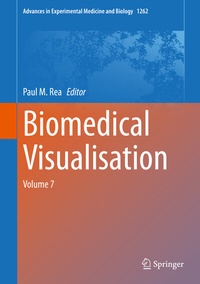
Biomedical Visualisation
Description

This edited book explores the use of technology to enable us to visualise the life sciences in a more meaningful and engaging way. It will enable those interested in visualisation techniques to gain a better understanding of the applications that can be used in visualisation, imaging and analysis, education, engagement and training.
The reader will be able to explore the utilisation of technologies from a number of fields to enable an engaging and meaningful visual representation of the biomedical sciences, with a focus in this volume related to anatomy, and clinically applied scenarios.
All chapters in this volume feature collaborative and innovative postgraduate research projects from graduate students of the MSc Medical Visualisation and Human Anatomy. This pioneering, world-leading postgraduate taught degree program is a joint partnership degree between the School of Life Sciences within the College of Medical, Veterinary and Life Sciences in the University of Glasgow, and the School of Simulation and Visualisation, The Glasgow School of Art. These chapters truly showcase the amazing and diverse technological applications that have been carried out as part of their research projects.More details
Other editions
Additional editions
Person
Paul is a Professor of Digital and Anatomical Education at the University of Glasgow. He is qualified with a medical degree (MBChB), a MSc (by research) in craniofacial anatomy/surgery, a PhD in neuroscience, the Diploma in Forensic Medical Science (DipFMS), and an MEd with Merit (Learning and Teaching in Higher Education). He is an elected Fellow of the Royal Society for the encouragement of Arts, Manufactures and Commerce (FRSA), elected Fellow of the Royal Society of Biology (FRSB), Senior Fellow of the Higher Education Academy, professional member of the Institute of Medical Illustrators (MIMI) and a registered medical illustrator with the Academy for Healthcare Science.
Paul has published widely and presented at many national and international meetings, including invited talks. He sits on the Executive Editorial Committee for the Journal of Visual Communication in Medicine, is Associate Editor for the European Journal of Anatomy and reviews for 25 different journals/publishers.
He is the Public Engagement and Outreach lead for anatomy coordinating collaborative projects with the Glasgow Science Centre, NHS and Royal College of Physicians and Surgeons of Glasgow. Paul is also a STEM ambassador and has visited numerous schools to undertake outreach work.
His research involves a long-standing strategic partnership with the School of Simulation and Visualisation The Glasgow School of Art. This has led to multi-million pound investment in creating world leading 3D digital datasets to be used in undergraduate and postgraduate teaching to enhance learning and assessment. This successful collaboration resulted in the creation of the worlds first taught MSc Medical Visualisation and Human Anatomy combining anatomy and digital technologies. The Institute of Medical Illustrators also accredits it. This degree, now into its 9th year, has graduated over 100 people, and created college-wide, industry, multi-institutional and NHSresearch linked projects for students. Paul is the Programme Director for this degree.
Content
Virtual Anatomy Museum - Facilitating Public Engagement Through An Interactive Application.- E-Learning And Embryology; Designing An Application To Improve 3D Comprehension Of Embryological Structures.- Animated Guide to Represent A Novel Means of Gut-brain Axis Communication.- Engaging with Children using Augmented Reality on Clothing to Prevent them from Smoking.- Enabling More Accessible MS Rehabilitation Training Using Virtual Reality.- The Use of Augmented Reality to Raise Awareness of the Differences between Osteoarthritis and Rheumatoid Arthritis.- Understanding the Brain and Exploring the Effects of Clinical Fatigue: From A Patient's Perspective.- A Methodology for Visualising Growth and Development of the Human Temporal Bone.- Collect the Bones, Avoid the Cones: A Game-Based App for Public Engagement.- A Serious Game on Skull Anatomy for Dental Undergraduates.
