

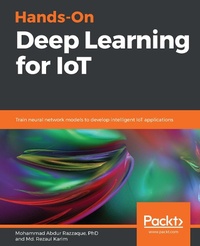
Hands-On Deep Learning for IoT
Train neural network models to develop intelligent IoT applications
1st Edition
Published on 27. June 2019
308 pages
978-1-78961-606-4 (ISBN)
Description

Implement popular deep learning techniques to make your IoT applications smarterKey Features - Understand how deep learning facilitates fast and accurate analytics in IoT
- Build intelligent voice and speech recognition apps in TensorFlow and Chainer
- Analyze IoT data for making automated decisions and efficient predictions
Book DescriptionArtificial Intelligence is growing quickly, which is driven by advancements in neural networks(NN) and deep learning (DL). With an increase in investments in smart cities, smart healthcare, and industrial Internet of Things (IoT), commercialization of IoT will soon be at peak in which massive amounts of data generated by IoT devices need to be processed at scale. Hands-On Deep Learning for IoT will provide deeper insights into IoT data, which will start by introducing how DL fits into the context of making IoT applications smarter. It then covers how to build deep architectures using TensorFlow, Keras, and Chainer for IoT. You'll learn how to train convolutional neural networks(CNN) to develop applications for image-based road faults detection and smart garbage separation, followed by implementing voice-initiated smart light control and home access mechanisms powered by recurrent neural networks(RNN). You'll master IoT applications for indoor localization, predictive maintenance, and locating equipment in a large hospital using autoencoders, DeepFi, and LSTM networks. Furthermore, you'll learn IoT application development for healthcare with IoT security enhanced. By the end of this book, you will have sufficient knowledge need to use deep learning efficiently to power your IoT-based applications for smarter decision making.What you will learn - Get acquainted with different neural network architectures and their suitability in IoT
- Understand how deep learning can improve the predictive power in your IoT solutions
- Capture and process streaming data for predictive maintenance
- Select optimal frameworks for image recognition and indoor localization
- Analyze voice data for speech recognition in IoT applications
- Develop deep learning-based IoT solutions for healthcare
- Enhance security in your IoT solutions
- Visualize analyzed data to uncover insights and perform accurate predictions
Who this book is forIf you're an IoT developer, data scientist, or deep learning enthusiast who wants to apply deep learning techniques to build smart IoT applications, this book is for you. Familiarity with machine learning, a basic understanding of the IoT concepts, and some experience in Python programming will help you get the most out of this book.
- Build intelligent voice and speech recognition apps in TensorFlow and Chainer
- Analyze IoT data for making automated decisions and efficient predictions
Book DescriptionArtificial Intelligence is growing quickly, which is driven by advancements in neural networks(NN) and deep learning (DL). With an increase in investments in smart cities, smart healthcare, and industrial Internet of Things (IoT), commercialization of IoT will soon be at peak in which massive amounts of data generated by IoT devices need to be processed at scale. Hands-On Deep Learning for IoT will provide deeper insights into IoT data, which will start by introducing how DL fits into the context of making IoT applications smarter. It then covers how to build deep architectures using TensorFlow, Keras, and Chainer for IoT. You'll learn how to train convolutional neural networks(CNN) to develop applications for image-based road faults detection and smart garbage separation, followed by implementing voice-initiated smart light control and home access mechanisms powered by recurrent neural networks(RNN). You'll master IoT applications for indoor localization, predictive maintenance, and locating equipment in a large hospital using autoencoders, DeepFi, and LSTM networks. Furthermore, you'll learn IoT application development for healthcare with IoT security enhanced. By the end of this book, you will have sufficient knowledge need to use deep learning efficiently to power your IoT-based applications for smarter decision making.What you will learn - Get acquainted with different neural network architectures and their suitability in IoT
- Understand how deep learning can improve the predictive power in your IoT solutions
- Capture and process streaming data for predictive maintenance
- Select optimal frameworks for image recognition and indoor localization
- Analyze voice data for speech recognition in IoT applications
- Develop deep learning-based IoT solutions for healthcare
- Enhance security in your IoT solutions
- Visualize analyzed data to uncover insights and perform accurate predictions
Who this book is forIf you're an IoT developer, data scientist, or deep learning enthusiast who wants to apply deep learning techniques to build smart IoT applications, this book is for you. Familiarity with machine learning, a basic understanding of the IoT concepts, and some experience in Python programming will help you get the most out of this book.
More details
Other editions
Additional editions
Md. Rezaul Karim | Mohammad Abdur Razzaque
Hands-On Deep Learning for IoT
Train neural network models to develop intelligent IoT applications
Book
06/2019
Packt Publishing
€46.20
Shipment within 3-4 weeks
Content
- Cover
- Title Page
- Copyright and Credits
- About Packt
- Contributors
- Table of Contents
- Preface
- Section 1: IoT Ecosystems, Deep Learning Techniques, and Frameworks
- Chapter 1: The End-to-End Life Cycle of the IoT
- The E2E life cycle of the IoT
- The three-layer E2E IoT life cycle
- The five-layer IoT E2E life cycle
- IoT system architectures
- IoT application domains
- The importance of analytics in IoT
- The motivation to use DL in IoT data analytics
- The key characteristics and requirements of IoT data
- Real-life examples of fast and streaming IoT data
- Real-life examples of IoT big data
- Summary
- Reference
- Chapter 2: Deep Learning Architectures for IoT
- A soft introduction to ML
- Working principle of a learning algorithm
- General ML rule of thumb
- General issues in ML models
- ML tasks
- Supervised learning
- Unsupervised learning
- Reinforcement learning
- Learning types with applications
- Delving into DL
- How did DL take ML to the next level?
- Artificial neural networks
- ANN and the human brain
- A brief history of ANNs
- How does an ANN learn?
- Training a neural network
- Weight and bias initialization
- Activation functions
- Neural network architectures
- Deep neural networks
- Autoencoders
- Convolutional neural networks
- Recurrent neural networks
- Emergent architectures
- Residual neural networks
- Generative adversarial networks
- Capsule networks
- Neural networks for clustering analysis
- DL frameworks and cloud platforms for IoT
- Summary
- Section 2: Hands-On Deep Learning Application Development for IoT
- Chapter 3: Image Recognition in IoT
- IoT applications and image recognition
- Use case one - image-based automated fault detection
- Implementing use case one
- Use case two - image-based smart solid waste separation
- Implementing use case two
- Transfer learning for image recognition in IoT
- CNNs for image recognition in IoT applications
- Collecting data for use case one
- Exploring the dataset from use case one
- Collecting data for use case two
- Data exploration of use case two
- Data pre-processing
- Models training
- Evaluating models
- Model performance (use case one)
- Model performance (use case two)
- Summary
- References
- Chapter 4: Audio/Speech/Voice Recognition in IoT
- Speech/voice recognition for IoT
- Use case one - voice-controlled smart light
- Implementing use case one
- Use case two - voice-controlled home access
- Implementing use case two
- DL for sound/audio recognition in IoT
- ASR system model
- Features extraction in ASR
- DL models for ASR
- CNNs and transfer learning for speech recognition in IoT applications
- Collecting data
- Exploring data
- Data preprocessing
- Models training
- Evaluating models
- Model performance (use case 1)
- Model performance (use case 2)
- Summary
- References
- Chapter 5: Indoor Localization in IoT
- An overview of indoor localization
- Techniques for indoor localization
- Fingerprinting
- DL-based indoor localization for IoT
- K-nearest neighbor (k-NN) classifier
- AE classifier
- Example - Indoor localization with Wi-Fi fingerprinting
- Describing the dataset
- Network construction
- Implementation
- Exploratory analysis
- Preparing training and test sets
- Creating an AE
- Creating an AE classifier
- Saving the trained model
- Evaluating the model
- Deployment techniques
- Summary
- Chapter 6: Physiological and Psychological State Detection in IoT
- IoT-based human physiological and psychological state detection
- Use case one - remote progress monitoring of physiotherapy
- Implementation of use case one
- Use case two - IoT-based smart classroom
- Implementation of use case two
- Deep learning for human activity and emotion detection in IoT
- Automatic human activity recognition system
- Automated human emotion detection system
- Deep learning models for HAR and emotion detection
- LSTM, CNNs, and transfer learning for HAR/FER in IoT applications
- Data collection
- Data exploration
- Data preprocessing
- Model training
- Use case one
- Use case two
- Model evaluation
- Model performance (use case one)
- Model performance (use case two)
- Summary
- References
- Chapter 7: IoT Security
- Security attacks in IoT and detections
- Anomaly detection and IoT security
- Use case one: intelligent host intrusion detection in IoT
- Implementation of use case one
- Use case two: traffic-based intelligent network intrusion detection in IoT
- Implementation of use case two
- DL for IoT security incident detection
- DNN, autoencoder, and LSTM in IoT security incidents detection
- Data collection
- CPU utilisation data
- KDD cup 1999 IDS dataset
- Data exploration
- Data preprocessing
- Model training
- Use case one
- Use case two
- Model evaluation
- Model performance (use case one)
- Model performance (use case two)
- Summary
- References
- Section 3: Advanced Aspects and Analytics in IoT
- Chapter 8: Predictive Maintenance for IoT
- Predictive maintenance for IoT
- Collecting IoT data in an industrial setting
- ML techniques for predictive maintenance
- Example - PM for an aircraft gas turbine engine
- Describing the dataset
- Exploratory analysis
- Inspecting failure modes
- Prediction challenges
- DL for predicting RLU
- Calculating cut-off times
- Deep feature synthesis
- ML baselines
- Making predictions
- Improving MAE with LSTM
- Unsupervised deep feature synthesis
- FAQs
- Summary
- Chapter 9: Deep Learning in Healthcare IoT
- IoT in healthcare
- Use case one - remote management of chronic disease
- Implementation of use case one
- Use case two - IoT for acne detection and care
- Implementation of use case two
- DL for healthcare
- CNN and LSTM in healthcare applications
- Data collection
- Use case one
- Use case two
- Data exploration
- The ECG dataset
- The acne dataset
- Data preprocessing
- Model training
- Use case one
- Use case two
- Model evaluations
- Model performance (use case one)
- Model performance (use case two)
- Summary
- References
- Chapter 10: What's Next - Wrapping Up and Future Directions
- What we have covered in this book?
- Deployment challenges of DL solutions in resource-constrained IoT devices
- Machine learning/DL perspectives
- DL limitations
- IoT devices, edge/fog computing, and cloud perspective
- Existing solutions to support DL in resource-constrained IoT devices
- Potential future solutions
- Summary
- References
- Other Books You May Enjoy
- Index
