

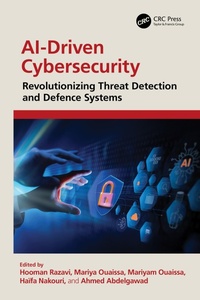
AI-Driven Cybersecurity
Revolutionizing Threat Detection and Defence Systems
Published on 26. September 2025
300 pages
978-1-040-42224-3 (ISBN)
Description

This book delves into the revolutionary ways in which AI-driven innovations are enhancing every aspect of cybersecurity, from threat detection and response automation to risk management and endpoint protection. As AI continues to evolve, the synergy between cybersecurity and artificial intelligence promises to reshape the landscape of digital defence, providing the tools needed to tackle complex, ever-evolving cyber threats. Designed for professionals, researchers, and decision-makers, this book emphasizes that understanding and leveraging AI in cybersecurity is not just advantageous-it is essential for building robust, future-proof defences in a world where digital security is paramount.
More details
Language
English
Place of publication
London
United Kingdom
Publishing group
Taylor & Francis Ltd
Target group
College/higher education
Professional and scholarly
Illustrations
47 Tables, black and white; 53 Line drawings, black and white; 1 Halftones, black and white; 54 Illustrations, black and white
File size
6,27 MB
ISBN-13
978-1-040-42224-3 (9781040422243)
Copyright in bibliographic data and cover images is held by Nielsen Book Services Limited or by the publishers or by their respective licensors: all rights reserved.
Schweitzer Classification
Other editions
Additional editions
Hooman Razavi | Mariya Ouaissa | Mariyam Ouaissa
AI-Driven Cybersecurity
Revolutionizing Threat Detection and Defence Systems
Book
09/2025
1st Edition
CRC Press
€167.30
Shipment within 15-20 days
Persons
Hooman Razavi is currently an associate research assistant in the Department of Engineering Science at Tecnologico de Monterrey, Mexico, and the University of Ottawa. He holds a B.Sc. in Computer Engineering, an M.Sc. in Artificial Intelligence, and a Ph.D. in Engineering Science. Dr. Razavi has served as a sessional lecturer at University Canada West (2017-2022) and as a lecturer for the United Nations (UNITAR) IoMT course. He has published widely in conferences, book chapters, and journal papers in the fields of applied AI and Cyber Risk Management. His professional experience also includes roles as a senior data scientist and consultant in several fintech firms. He currently serves as an editorial board member of the International Journal of Cybersecurity and Risk Assessment. Dr. Razavi has the role of reviewer for numerous journals, including IEEE Transactions on Artificial Intelligence, IEEE Communications Magazine, Information Systems Journal, Expert Systems with Applications, Engineering Applications of Artificial Intelligence, Applied Soft Computing, Cyber security and Applications, and Digital Business. Additionally, he has served on technical program committees for leading conferences, such as ICLR, NeurIPS, AISTATS, IEEE WINCOM, IEEE CSR, IEEE GCAIoT, IEEE CSNet, and ICMI. Dr. Razavi has also been a keynote speaker at numerous international conferences and has conducted multiple webinars.
Mariya Ouaissa is currently Professor of Cybersecurity and Networks at the Faculty of Sciences Semlalia, Cadi Ayyad University, Marrakech, Morocco. She is a Ph.D. graduate (2019) in computer science and networks from ENSAM-Moulay Ismail University, Meknes, Morocco. She is a networks and telecoms engineer, graduated in 2013 from the National School of Applied Sciences Khouribga, Morocco. She is a co-founder and IT consultant at the IT Support and Consulting Center. She was working for the School of Technology of Meknes, Morocco, as a visiting professor from 2013 to 2021. She is a member of the International Association of Engineers and the International Association of Online Engineering, and since 2021, she has been an ACM professional member. She is an expert reviewer with the Academic Exchange Information Centre (AEIC) and a brand ambassador with Bentham Science. She has served and continues to serve on technical program and organizer committees of several conferences and events and has organized many symposiums/workshops/conferences as a general chair and also as a reviewer of numerous international journals. Dr. Ouaissa has made contributions in the fields of information security and privacy, Internet of Things security, and wireless and constrained networks security. Her main research topics are IoT, M2M, D2D, WSN, cellular networks, and vehicular networks. She has published over 80 papers (book chapters, international journals, and conferences/workshops), 30 edited books, and ten special issues as guest editor.
Mariyam Ouaissa is currently Assistant Professor of Networks and Systems at ENSA, Chouaib Doukkali University, El Jadida, Morocco. She received her Ph.D. degree in 2019 from the National Graduate School of Arts and Crafts, Meknes, Morocco, and her engineering degree in 2013 from the National School of Applied Sciences, Khouribga, Morocco. She is a communication and networking researcher and practitioner with industry and academic experience. Dr. Ouaissa's research is multidisciplinary that focuses on the Internet of Things, M2M, WSN, vehicular communications and cellular networks, security networks, the congestion overload problem, and resource allocation management and access control. She is serving as a reviewer for international journals and conferences, including IEEE Access, Wireless Communications, and Mobile Computing. Since 2020, she has been a member of the International Association of Engineers and the International Association of Online Engineering, and since 2021, she has been an ACM Professional Member. She has published more than 60 research papers (this includes book chapters, peer-reviewed journal articles, and peer-reviewed conference manuscripts), 20 edited books, and six special issues as guest editor. She has served on Program Committees and Organizing Committees of several conferences and events and has organized many symposiums, workshops, and conferences.
Haifa Nakouri is a machine learning specialist and currently holds the position of Invited Professor of Computer Science at the University of Quebec at Chicoutimi (UQAC). She is also Assistant Professor in Business Computing at the Higher School of Digital Economy, University of Manouba, Tunisia. Dr. Nakouri obtained her Business Computing Bachelor, M.Sc., and Ph.D. degrees from the Higher Institute of Management, University of Tunis, Tunisia (ISG Tunis) in 2007, 2009, and 2016, respectively. She is associated with the LARODEC laboratory at ISG Tunis and focuses on research topics such as Machine Learning, Responsible/Secure AI, Computer Vision, and Image Processing. She developed expertise in analysing the vulnerabilities and shortcomings of Machine Learning models and designing solutions to enhance their resilience. Dr. Nakouri is a member of the UQAC Cybersecurity Research Chair, where she collaborates with experts in the field to advance knowledge in learning model security. She is actively involved in various international research projects and collaborations and has published over 25 research papers. Additionally, she has contributed to Program Committees and Organizing Committees and chaired several reputable international conferences and workshops.
Ahmed Abdelgawad received his M.S. and Ph.D. degrees in computer engineering from the University of Louisiana at Lafayette in 2007 and 2011 and subsequently joined IBM as a design aids and automation engineering professional at the Semiconductor Research and Development Center, New York, USA. In Fall 2012 he joined Central Michigan University as a computer engineering assistant professor. In Fall 2022, Dr. Abdelgawad was promoted to the rank of professor. He is a senior member of IEEE. His area of expertise is the Internet of Things (IoT), distributed computing for wireless sensor networks (WSN), structural health monitoring (SHM), data fusion techniques for WSN, low-power embedded systems, digital signal processing, robotics, radio-frequency identification, localization, very-large-scale integration, and field-programmable gate array design. He has published two books and more than 130 articles in related journals and conferences. Dr. Abdelgawad served as a reviewer for several journals and conferences, including the IEEE IoT journal, the IEEE Communications magazine, IEEE Transactions on VLSI, and IEEE Transactions on I&M, Springer, Elsevier, IEEE WF-IoT, IEEE ISCAS, IEEE SAS, and IEEE MWSCAS. Dr. Abdelgawad served as the general chair of the IEEE International Conference on Artificial Intelligence, Blockchain, and Internet of Things (AIBThings2023); the 3rd IEEE International Conference on Computing and Machine Intelligence (ICMI2024); and the International Conference on Intelligent Systems, Blockchain, and Communication Technologies (ISBCom2024). He served in the organizing committees of IEEE WF-IoT, IEEE ISCAS, IEEE ICIP, IEEE SiPS, IEEE MWSCAS, and GIoTS. In addition, he taught many short IoT courses in different countries. He was the keynote speaker for many international conferences and conducted many webinars. He is currently the IEEE Northeast Michigan section chair and IEEE SPS Internet of Things (IoT) SIG Member. In the last few years, Dr. Abdelgawad was listed in the world's top 2% of scientists by Stanford University, USA. In addition, Dr. Abdelgawad served as a principal investigator and co-principal investigator for several funded grants from the National Science Foundation.
Mariya Ouaissa is currently Professor of Cybersecurity and Networks at the Faculty of Sciences Semlalia, Cadi Ayyad University, Marrakech, Morocco. She is a Ph.D. graduate (2019) in computer science and networks from ENSAM-Moulay Ismail University, Meknes, Morocco. She is a networks and telecoms engineer, graduated in 2013 from the National School of Applied Sciences Khouribga, Morocco. She is a co-founder and IT consultant at the IT Support and Consulting Center. She was working for the School of Technology of Meknes, Morocco, as a visiting professor from 2013 to 2021. She is a member of the International Association of Engineers and the International Association of Online Engineering, and since 2021, she has been an ACM professional member. She is an expert reviewer with the Academic Exchange Information Centre (AEIC) and a brand ambassador with Bentham Science. She has served and continues to serve on technical program and organizer committees of several conferences and events and has organized many symposiums/workshops/conferences as a general chair and also as a reviewer of numerous international journals. Dr. Ouaissa has made contributions in the fields of information security and privacy, Internet of Things security, and wireless and constrained networks security. Her main research topics are IoT, M2M, D2D, WSN, cellular networks, and vehicular networks. She has published over 80 papers (book chapters, international journals, and conferences/workshops), 30 edited books, and ten special issues as guest editor.
Mariyam Ouaissa is currently Assistant Professor of Networks and Systems at ENSA, Chouaib Doukkali University, El Jadida, Morocco. She received her Ph.D. degree in 2019 from the National Graduate School of Arts and Crafts, Meknes, Morocco, and her engineering degree in 2013 from the National School of Applied Sciences, Khouribga, Morocco. She is a communication and networking researcher and practitioner with industry and academic experience. Dr. Ouaissa's research is multidisciplinary that focuses on the Internet of Things, M2M, WSN, vehicular communications and cellular networks, security networks, the congestion overload problem, and resource allocation management and access control. She is serving as a reviewer for international journals and conferences, including IEEE Access, Wireless Communications, and Mobile Computing. Since 2020, she has been a member of the International Association of Engineers and the International Association of Online Engineering, and since 2021, she has been an ACM Professional Member. She has published more than 60 research papers (this includes book chapters, peer-reviewed journal articles, and peer-reviewed conference manuscripts), 20 edited books, and six special issues as guest editor. She has served on Program Committees and Organizing Committees of several conferences and events and has organized many symposiums, workshops, and conferences.
Haifa Nakouri is a machine learning specialist and currently holds the position of Invited Professor of Computer Science at the University of Quebec at Chicoutimi (UQAC). She is also Assistant Professor in Business Computing at the Higher School of Digital Economy, University of Manouba, Tunisia. Dr. Nakouri obtained her Business Computing Bachelor, M.Sc., and Ph.D. degrees from the Higher Institute of Management, University of Tunis, Tunisia (ISG Tunis) in 2007, 2009, and 2016, respectively. She is associated with the LARODEC laboratory at ISG Tunis and focuses on research topics such as Machine Learning, Responsible/Secure AI, Computer Vision, and Image Processing. She developed expertise in analysing the vulnerabilities and shortcomings of Machine Learning models and designing solutions to enhance their resilience. Dr. Nakouri is a member of the UQAC Cybersecurity Research Chair, where she collaborates with experts in the field to advance knowledge in learning model security. She is actively involved in various international research projects and collaborations and has published over 25 research papers. Additionally, she has contributed to Program Committees and Organizing Committees and chaired several reputable international conferences and workshops.
Ahmed Abdelgawad received his M.S. and Ph.D. degrees in computer engineering from the University of Louisiana at Lafayette in 2007 and 2011 and subsequently joined IBM as a design aids and automation engineering professional at the Semiconductor Research and Development Center, New York, USA. In Fall 2012 he joined Central Michigan University as a computer engineering assistant professor. In Fall 2022, Dr. Abdelgawad was promoted to the rank of professor. He is a senior member of IEEE. His area of expertise is the Internet of Things (IoT), distributed computing for wireless sensor networks (WSN), structural health monitoring (SHM), data fusion techniques for WSN, low-power embedded systems, digital signal processing, robotics, radio-frequency identification, localization, very-large-scale integration, and field-programmable gate array design. He has published two books and more than 130 articles in related journals and conferences. Dr. Abdelgawad served as a reviewer for several journals and conferences, including the IEEE IoT journal, the IEEE Communications magazine, IEEE Transactions on VLSI, and IEEE Transactions on I&M, Springer, Elsevier, IEEE WF-IoT, IEEE ISCAS, IEEE SAS, and IEEE MWSCAS. Dr. Abdelgawad served as the general chair of the IEEE International Conference on Artificial Intelligence, Blockchain, and Internet of Things (AIBThings2023); the 3rd IEEE International Conference on Computing and Machine Intelligence (ICMI2024); and the International Conference on Intelligent Systems, Blockchain, and Communication Technologies (ISBCom2024). He served in the organizing committees of IEEE WF-IoT, IEEE ISCAS, IEEE ICIP, IEEE SiPS, IEEE MWSCAS, and GIoTS. In addition, he taught many short IoT courses in different countries. He was the keynote speaker for many international conferences and conducted many webinars. He is currently the IEEE Northeast Michigan section chair and IEEE SPS Internet of Things (IoT) SIG Member. In the last few years, Dr. Abdelgawad was listed in the world's top 2% of scientists by Stanford University, USA. In addition, Dr. Abdelgawad served as a principal investigator and co-principal investigator for several funded grants from the National Science Foundation.
Content
1. Artificial Intelligence in Cybersecurity: Fundamentals, Challenges, and Opportunities 2. Artificial Intelligence Applications in Cybersecurity 3. Large Language Models (LLMs) for Cybersecurity 4. Machine Learning in Identifying Cyber Threats: A Research Overview 5. Advanced Data Analytics for Proactive Security 6. Malware Unmasked: AI-Driven Forensics for Threat Detection and Response 7. Leveraging AI/ML in Identity and Access Management (IAM) for Enterprise Security 8. Smart Cyber Defence: Leveraging AI for Real-Time Threat Detection and Mitigation 9. Leveraging AI in Cyber Defence: Transforming Modern Cybersecurity 10. AI Meets IDPS: A New Era in Cybersecurity 11. Real-Time Detection: Machine Learning Against Evolving Cyber Threats 12. Artificial Intelligence Powered Cyberattacks 13. Automating Cyber Threat Detection with AI and Machine Learning 14. Securing SD-WAN with Edge and Fog Computing: AI-Driven Optimization and Challenges
