

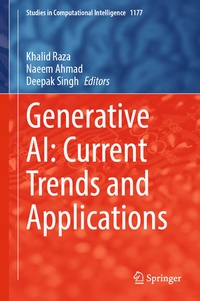
Generative AI: Current Trends and Applications
Description

This comprehensive volume focuses on the latest advancements in Generative AI, including state-of-the-art techniques and models that are pushing the boundaries of what is possible. It covers recent developments in areas such as Generative AI models, transfer learning and Natural Language Processing (NLP) highlighting their potential to revolutionize content generation and creative applications including OpenAI, LangChain, NLTK and their practical implementations across diverse domains. The volume provides insights into emerging research areas, novel architectures, and innovative approaches in Generative AI, giving searchers a glimpse into the exciting future of the field. The aim is to offer readers a deep understanding of Generative AI and how it can be harnessed to tackle complex real-world challenges.
More details
Other editions
Additional editions
Persons
Dr. Khalid Raza is an Associate Professor at the Department of Computer Science, Jamia Millia Islamia (Central University), New Delhi, India. He also served as ICCR Chair Visiting Professor at the Faculty of Computer and Information Sciences, Ain Shams University, Egypt. Dr. Raza has over 13 years of teaching and research experience. He has contributed over 140 peer-reviewed research articles. Dr. Raza has authored/edited 10 Books published by reputed publishers like Springer, Elsevier, and CRC Press. Dr. Raza is an Academic Editor of PeerJ Computer Science, Guest Editor of Natural Product Communications, and Mini-Reviews in Medicinal Chemistry. He has an active collaboration with the scientists from leading institutions of India and abroad. He is an Honorary Research Fellow of INIT International University, Malaysia. Dr. Raza has been featured in the list of World's Top 2% Scientists released by Stanford University (USA) in collaboration with Elsevier for the two consecutive years 2021 and 2022. His research interests lie in computational intelligence and applications in computational biology, bioinformatics, and health-informatics.
Dr. Naeem Ahmad received his Ph.D. in Computer Science from Jamia Millia Islamia, (Central University), New Delhi. Dr. Ahmad is currently with the Department of Computer Applications, National Institute of Technology (NIT) Raipur, Raipur, India. Prior to working here, he also worked with Department of Computer Applications, Madanapalle Institute of Technology and Science, Madanapalle, India from 2018 to 2021, and School of Network Engineering, Jiangxi Ahead Software Vocational and Technical College, Nanchang, China from 2017 to 2018. He has over 8 years of teaching/research experience in various academic institutions. He has edited several books of international repute and has authored or co-authored more than 30 publications in journals and conferences. He is one of the editorial board members for one of the journals of repute and also serving as reviewers for various journals and conferences. His research interests lie in Deep Learning, Wireless Networks, Image Processing, and Signal Processing and its applications in Healthcare.
Dr. Deepak Singh is an Assistant Professor at the Department of Computer Science and Engineering, National Institute of Technology (NIT) Raipur, India. He has over 10 years of teaching and research experience in various academic institutes. He has published over 30 research articles in journals and conferences. He has also Edited a book titled "Deep Learning Applications in Translational Bioinformatics" published by Academic Press, Elsevier. Dr. Deepak has also completed several sponsored research projects funded by DSCI, DRDO, and UNISEF, and has 4 patents to his credit. His research interests include evolutionary computation, machine learning, and data mining.
Content
Generative AI Fundamentals and Evolution.- Fundamentals of Encoders and Decoders in Generative AI.- Generative AI Applications Development using OpenAI.- Generative AI for Smart Data Analytics.- Detection of Real vs Fake Images on Social Media through Generative Adversarial Networks.
