

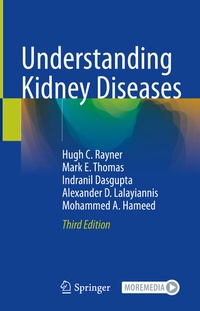
Understanding Kidney Diseases
Description

Understanding Kidney Diseases makes accessible a medical specialty that is commonly regarded by students as difficult. The target audience is undergraduate and non-specialist postgraduate students.
The book is unique in combining the reference material normally found in a nephrology textbook with the everyday clinical applicability of a medical handbook. The chapters are structured on the approach that a clinician should take when assessing someone with a possible kidney problem. The factual content is brought to life by over 60 case studies and is illustrated by a high density of figures, many displaying information in a graphical form that avoids off-putting data and text.
It is an authored book, written in a consistent style that is deliberately clear, concise and easy to follow. Nonetheless, it is referenced in as much detail as would be expected in a conventional textbook. It explains principles and concepts that help students understand and interpret clinical problems. No other textbook of nephrology combines these features.
The book emphasises a patient-centred approach to practice. Students' knowledge can be put it into practice by answering a bank of questions that patients frequently ask, and tested against traditional multiple-choice questions.
In summary, Understanding Kidney Diseases gives students confidence in helping someone with a kidney problem. Praised by leading nephrologists, it is the book the authors wish they could have read when they were students.
More details
Other editions
Additional editions
Persons
Hugh C. Rayner
gained a first-class degree in physiology at Cambridge University before qualifying with honours at the London Hospital Medical College in 1981. Following an MD at the University of Leicester and clinical fellowship in Melbourne, Australia, he was a Consultant and Medical Director in Birmingham between 1993 and 2019.
He was a Founder Investigator of the Dialysis Outcomes and Practice Patterns Study (DOPPS). He was lead author of the Academy of Medical Royal Colleges' guideline for writing letters directly to patients.
Mark E. Thomas
studied Biological Sciences and Medicine at King's College London and Westminster Medical School. He was a Research Fellow at Washington University Medical School in St. Louis, USA, and Senior Registrar in Leicester. A Consultant Nephrologist since 1998, he is also an Honorary Associate Clinical Professor at the University of Birmingham.
He is chief investigator for the Acute Kidney Outreach to Reduce Deterioration and Death (AKORDD) study and has chaired clinical guideline development groups for AKI, Anaemia Management in CKD and End of Life Care for the UK National Institute for Health and Care Excellence (NICE).
Indranil Dasgupta
studied medicine at Calcutta University, India, where he also gained an MD. Following specialist training and hypertension research in Nottingham, he is now Consultant Nephrologist in Birmingham and Honorary Professor at the Warwick Medical School.
He holds posts at the NIHR Clinical Research Network, the British and Irish Hypertension Society, the National Institute for Health and Care Excellence, the Association of British Clinical Diabetologists, the UK Kidney Association, the UK Kidney Research Consortium CKD and Diabetes Clinical Study Group, the International Society of Nephrology Western Europe Board, the European Society of Nephrology Diabesity Working Group and is past Honorary Secretary of Renal Association UK
Alexander D. Lalayiannis
studied medicine at the University of Birmingham and completed his paediatric nephrology specialty training in Birmingham. He gained a PhD as a Paediatric Nephrology Research Fellow at the Great Ormond Street Hospital for Children, focusing on CKD-mineral bone disorder. He is now a Consultant Paediatric Nephrologist at the Birmingham Children's Hospital.
He is a member of the European Society for Paediatric Nephrology (ESPN) dialysis working group and a board member of the ESPN CKD-Mineral Bone Disorder working group.
Mohammed A. Hameed
studied medicine at the University of Birmingham and completed his nephrology specialty training in Birmingham. He gained a PhD, focussing on pathophysiological features, adherence to antihypertensives and treatment with renal denervation in patients with treatment-resistant hypertension.
He is currently a Consultant Physician and Nephrologist at Birmingham Heartlands Hospital, with a specialist interest in hypertension. He is a member of UK Kidney Association and British and Irish Hypertension Society.
Content
1. Kidney anatomy and physiology - The basis of clinical nephrology.- 2. Measuring kidney function - Quantifying glomerular filtration from laboratory tests.- 3. Plot all the dots - Graphs reveal the progression of kidney disease.- 4. Kidney function in acute illness and acute kidney injury.- 5. How are you feeling? - Symptoms of kidney disease.- 6. What is your lifestyle, occupation and past medical history? - How social, environmental and other medical conditions are linked to kidney disease.- 7. Do you have diabetes mellitus? - How diabetes and its treatments are linked to kidney disease.- 8. Are you pregnant or planning a pregnancy? - How pregnancy affects the kidneys and vice versa.- 9. What is your family history? - The molecular genetics of inherited kidney diseases.- 10. What have you been taking? - Nephrotoxicity from drugs and other chemicals.- 11. Height and weight - The effects of kidney disease on development; links between obesity and kidney disease.- 12. Blood pressure - The interactions between hypertension and kidney disease.- 13. Urine testing - Understanding haematuria, proteinuria and urinary infection.- 14. May I examine you?- Physical signs related to kidney diseases.- 15. Full Blood Count - Haematology results and kidney diseases.- 16. Acid, base and the kidneys.- 17. Calcium, phosphate and bones - How bone and mineral metabolism is altered in kidney disease.- 18. Immunology - Serological tests that help diagnose kidney diseases.- 19. Urinary tract imaging - Strengths and weaknesses of different radiology modalities.- 20. Should we biopsy a kidney? - Balancing the benefits against the risks.- 21. Kidney stone disease - A link between nephrology and urology.- 22. Planning treatment - When and how to prepare for a life with kidney disease.- 23. Kidney replacement therapy - Common problems in dialysis and transplant patients.- 24. Frequently asked questions.
