

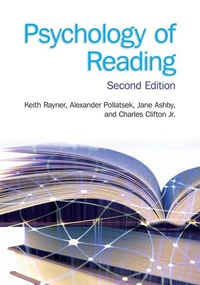
Psychology of Reading
2nd Edition
1st Edition
Published on 22. May 2012
496 pages
978-1-136-57968-4 (ISBN)
Description

Reading is a highly complex skill that is prerequisite to success in many societies in which a great deal of information is communicated in written form. Since the 1970s, much has been learned about the reading process from research by cognitive psychologists. This book summarizes that important work and puts it into a coherent framework.
The book's central theme is how readers go about extracting information from the printed page and comprehending the text. Like its predecessor, this thoroughly updated 2nd Edition encompasses all aspects of the psychology of reading with chapters on writing systems, word recognition, the work of the eyes during reading, inner speech, sentence processing, discourse processing, learning to read, dyslexia, individual differences and speed reading.
Psychology of Reading, 2nd Edition, is essential reading for undergraduates, graduates, and researchers in cognitive psychology and could be used as a core textbook on courses on the psychology of reading and related topics. In addition, the clear writing style makes the book accessible to people without a background in psychology but who have a personal or professional interest in the process of reading.
The book's central theme is how readers go about extracting information from the printed page and comprehending the text. Like its predecessor, this thoroughly updated 2nd Edition encompasses all aspects of the psychology of reading with chapters on writing systems, word recognition, the work of the eyes during reading, inner speech, sentence processing, discourse processing, learning to read, dyslexia, individual differences and speed reading.
Psychology of Reading, 2nd Edition, is essential reading for undergraduates, graduates, and researchers in cognitive psychology and could be used as a core textbook on courses on the psychology of reading and related topics. In addition, the clear writing style makes the book accessible to people without a background in psychology but who have a personal or professional interest in the process of reading.
Reviews / Votes
"I don't think it's possible to overstate the importance of this book. It's written by some of the very best-known and respected researchers in the field who, to a very large degree, have defined the field itself. In short, reading research would not have been the same without these authors, and to the present day they're still amongst the most prominent scholars in the world."-Steven Frisson, Ph.D., University of Birmingham, UK
"I absolutely loved reading this book. The level of detail and analysis provided in several of the chapters was exceptional. In fact, given the attention to detail, and the continual use of presenting data followed by argument/criticism to build a position, results in a book that will be valuable at many levels."
-Edward O'Brien, Ph.D., University of New Hampshire, US
"The original Psychology of Reading by Rayner and Pollatsek - of which this current book is a thoroughly revised and updated version - has often been described as a seminal book. Only too frequently this term is used to describe books which have received considerable attention in the field but in hindsight fail to meet the criterion for using that specific, powerful epithet . . . The current book is a rightful heir to the throne of the [first edition]."
-Denis Drieghe, Ph.D., University of Southampton, UK
More details
Language
English
Place of publication
London
United Kingdom
Publishing group
Taylor & Francis Ltd
Target group
College/higher education
File size
6,24 MB
ISBN-13
978-1-136-57968-4 (9781136579684)
Copyright in bibliographic data and cover images is held by Nielsen Book Services Limited or by the publishers or by their respective licensors: all rights reserved.
Schweitzer Classification
Other editions
Additional editions
Book
11/2011
Psychology Press Ltd
€215.41
Shipment within 3-4 weeks
Book
11/2011
1st Edition
Psychology Press Ltd
€86.00
Shipment within 3-4 weeks
Persons
Keith Rayner is the Atkinson Professor of Psychology at the University of California, San Diego and Emeritus Distinguished University Professor at the University of Massachusetts.? He has published widely on topics related to reading, eye movements, and language processing.
Alexander Pollatsek is Emeritus Professor of Psychology and Research Professor at the University of Massachusetts Amherst.? His primary research interests are in reading, word recognition, scene perception, and driving behavior.? He has published widely in each area.
Jane Ashby is an Assistant Professor of Psychology at Central Michigan University. Her primary interests are in skilled reading, phonological processing, dyslexia, and reading development.
Charles Clifton, Jr is Emeritus Professor of Psychology and Research Professor at the University of Massachusetts Amherst.? He is primarily interested in psycholinguistics and has published numerous papers dealing with linguistic processing, parsing, and syntactic ambiguity.
Alexander Pollatsek is Emeritus Professor of Psychology and Research Professor at the University of Massachusetts Amherst.? His primary research interests are in reading, word recognition, scene perception, and driving behavior.? He has published widely in each area.
Jane Ashby is an Assistant Professor of Psychology at Central Michigan University. Her primary interests are in skilled reading, phonological processing, dyslexia, and reading development.
Charles Clifton, Jr is Emeritus Professor of Psychology and Research Professor at the University of Massachusetts Amherst.? He is primarily interested in psycholinguistics and has published numerous papers dealing with linguistic processing, parsing, and syntactic ambiguity.
Content
Preface. Part 1. Background Information. 1. Introduction and Preliminary Information. 2. Writing Systems. 3. Word Perception I: Some Basic Issues and Methods. Part 2. Skilled Reading of Text. 4. The Work of the Eyes. 5. Word Perception II: Word Identification in Text. 6. A Model of Eye Movements in Reading. Part 3. Understanding Text. 7. Inner Speech. 8. Words and Sentences. 9. Comprehension of Discourse. Part 4. Beginning Reading, Reading Disability, Individual Differences. 10. Stages of Reading Development. 11. Learning to Read. 12. Reading Disorders. 13. Speed Reading, Proofreading, and Individual Differences. 14. Overview.
