

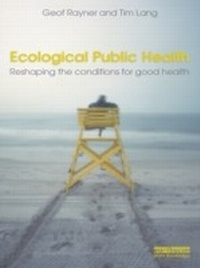
Ecological Public Health
Reshaping the Conditions for Good Health
1st Edition
Published on 19. June 2013
432 pages
978-1-136-48271-7 (ISBN)
Description

What is public health? To some, it is about drains, water, food and housing, all requiring engineering and expert management. To others, it is the State using medicine or health education and tackling unhealthy lifestyles.
This book argues that public health thinking needs an overhaul, a return to and modernisation around ecological principles. Ecological Public Health thinking, outlined here, fits the twenty-first century's challenges. It integrates what the authors call the four dimensions of existence: the material, biological, social and cultural aspects of life. Public health becomes the task of transforming the relationship between people, their circumstances and the biological world of nature and bodies. For Geof Rayner and Tim Lang, this is about facing a number of long-term transitions, some well recognized, others not. These transitions are Demographic, Epidemiological, Urban, Energy, Economic, Nutrition, Biological, Cultural and Democracy itself.
The authors argue that identifying large scale transitions such as these refocuses public health actions onto the conditions on which human and eco-systems health interact. Making their case, Rayner and Lang map past confusions in public health images, definitions and models. This is an optimistic book, arguing public health can be rescued from its current dilemmas and frustrations. This century's agenda is unavoidably complex, however, and requires stronger and more daring combinations of interdisciplinary work, movements and professions locally, nationally and globally. Outlining these in the concluding section, the book charts a positive and reinvigorated institutional purpose.
This book argues that public health thinking needs an overhaul, a return to and modernisation around ecological principles. Ecological Public Health thinking, outlined here, fits the twenty-first century's challenges. It integrates what the authors call the four dimensions of existence: the material, biological, social and cultural aspects of life. Public health becomes the task of transforming the relationship between people, their circumstances and the biological world of nature and bodies. For Geof Rayner and Tim Lang, this is about facing a number of long-term transitions, some well recognized, others not. These transitions are Demographic, Epidemiological, Urban, Energy, Economic, Nutrition, Biological, Cultural and Democracy itself.
The authors argue that identifying large scale transitions such as these refocuses public health actions onto the conditions on which human and eco-systems health interact. Making their case, Rayner and Lang map past confusions in public health images, definitions and models. This is an optimistic book, arguing public health can be rescued from its current dilemmas and frustrations. This century's agenda is unavoidably complex, however, and requires stronger and more daring combinations of interdisciplinary work, movements and professions locally, nationally and globally. Outlining these in the concluding section, the book charts a positive and reinvigorated institutional purpose.
Reviews / Votes
Ecological Public Health came Highly Commended in the Public Health category for the 2013 BMA Medical Book and Patient Information Awards."Rich in understanding the history of the public health movement, the authors argue that a new ecological sense of public health is emerging based on the recognition of the limits on nature, that nature no longer offers an endless cornucopia of its resources for human use or that the biological world can be ceaselessly altered to human advantage." - Food Ethics Council Newsletter, July 2012
"...this book offers an exemplary account of ecological thinking and is extremely persuasive in arguing for the adoption of an ecological perspective when addressing the seemingly intractable health problems of modern society. It has the scope to invigorate public health, as both project and practice, by providing new and important ways of thinking about both the aetiology of health and respondent intervention activities. As a result, I would recommend it to anyone with an interest in public health, from students and academics to policy makers and practitioners." - Rhiannon Evans, Cardiff University, in Critical Public Health (2013, vol.23)
"Their analysis of the food system, its current negative impacts and the potential for change is exemplary, drawing on their own scholarship and work with policy makers... Overall, the authors' work on historical and conceptual synthesis is illuminating." - Donald C. Cole, University of Toronto, Canada
More details
Language
English
Place of publication
London
United Kingdom
Publishing group
Taylor & Francis Ltd
Target group
College/higher education
Professional and scholarly
Illustrations
12 s/w Tabellen, 40 s/w Abbildungen
12 Tables, black and white; 40 Illustrations, black and white
File size
9,41 MB
ISBN-13
978-1-136-48271-7 (9781136482717)
Copyright in bibliographic data and cover images is held by Nielsen Book Services Limited or by the publishers or by their respective licensors: all rights reserved.
Schweitzer Classification
Other editions
Additional editions

Book
04/2012
Earthscan Ltd
€85.60
Shipment within 3-4 weeks
Book
04/2012
1st Edition
Earthscan Ltd
€253.30
Shipment within 3-4 weeks
Persons
Both authors have long been active in the international public health movement as practitioners, advocates, researchers and thinkers. Geof Rayner PhD is an independent social scientist working in public health, and is currently a Research Fellow at the Centre for Food Policy, City University London and Professor Associate at Brunel University. Tim Lang PhD is a social scientist specialising in food, public health, the environment and social justice, and is Professor of Food Policy at City University London.
Content
Preface Acknowledgements Glossary Part 1: Images and Models of Public Health 1. Introducing the Notion of Ecological Public Health 2. Defining Public Health 3. The Recevied Wisdom of Public Health Part 2: The Transitions which Public Health has to Address Introduction to Part 2 4. Demographic Transition 5. Epidemiological and Health Transition 6. Urban Transition 7. Energy Transition 8. Economic Transition 9. The Nutrition Transition 10. Biological and Ecological Transition 11. Cultural Transition 12. Democratic Transition Conclusion to Part 2 - An Overview of the Transitions Part 3: Reshaping the Conditions for Good Health 13. The Implications of Ecological Public Health References Index
