

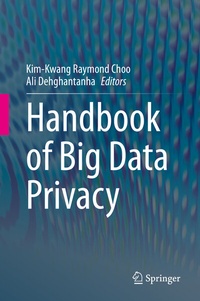
Handbook of Big Data Privacy
1st Edition
Published on 18. March 2020
IX, 397 pages
978-3-030-38557-6 (ISBN)
Description

This handbook provides comprehensive knowledge and includes an overview of the current state-of-the-art of Big Data Privacy, with chapters written by international world leaders from academia and industry working in this field. The first part of this book offers a review of security challenges in critical infrastructure and offers methods that utilize acritical intelligence (AI) techniques to overcome those issues. It then focuses on big data security and privacy issues in relation to developments in the Industry 4.0. Internet of Things (IoT) devices are becoming a major source of security and privacy concern in big data platforms. Multiple solutions that leverage machine learning for addressing security and privacy issues in IoT environments are also discussed this handbook.
The second part of this handbook is focused on privacy and security issues in different layers of big data systems. It discusses about methods for evaluating security and privacy of big data systems on network, application and physical layers. This handbook elaborates on existing methods to use data analytic and AI techniques at different layers of big data platforms to identify privacy and security attacks. The final part of this handbook is focused on analyzing cyber threats applicable to the big data environments. It offers an in-depth review of attacks applicable to big data platforms in smart grids, smart farming, FinTech, and health sectors. Multiple solutions are presented to detect, prevent and analyze cyber-attacks and assess the impact of malicious payloads to those environments.
This handbook provides information for security and privacy experts in most areas of big data including; FinTech, Industry 4.0, Internet of Things, Smart Grids, Smart Farming and more. Experts working in big data, privacy, security, forensics, malware analysis, machine learning and data analysts will find this handbook useful as areference. Researchers and advanced-level computer science students focused on computer systems, Internet of Things, Smart Grid, Smart Farming, Industry 4.0 and network analysts will also find this handbook useful as a reference.
The second part of this handbook is focused on privacy and security issues in different layers of big data systems. It discusses about methods for evaluating security and privacy of big data systems on network, application and physical layers. This handbook elaborates on existing methods to use data analytic and AI techniques at different layers of big data platforms to identify privacy and security attacks. The final part of this handbook is focused on analyzing cyber threats applicable to the big data environments. It offers an in-depth review of attacks applicable to big data platforms in smart grids, smart farming, FinTech, and health sectors. Multiple solutions are presented to detect, prevent and analyze cyber-attacks and assess the impact of malicious payloads to those environments.
This handbook provides information for security and privacy experts in most areas of big data including; FinTech, Industry 4.0, Internet of Things, Smart Grids, Smart Farming and more. Experts working in big data, privacy, security, forensics, malware analysis, machine learning and data analysts will find this handbook useful as areference. Researchers and advanced-level computer science students focused on computer systems, Internet of Things, Smart Grid, Smart Farming, Industry 4.0 and network analysts will also find this handbook useful as a reference.
More details
Other editions
Additional editions
Kim-Kwang Raymond Choo | Ali Dehghantanha
Handbook of Big Data Privacy
Book
03/2020
Springer
€192.59
Shipment within 7-9 days
Persons
Kim-Kwang Raymond Choo holds the Cloud Technology Endowed Professorship at The University of Texas at San Antonio (UTSA), San Antonio, TX, USA. In 2015 he and his team won the Digital Forensics Research Challenge organized by Germany's University of Erlangen-Nuremberg. He is the recipient of the 2019 IEEE TCSC Award for Excellence in Scalable Computing (Middle Career Researcher), 2018 UTSA College of Business Col. Jean Piccione and Lt. Col. Philip Piccione Endowed Research Award for Tenured Faculty, British Computer Society's 2019 Wilkes Award Runner-up, 2019 EURASIP JWCN Best Paper Award, Korea Information Processing Society's JIPS Survey Paper Award (Gold) 2019, IEEE Blockchain 2019 Outstanding Paper Award, Best Paper Awards from IEEE TrustCom 2018 and ESORICS 2015, Fulbright Scholarship in 2009, 2008 Australia Day Achievement Medallion, and British Computer Society's Wilkes Award in 2008. He is also a Fellow of the Australian Computer Society, an IEEE Senior Member, and Co-Chair of IEEE Multimedia Communications Technical Committee's Digital Rights Management for Multimedia Interest Group.
Ali Dehghantanha is the director of Cyber Science Lab in the University of Guelph, Ontario, Canada. His lab is focused on building AI-powered solutions to support cyber threat attribution, cyber threat hunting and digital forensics tasks in Internet of Things (IoT), Industrial IoT, and Internet of Military of Things (IoMT) environments. Ali has served for more than a decade in a variety of industrial and academic positions with leading players in cyber security and AI. Prior to joining UofG, he has served as a Sr. Lecturer in the University of Sheffield - UK. He is an EU Marie-Curie Fellow alumnus and an IEEE Sr. member. He received his Ph.D. in Security in Computing in 2011 and his M.Sc. in Security in Computing in 2008.
Ali Dehghantanha is the director of Cyber Science Lab in the University of Guelph, Ontario, Canada. His lab is focused on building AI-powered solutions to support cyber threat attribution, cyber threat hunting and digital forensics tasks in Internet of Things (IoT), Industrial IoT, and Internet of Military of Things (IoMT) environments. Ali has served for more than a decade in a variety of industrial and academic positions with leading players in cyber security and AI. Prior to joining UofG, he has served as a Sr. Lecturer in the University of Sheffield - UK. He is an EU Marie-Curie Fellow alumnus and an IEEE Sr. member. He received his Ph.D. in Security in Computing in 2011 and his M.Sc. in Security in Computing in 2008.
Content
1. Big Data and Privacy : Challenges and Opportunities.- 2. AI and Security of Critical Infrastructure.- 3. Industrial Big Data Analytics: Challenges and Opportunities.- 4. A Privacy Protection Key Agreement Protocol Based on ECC for Smart Grid.- 5. Applications of Big Data Analytics and Machine Learning in the Internet of Things.- 6. A Comparison of State-of-the-art Machine Learning Models for OpCode-Based IoT Malware Detection.- 7. Artificial Intelligence and Security of Industrial Control Systems.- 8. Enhancing Network Security via Machine Learning: Opportunities and Challenges.- 9. Network Security and Privacy Evaluation Scheme for Cyber Physical Systems (CPS).- 10. Anomaly Detection in Cyber-Physical Systems Using Machine Learning.- 11. Big Data Application for Security of Renewable Energy Resources.- 12. Big-Data and Cyber-Physical Systems in Healthcare: Challenges and Opportunities.- 13. Privacy Preserving Abnormality Detection: A Deep Learning Approach.-14. Privacy and Security in Smart and Precision Farming: A Bibliometric Analysis.- 15. A Survey on Application of Big Data in Fin Tech Banking Security and Privacy.- 16. A Hybrid Deep Generative Local Metric Learning Method For Intrusion Detection.- 17. Malware elimination impact on dynamic analysis: An experimental machine learning approach.- 18. RAT Hunter: Building Robust Models for Detecting Remote Access Trojans Based on Optimum Hybrid Features.- 19. Active Spectral Botnet Detection based on Eigenvalue Weighting.-
