

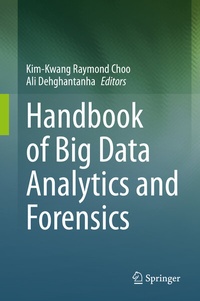
Handbook of Big Data Analytics and Forensics
Description

This handbook discusses challenges and limitations in existing solutions, and presents state-of-the-art advances from both academia and industry, in big data analytics and digital forensics. The second chapter comprehensively reviews IoT security, privacy, and forensics literature, focusing on IoT and unmanned aerial vehicles (UAVs). The authors propose a deep learning-based approach to process cloud's log data and mitigate enumeration attacks in the third chapter. The fourth chapter proposes a robust fuzzy learning model to protect IT-based infrastructure against advanced persistent threat (APT) campaigns. Advanced and fair clustering approach for industrial data, which is capable of training with huge volume of data in a close to linear time is introduced in the fifth chapter, as well as offering an adaptive deep learning model to detect cyberattacks targeting cyber physical systems (CPS) covered in the sixth chapter.
The authors evaluate the performance of unsupervised machine learning for detecting cyberattacks against industrial control systems (ICS) in chapter 7, and the next chapter presents a robust fuzzy Bayesian approach for ICS's cyber threat hunting. This handbook also evaluates the performance of supervised machine learning methods in identifying cyberattacks against CPS. The performance of a scalable clustering algorithm for CPS's cyber threat hunting and the usefulness of machine learning algorithms for MacOS malware detection are respectively evaluated.
This handbook continues with evaluating the performance of various machine learning techniques to detect the Internet of Things malware. The authors demonstrate how MacOSX cyberattacks can be detected using state-of-the-art machine learning models. In order to identify credit card frauds, the fifteenth chapter introduces a hybrid model. In the sixteenth chapter, the editors propose a model that leverages natural language processing techniques for generating a mapping between APT-related reports and cyber kill chain. A deep learning-based approach to detect ransomware is introduced, as well as a proposed clustering approach to detect IoT malware in the last two chapters.
This handbook primarily targets professionals and scientists working in Big Data, Digital Forensics, Machine Learning, Cyber Security Cyber Threat Analytics and Cyber Threat Hunting as a reference book. Advanced level-students and researchers studying and working in Computer systems, Computer networks and Artificial intelligence will also find this reference useful.
More details
Other editions
Additional editions
Persons
Since receiving his PhD in 2011, Dr. Dehghantanha has made significant contributions to the fast-moving fields of cybersecurity and cyber threat intelligence. He is a Canada Research Chair in Cybersecurity and Threat Intelligence, and an EU Marie-Curie Fellow Alumni in digital forensics. Dr. Dehghantanha has pioneered the use of ML-based systems for threat hunting in IoT/ICS devices using physical characteristics(e.g. power consumption) as opposed to application-level characteristics (e.g. IP addresses). His works have resulted in an Intrusion Detection System (IDS) for IoT networks; and deep learning models for threat hunting in the edge layer of ICS networks. In 2019, with support from the Department of National Defense Canada, he has developed the first multi-view fuzzy machine learning system for cyber threat attribution. He is among few academics contributing to fundamental research in cyber threat intelligence, with most research taking place in industry settings. His work helps define this new discipline while informing practical strategies. He has built a Cyber Kill Chain-based threat intelligence framework for analyzing banking Trojan campaigns which is widely used to model different attack campaigns, including APT groups activities, analyzing crypto-ransomware campaigns, and analyzing Advanced Persistent Threat (APT) groups targeting critical national infrastructure. He is currently the director of Cyber Science Lab at the University of Guelph, Ontario, Canada.
