

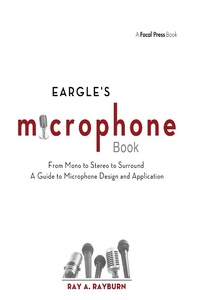
Eargle's The Microphone Book
From Mono to Stereo to Surround - A Guide to Microphone Design and Application
3rd Edition
Published on 12. November 2012
480 pages
978-1-136-11814-2 (ISBN)
Description

Eargle's Microphone Book is the only guide you will ever need for the latest in microphone technology, application and technique. This new edition features more on microphone arrays and wireless microphones, new material on digital models; the latest developments in surround; expanded advice on studio set up, recording and mic selection.
Ray A. Rayburn provides detailed analysis of the different types of microphones available and addresses their application through practical examples of actual recording sessions and studio operations.
The book takes you into the studio or concert hall to see how performers are positioned and how the best microphone array is determined. Problem areas such as reflections, studio leakage and isolation are analyzed from practical viewpoints. Creative solutions to stereo sound staging, perspective, and balance are covered in detail. Eargle's Microphone Book is an invaluable resource for learning the 'why' as well as the 'how' of choosing and placing a microphone for any situation.
Ray A. Rayburn provides detailed analysis of the different types of microphones available and addresses their application through practical examples of actual recording sessions and studio operations.
The book takes you into the studio or concert hall to see how performers are positioned and how the best microphone array is determined. Problem areas such as reflections, studio leakage and isolation are analyzed from practical viewpoints. Creative solutions to stereo sound staging, perspective, and balance are covered in detail. Eargle's Microphone Book is an invaluable resource for learning the 'why' as well as the 'how' of choosing and placing a microphone for any situation.
Reviews / Votes
"...this is a very interesting book which is well written and copiously illustrated with both graphs and pictures throughout. For anyone involved in using, specifying or manufacturing microphones this will prove an invaluable read." - Lighting and Sound International"Besides being a "must-have? reference source for recording engineers, producers or anybody who desires to better understand and utilize mics, The Microphone Book is an engaging read from its first chapter on microphone history to the 21st chapter and Eargle's unique take on classic microphones and their influence on the art and science of recording...The Microphone Book is unique in its balance of broad and meticulously detailed practical information." - Music Connection magazine
Reviews for the previous edition:
"John has brought his successful experience in classical and other music recording to the book's many pages, and one can find the best microphone arrangements for nearly every conceivable situation and guides to proceed for the more unusual ones." - The American Organist
"John Eargle has prepared another useful book for audio system contractors, engineers, designers and enthusiasts.?
Sound & Communications magazine
"Highly recommended for everyone who wants to know more. Read it.?
Amazon.com customer review
"The Microphone Book will save you time and money, even if you only ever buy one microphone to use in a home studio. If you do live sound, record on location, or are kitting out a slightly more ambitious project studio, then this book will be invaluable. It takes you far further than the 'microphone' sections of general guides to studio recording.?
Amazon.co.uk customer review "This book is a must for people in the recording and road show industry. It will not only help them understand the physics of microphones but also proper microphone placement.?
Glen Ballou, editor of The Handbook for Sound Engineers
More details
Series
Edition
3rd edition
Language
English
Place of publication
London
United Kingdom
Publishing group
Taylor & Francis Ltd
Target group
Professional and scholarly
Recording, sound reinforcement and system design engineers; television, film, and radio engineers. <BR id="CRLF">Suitable for engineers at all levels of expertise, applicable for both studio and location work
Edition type
Revised edition
File size
26,30 MB
ISBN-13
978-1-136-11814-2 (9781136118142)
Copyright in bibliographic data and cover images is held by Nielsen Book Services Limited or by the publishers or by their respective licensors: all rights reserved.
Schweitzer Classification
Other editions
Additional editions
Ray Rayburn
Eargle's The Microphone Book
From Mono to Stereo to Surround - A Guide to Microphone Design and Application
Book
07/2017
3rd Edition
Routledge
€248.50
Shipment within 10-20 days
Ray Rayburn
Eargle's The Microphone Book
From Mono to Stereo to Surround - A Guide to Microphone Design and Application
Book
10/2011
3rd Edition
Focal Press
€96.10
Shipment within 15-20 days
Person
Ray A. Rayburn, Senior Consultant with K2 Audio LLC. Member of the AES Standards Working Group on Microphones, and Chair of the Standards sub-committee on Interconnections. Recording engineer. Lifetime interest in microphone use, testing, and design.
Content
A Short History of the Microphone
Basic Sound Transmission and Operational Forces on Microphones
The Pressure Microphone
The Pressure Gradient Microphone
First-Order Directional Microphones
High-Directionality Microphones
Microphone Measurements, Standards, and Specifications
Electrical Considerations and Electronic Interface
Overview of Wireless Microphone Technology; Microphone Accessories
Basic Stereophonic Techniques
Stereo Microphones; Classical Stereo
Recording Techniques and Practice
Studio Recording Techniques
Surround Sound Microphone Technology
Surround Recording Case Studies
A Survey of Microphones in Broadcast and Communications
Fundamentals of Speech and Music Reinforcement
Overview of Microphone Arrays and Adaptive Systems
Care and Maintenance of Microphones
Classic Microphones: The Author's View
Basic Sound Transmission and Operational Forces on Microphones
The Pressure Microphone
The Pressure Gradient Microphone
First-Order Directional Microphones
High-Directionality Microphones
Microphone Measurements, Standards, and Specifications
Electrical Considerations and Electronic Interface
Overview of Wireless Microphone Technology; Microphone Accessories
Basic Stereophonic Techniques
Stereo Microphones; Classical Stereo
Recording Techniques and Practice
Studio Recording Techniques
Surround Sound Microphone Technology
Surround Recording Case Studies
A Survey of Microphones in Broadcast and Communications
Fundamentals of Speech and Music Reinforcement
Overview of Microphone Arrays and Adaptive Systems
Care and Maintenance of Microphones
Classic Microphones: The Author's View
