

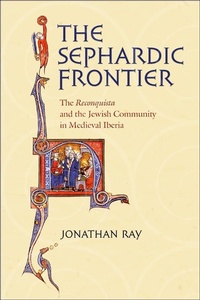
The Sephardic Frontier
The "Reconquista" and the Jewish Community in Medieval Iberia
Published on 15. February 2013
224 pages
978-0-8014-6826-1 (ISBN)
Description

No subject looms larger over the historical landscape of medieval Spain than that of the reconquista, the rapid expansion of the power of the Christian kingdoms into the Muslim-populated lands of southern Iberia, which created a broad frontier zone that for two centuries remained a region of warfare and peril. Drawing on a large fund of unpublished material in royal, ecclesiastical, and municipal archives as well as rabbinic literature, Jonathan Ray reveals a fluid, often volatile society that transcended religious boundaries and attracted Jewish colonists from throughout the peninsula and beyond.
The result was a wave of Jewish settlements marked by a high degree of openness, mobility, and interaction with both Christians and Muslims. Ray's view challenges the traditional historiography, which holds that Sephardic communities, already fully developed, were simply reestablished on the frontier. In the early years of settlement, Iberia's crusader kings actively supported Jewish economic and political activity, and Jewish interaction with their Christian neighbors was extensive.
Only as the frontier was firmly incorporated into the political life of the peninsular states did these frontier Sephardic populations begin to forge the communal structures that resembled the older Jewish communities of the North and the interior. By the end of the thirteenth century, royal intervention had begun to restrict the amount of contact between Jewish and Christian communities, signaling the end of the open society that had marked the frontier for most of the century.
The result was a wave of Jewish settlements marked by a high degree of openness, mobility, and interaction with both Christians and Muslims. Ray's view challenges the traditional historiography, which holds that Sephardic communities, already fully developed, were simply reestablished on the frontier. In the early years of settlement, Iberia's crusader kings actively supported Jewish economic and political activity, and Jewish interaction with their Christian neighbors was extensive.
Only as the frontier was firmly incorporated into the political life of the peninsular states did these frontier Sephardic populations begin to forge the communal structures that resembled the older Jewish communities of the North and the interior. By the end of the thirteenth century, royal intervention had begun to restrict the amount of contact between Jewish and Christian communities, signaling the end of the open society that had marked the frontier for most of the century.
Reviews / Votes
Ray examines the early development of Jewish communities in the various peninsular kingdoms during the transition from Muslim to Christian rule. He contends that the social, political, and economic factors of the frontier during the second half of the thirteenth century helped to create Jewish communities characterized by a high degree of fluidity.... Insightful and engaging.(Booklist) Using rabbinic sources and unpublished archives, Jonathan Ray brings Jewish settlement of the southern Iberian peninsula into clearer focus.... This interesting and lively book challenges the image of medieval Spanish and Portuguese society as invariably corporate and religious in its organization. The high medieval Iberian frontier, at least, was a place where the quest of individuals and families for financial and social opportunity took precedence over loyalty to rigidly defined confessional groups.
- Jessica A. Coope (American Historical Review)
More details
Series
Language
English
Place of publication
Ithaca
United States
Target group
College/higher education
Professional and scholarly
Product notice
Reflowable
ISBN-13
978-0-8014-6826-1 (9780801468261)
Copyright in bibliographic data and cover images is held by Nielsen Book Services Limited or by the publishers or by their respective licensors: all rights reserved.
Schweitzer Classification
Other editions
Additional editions
Book
04/2008
Cornell University Press
€24.50
Shipment within 10-20 days
Book
06/2006
Cornell University Press
€73.04
Shipment within 10-20 days
Person
Jonathan Ray is the Samuel Eig Assistant Professor of Jewish Studies in the Theology Department at Georgetown University.
Content
<pre>
Contents
Acknowledgments vii
List of Abbreviations ix
Introduction 1
Part I. The Jewish Settler and the Frontier 00
1. The Migration of Jewish Settlers to the Frontier 00
2. Jewish Land Ownership 00
3. Moneylending and Beyond: The Jews in the Economic Life of the Frontier 00
Part II. The Jewish Community and the Frontier 000
4. Royal Authority and the Legal Status of Iberian Jewry 000
5. Jewish Communal Organization and Authority 000
6. Communal Tensions and the Question of Jewish Autonomy 000
7. Maintenance of Social Boundaries on the Iberian Frontier 000
Conclusion 000
Glossary 000
Bibliography 000
Index 000
</pre>
