

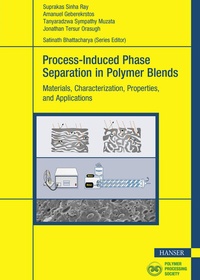
Process-Induced Phase Separation in Polymer Blends
Materials, Characterization, Properties, and Applications
1st Edition
Published on 17. April 2023
216 pages
978-1-56990-919-5 (ISBN)
Description

Phase separation in polymer blends has achieved a tremendous techno-commercial importance. Most of the applications of polymer blends, such as tissue engineering, membrane technology, electromagnetic shielding, energy harvesting, structural materials, packaging, smart multiphase polymer coatings, depend on the morphologies developed during processing.
This book outlines the fundamental aspects of polymer blend thermodynamics, the state-of-the-art processing techniques for specific polymer blend systems currently in use, and the design and fabrication of multiphasic polymeric materials, which will present a multiplicity of opportunities in the water remediation, packaging, and electronic industries, to mention a few. It emphasizes recent research developments, processing techniques, characterization methods, factors influencing phase separation temperature in phase-separated, including partially miscible, polymer blends, and key research challenges in the development of phase-separated polymers materials.
With unique and systematic coverage of the journey from fundamentals to applications in polymer blends, this book is ideal for polymer scientists and engineers, material scientists, researchers, engineers, and under- and post-graduate students who are interested in this exciting field of research. It will help industrial researchers and R&D managers bring advanced phase-separated polymer materials/products to the market.
More details
Other editions
Additional editions
Suprakas Sinha Ray | Amanuel Geberekrstos | Tanyaradzwa Sympathy Muzata
Process-Induced Phase Separation in Polymer Blends
Materials, Characterization, Properties, and Applications
Book
04/2023
1st Edition
Hanser Publications
€179.99
Shipment within 3-4 weeks
Persons
Author
Professor Suprakas Sinha Ray is a Chief Research Scientist and Manager of the Centre for Nanostructures and Advanced Materials, DSI-CSIR Nanotechnology Innovation Centre, Council for Scientific and Industrial Research, Pretoria, South Africa. His research focuses on the applications of advanced nanostructured & polymeric materials.
ISNI:
ISNI:
Dr. Amanuel Geberekrstos is a Postdoctoral Fellow at Department Chemical Sciences, University of Johannesburg and also associated as a senior researcher at Centre for Nanostructures and Advanced Materials, DSI-CSIR Nanotechnology Innovation Centre, Council for Scientific and Industrial Research, Pretoria, South Africa.
ISNI:
ISNI:
Dr. Tanyaradzwa Sympathy Muzata is a Postdoctoral Fellow at Department Chemical Sciences, University of Johannesburg and also associated as a senior researcher at Centre for Nanostructures and Advanced Materials, DSI-CSIR Nanotechnology Innovation Centre, Council for Scientific and Industrial Research, Pretoria.
ISNI:
ISNI:
Dr. Jonathan Tersur Orasugh is a Postdoctoral Fellow at Department Chemical Sciences, University of Johannesburg and also associated as a senior researcher at Centre for Nanostructures and Advanced Materials, DSI-CSIR Nanotechnology Innovation Centre, Council for Scientific and Industrial Research, Pretoria.
ISNI:
ISNI:
Content
- Intro
- Editorial Advisory Board
- The Authors
- Preface
- Contents
- 1 Introduction
- 1.1 Overview of the Polymer Blend Technology
- 1.1.1 Demixing in Polymer Blend Systems
- 1.2 Different Types of Miscible Polymer Blend Systems
- 1.2.1 PMMA/SAN Blend Systems
- 1.2.2 PS/PVME Blend Systems
- 1.2.3 PVDF/PMMA Blend Systems
- 1.3 Immiscible Polymer Blend Systems
- 1.3.1 Polypropylene (PP)-Based Blend Systems
- 1.3.2 PE-Based Polymer Blend Systems
- 1.3.3 PC-Based Polymer Blend Systems
- 1.4 Biobased Polymer Blend Systems
- 1.5 Industrial Significance and Commercial Applications of Different Polymer Blend Systems
- 1.6 Conclusions
- 2 Phase Separation, Heterogeneous Behavior and Prevention of Phase Separation
- 2.1 Basic Concept of Polymer Blends
- 2.2 Theories of Polymer Solutions
- 2.2.1 The Ideal Solutions of Small Molecules
- 2.2.2 Non-ideal Polymer Solutions
- 2.3 Mechanism of Phase Separation
- 2.4 Different Types of Morphologies
- 2.5 Influence of Compatibilizers on Morphology and the Phase Separation Behavior of Polymer Blends
- 2.5.1 Influence of Reactive Compatibilization
- 2.5.2 Particle-Induced Compatibilization
- 2.5.3 Role of Janus Hybrid Particles
- 2.6 Conclusions
- 3 Crystallization and Melting Kinetics of Phase Separated Polymer Blends
- 3.1 Introduction
- 3.2 Crystallization Kinetics from Melt
- 3.3 Theories of Nucleation and Growth
- 3.3.1 Homogeneous Nucleation
- 3.3.2 Heterogeneous Nucleation
- 3.3.3 Spherulite Growth and Fold Surface Free Energy
- 3.4 Crystallization Behavior (Isothermal and Non-isothermal) of Polymer Blends
- 3.5 Influence of Fillers on the Morphology and Crystalline Structure of Binary Polymer Blends
- 3.6 Impact of Compatibilizers on the Crystallization Morphology and Crystallization Rate of Polymer Blends
- 3.7 Conclusions
- 4 Theoretical Studies of Phase Separation in Polymer Blends
- 4.1 Introduction
- 4.2 Flory-Huggins Theory
- 4.3 Chad-Hilliard-Cook Theory
- 4.4 Landau-Ginzburg Theory
- 4.5 Conclusions
- 5 Processing of Phase-Separated Blends
- 5.1 Introduction
- 5.2 Processing Methods
- 5.2.1 Melt Compounding
- 5.2.2 Solution Blending
- 5.2.3 Latex Mixing
- 5.2.4 Interpenetrating Polymer Networks (IPNs)
- 5.2.5 Graft Copolymerization
- 5.2.6 In Situ Polymerization
- 5.2.7 Mill Mixing
- 5.3 Characterization of Phase-Separated Polymer Blends
- 5.4 Conclusions
- 6 Experimental Approaches for the Evaluation of Phase Separation Process in Polymer Blends
- 6.1 Introduction
- 6.2 Evaluation of Phase Separation Behavior in Polymer Blends by DSC
- 6.3 Evaluation of Phase Separation Behavior in Polymer Blends by DMA
- 6.4 Evaluation of Phase Separation Behavior in Polymer Blends by Rheology
- 6.5 Evaluation of Phase Separation Behavior in Polymer Blends by Broadband Dielectric Relaxation Spectroscopy
- 6.6 Evaluation of Phase Separation Behavior in Polymer Blends by Transmission Electron Microscope
- 6.7 Evaluation of Phase Separation Behavior in Polymer Blends by Scanning Electron Microscope
- 6.8 Evaluation of Phase Separation Behavior in Polymer Blends by Optical Microscope
- 6.9 Evaluation of Phase Separation Behavior in Polymer Blends by Atomic Force Microscope
- 6.10 Conclusions
- 7 Factors Influencing Phase Separation in Partially Miscible Polymer Blends
- 7.1 Introduction
- 7.2 Processing Techniques
- 7.2.1 Solution Mixing and Film Casting
- 7.2.2 Doctor Blade
- 7.2.3 Electrospinning
- 7.2.4 Spin Coating
- 7.2.5 Compression Molding
- 7.2.6 Incorporation of Nanoparticles
- 7.3 Conclusions
- 8 Interfacial Modification of Immiscible Polymer Blends
- 8.1 Introduction
- 8.2 Block Copolymers
- 8.3 Janus Nanoparticles
- 8.4 Compatibilization by Nanoparticles
- 8.4.1 Graphene Oxide
- 8.4.2 Carbon Nanotubes
- 8.5 Conclusions
- 9 Applications of Immiscible Polymer Blends
- 9.1 Introduction
- 9.2 Gas and Moisture Barrier Applications
- 9.3 Gas Sensing Applications
- 9.4 Membranes for Water Remediation
- 9.5 Electromagnetic Interference Shielding Materials
- 9.6 Conclusions
- Index
1. Introduction
2. Basic concepts of polymer blends
3. Crystallization and melting kinetics of polymer blends
4. Theoretical studies of phase separation in polymer blends
5. Preparation and characterization of phase-separated polymer blends
6. Characterizations of polymer blends and multiphase polymer blend systems
7. Factors Influencing phase separation temperature in partially miscible polymer blends
8. Interfacial modification of Immiscible polymer blends
9. Application of phase-separated polymer blends
10. Challenges and future prospects
