

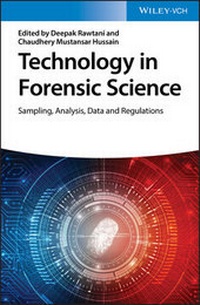
Technology in Forensic Science
Description

More details
Other editions
Additional editions
Persons
Chaudhery Mustansar Hussain, PhD, is Adjunct Professor in the Department of Chemistry & Environmental Sciences at the New Jersey Institute of Technology (NJIT), USA. His research is focused on the applications of nanotechnology and advanced materials in the environment and analytical chemistry. Dr. Hussain is the author of numerous papers in peer-reviewed journals as well as prolific author and editor of several scientific monographs and handbooks in his research areas.
Content
Software-Defined Networking Enabled Smart and Safer Buildings
Advanced Forensic Models
PART II: FORENSIC SAMPLES
Biological Evidence and Their Handling
Physical Evidence and Their Handling
Chemical Evidence and Their Handling
PART III: ANALYTICAL TECHNIQUES FOR FORENSIC SCIENCE
Microscopy for Forensic Investigations
Chromatographic Techniques Forensic Investigations
Hyphenated Techniques for Forensic Investigations
PART IV: BIOMETRICS TECHNOLOGY FOR FORENSIC SCIENCE
Conventional Biometric Techniques in Forensic Investigations
Emerging Biometric Techniques in Forensic Investigations
PART V: SENSORS TECHNOLOGY FOR FORENSIC SCIENCE
Sensors for the Detection of Explosives and Gunshots Residues
Sensors for the Detection of Illicit Drugs
Sensors for the Detection of Biological Fluids
PART VI: EMERGING TECHNOLOGIES (NANOTECHNOLOGY, TAGGANT TECHNOLOGY ETC.)
Nanotechnology in Forensic Science
Taggant Technology in Forensic Science
PART VII: ETHICAL AND LEGAL ISSUES OF FORENSIC SCIENCE
Conventional and Internal Standards in Forensic Sciences
Evidence Collection and Forensics on Social Networks
PART VIII: ECONOMICS & COMMERCIALIZATION OF FORENSIC SCIENCE TECHNOLOGIES
Commercialization on the Evaluation of Evidence
Commercialized of Regulatory Forensic Program
PART IX: FUTURE OF FORENSIC SCIENCE TECHNOLOGIES
Future of Forensic and Crime Scene Science Technologies
Forensic Science in a Process of Transition
1
History of Forensic Science
Kavya Hemanth, Maithri Tharmavaram, and Gaurav Pandey*
Gujarat Forensic Sciences University, Institute of Research and Development, Sector 9, Gandhinagar, 382007, Gujarat, India
1.1 Introduction
In ancient world, the king used to decide the culprit and punish them, which were very cruel in nature. These punishments were applied in favor of their existence, just to show how powerful they are. Gradually everything changed; the man with knowledge replaced the king, and punishments were given with respect to the intensity of the crime the culprit had committed. Now when a crime occurs, the court of law decides the culprit, and punishment are based on the evidence and statements produced by the authorized officials in front of the court. During the time of Romans, the incident was narrated in front of the public. The culprit and the victim were given a chance to deliver their words based on their side of the story to prove their innocence and escape from the punishment and further procedures or consequences of committing a crime at that time. The individual with the best argument would win the debate of proving the crime, and based on the points of argument, the public or the people with higher power determine the outcome of the case.
Our ancestors applied forensic science in various fields, without knowing the science behind it. Now, forensic science has turned into a wide branch, which is used to solve crimes and in other purposes also. In this chapter we are mainly discussing about the main branches of forensic science that include forensic chemistry, forensic toxicology, and forensic behavioral science, questioned document, fingerprint forensics, digital forensics, cyber forensics, forensic anthropology, criminology, forensic biology, forensic ballistics, forensic serology, and so on. One of the important parts of forensic science is that the contamination of the sample collected and crime scene is low as compared to earlier centuries. The analyzed records are being preserved for the future requirements. The forensic investigators follow a particular procedure during their investigation including seizing the crime scene, collection of evidences, forwarding to the laboratories, questioning, and making reports of the statements given by witnesses, suspect, victim, and scientific officer, till they produce their concluded report to the court (Rawtani et al. 2019).
Forensic science in its modern form is not a new methodology, especially to the Indian investigation. In India, the ancestors around 2300 years ago had mentioned the application of science for investigating in Arthashastra (Grover and Tyagi 2014) written by Kautilya (also known as Chanakya), the prime minister of The Great Mauryan Empire (Ranade 2011). Kautilya discussed about the maintenance of law and order by the ruling government. The laws that were discussed in his book Arthashastra were derived from four sources. These four sources are dharma, scared law based on truth (Ranade 2011); vyahara, evidence based on the witnesses (Ranade 2011); charita, history and custom based on tradition accepted by the people (Ranade 2011); and rajasasana, edicts of the king, i.e. the laws as promulgated (Ranade 2011).
In earlier days Indians used signature occasionally without knowing science behind it. It is being mentioned in the ancient Chinese records that the fingerprints were used by the ancient kingdom of south India. They named the handprints as Tarija (Grover and Tyagi 2014) and these were inimitable. Under a chance of probability, it is believed that the Indian ancestors had the knowledge about the persistency and individuality of fingerprint.
In 1849, the first chemical examination laboratory was established under the department of health in Madras Presidency (Nabar 1988), since many people died due to the consumption of poisonous substances in the nineteenth century. This was introduced to detect and analyze the various poisonous substances and their poisons; they took over the chemical analysis and toxicological analysis. After the independence, the modernization of the techniques in crime investigation needed a great improvement. In the year 1897, the first fingerprint bureau was established in Calcutta (Nabar 1988). The history of forensic science is shown in a chronological fashion in Table 1.1.
A special branch of laboratories is being introduced in each country to analyze the evidences collected. After all it's a chance of prediction and probability to reach the accurate result. Forensic science helps in criminal profiling, identifying the cause and manner of death, and prevention of criminal activity, and all of which are discussed in this chapter.
1.2 History of Origin of Forensic Science
1.2.1 Origin of the Word "Forensic"
Forensic science is the application of scientific knowledge and methodology to criminal investigation and legal problems. It is applied in the procedure of criminal investigation to prove a crime and bring the accused in front of the court to punish according to the type and manner of crime he/she has committed. After all it is a probability that links the evidence with the crime and suspected people to prove a case. Till now, the origin of the concept of forensic science is unknown. Most of the historical experts agree that the concept of forensic science was originated in the sixteenth century (Museum 2008). It is believed that the concept is being discussed in the book Ming Yuen Shih Lu (true record of clarification of wrongs) (Fleming 2014) by Chich-Ts'Si (Svarney and Svarney 2018). It is the first written document about forensics. But copy of the book is not yet founded. In the tenth century, Ho Ning discussed the concept of forensic science in his book Records of Doubtful Criminal Case (Svarney and Svarney 2018).
Table 1.1 Chronological history of forensic science.
S. no. Year History 1 44 BCE Roman physician Antistius performed the autopsy on the body of Roman politician Julius Caesar (Sheldon 2017) 2 3000 BCE Egyptian started the practice of removal of the examination of internal organs after the death (Mark 2017) 3 First century CE Roman orator and jurist Quintilian used basic forensics to acquit an innocent at the thirteenth century (Sheldon 2017) 4 Thirteenth century The first literature to determine cause of death is Xi Yuan Li by Song Ci (Asen 2017) 5 Sixteenth century Fortunato Fidelis and Paolo Zacchia studied the changes in the structure of the body due to a disease and laid the foundation of modern pathology (Hernigou 2013) 6 1773 Carl Wilhelm Scheele developed a chemical test to detect the presence of Arsenic in a dead body (Acocella 2013) 7 1775 Paul Revere an amateur dentist identified the dead body of American revolutionist Dr. Joseph Warren using his dental work (Bruce 2010) 8 1814 Mathieu Orfila wrote the first book on forensic toxicology Traite des Poisons (Bertomeu-Sánchez and Nieto-Galan 2006) 9 1835 Henry Goddard connected a bullet to a murder weapon as a physical analysis (Goddard 1927) 10 1836 James Marsh developed arsenic detection process called Marsh test (Bell 2009) 11 1879 Alphonse Bertillon developed anthropological technique called anthropometry (Sonderegger and Peter 2012) 12 1879 Wilhelm Wundt founded his first laboratory in Germany for forensic psychology 13 1880 Sir Francis Galton developed the first technique of fingerprint (Sonderegger and Peter 2012) 14 1889 Dr. Oscar Amoedo published his book on forensic odontology named L'Art Detaire en Medicine Legale (Bruce 2010) 15 1896 Henry's classification system developed by Edward Henry (Sonderegger and Peter 2012) 16 1910 Edmond Locard formulated the principle of exchange (Sonderegger and Peter 2012) ... 17 1930 Karl Landsteiner was awarded with Nobel Prize for the discovery of blood grouping (Harbison 2016)