

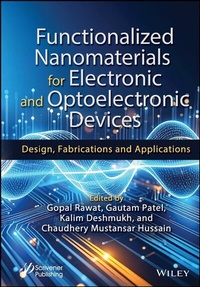
Functionalized Nanomaterials for Electronic and Optoelectronic Devices
Description

The book gives invaluable insights and expertise from leading researchers on the latest advancements, challenges, and applications of functionalized nanomaterials.
Functionalized Nanomaterials for Electronic and Optoelectronic Devices: Design, Fabrications and Applications examines the current state-of-the-art, recent progress, new challenges, and future perspectives of functionalized nanomaterials in high-performance electronic and optoelectronic device applications. The book focuses on the synthesis strategies, functionalization methods, characterizations, properties, and applications of functionalized nanomaterials in various electronic and optoelectronic devices and the essential criteria in each specified field. The physicochemical, optical, electrical, magnetic, electronic, and surface properties of functionalized nanomaterials are also discussed in detail. Additionally, the book discusses reliability, ethical and legal issues, environmental and health impact, and commercialization aspects of functionalized nanomaterials, as well as essential criteria in each specified field. This curated selection of topics and expert contributions from across the globe make this book an outstanding reference source for anyone involved in the field of functionalized nanomaterials-based electronic and optoelectronic devices. The book gives a comprehensive summary of recent advancements and key technical research accomplishments in the area of electronic/optoelectronic device applications of functionalized nanomaterials. Functionalized Nanomaterials for Electronic and Optoelectronic Devices serves as a one-stop reference for important research in this innovative research field.
Readers will find this volume:
- Explores technological advances, recent trends, and various applications of functionalized nanomaterials;
- Provides state-of-the-art knowledge on synthesis, processing, properties, and characterization of functionalized nanomaterials;
- Presents fundamental knowledge and an extensive review on functionalized nanomaterials, especially those designed for electronic device applications;
- Summarizes key challenges, future perspectives, reliability, and commercialization aspects of functionalized nanomaterials in various electronic devices.
Audience
This book will be a very valuable reference source for research scholars, graduate students (primarily in the field of materials science and engineering, nanomaterials and nanotechnology) and industry engineers working in the field of functionalized nanomaterials for electronic applications.
Gopal Rawat, PhD is an assistant professor in the School of Computing and Electrical Engineering at the Indian Institute of Technology Mandi, Himachal Pradesh, India. He has published over 50 research articles in leading peer-reviewed international journals and conferences, one book chapter, and four patents. His research interests include semiconducting materials, device design and development, novel materials, and semiconductor devices.
Gautam Patel, PhD works in the Department of Industrial Chemistry at the Institute of Science and Technology for Advanced Studies and Research, CVM University, Nagar, Gujarat, India, with over seven years of experience. He has published one book, six chapters, three patents, and five research papers in international journals. His research interests include organic synthesis, green chemistry, nanosciences, and nanotechnology.
Kalim Deshmukh, PhD is a senior researcher at the New Technologies Research Centre at the University of West Bohemia, Plzen, Czech Republic, with over 15 years of research experience. He has published over 110 research articles in peer-reviewed journals and 36 book chapters and edited several books. His research interests include synthesis, characterization, and property investigations of polymer nanocomposites reinforced with different nanofillers, including various nanoparticles and carbon allotropes such as carbon black, carbon nanotubes, graphene, and its derivatives for energy storage, energy harvesting, gas sensing, EMI shielding, and high-k dielectric applications.
Chaudhery Mustansar Hussain, PhD is an adjunct professor, academic advisor, and Lab Director in the Department of Chemistry and Environmental Sciences at the New Jersey Institute of Technology, USA. He is the author of numerous papers in peer-reviewed journals as well as author and editor of over 100 scientific monographs and books. His research focuses on the application of nanotechnology and advanced materials in environmental and analytical chemistry.
More details
Other editions
Additional editions
Persons
Gopal Rawat, PhD is an assistant professor in the School of Computing and Electrical Engineering at the Indian Institute of Technology Mandi, Himachal Pradesh, India. He has published over 50 research articles in leading peer-reviewed international journals and conferences, one book chapter, and four patents. His research interests include semiconducting materials, device design and development, novel materials, and semiconductor devices.
Gautam Patel, PhD works in the Department of Industrial Chemistry at the Institute of Science and Technology for Advanced Studies and Research, CVM University, Nagar, Gujarat, India, with over seven years of experience. He has published one book, six chapters, three patents, and five research papers in international journals. His research interests include organic synthesis, green chemistry, nanosciences, and nanotechnology.
Kalim Deshmukh, PhD is a senior researcher at the New Technologies Research Centre at the University of West Bohemia, Plzen, Czech Republic, with over 15 years of research experience. He has published over 110 research articles in peer-reviewed journals and 36 book chapters and edited several books. His research interests include synthesis, characterization, and property investigations of polymer nanocomposites reinforced with different nanofillers, including various nanoparticles and carbon allotropes such as carbon black, carbon nanotubes, graphene, and its derivatives for energy storage, energy harvesting, gas sensing, EMI shielding, and high-k dielectric applications.
Chaudhery Mustansar Hussain, PhD is an adjunct professor, academic advisor, and Lab Director in the Department of Chemistry and Environmental Sciences at the New Jersey Institute of Technology, USA. He is the author of numerous papers in peer-reviewed journals as well as author and editor of over 100 scientific monographs and books. His research focuses on the application of nanotechnology and advanced materials in environmental and analytical chemistry.
Content
Preface xix
Part I: Synthesis, Characterizations and Surface Modification of Functionalized Nanomaterials 1
1 Functionalized Nanomaterials: Fundamentals, New Perspectives, and Emerging Research Trends in Electronic and Optoelectronic Device Fabrications, Challenges, and Future Perspectives 3
Sunil Kumar Baburao Mane, Naghma Shaishta and G. Manjunatha
1.1 Introduction 4
1.2 Implementations of 0D NMs in Optoelectronics 6
1.3 Implementations of 1D NMs in Optoelectronics 11
1.4 Implementations of 2D NMs in Optoelectronics 15
1.5 Implementations of 3D NMs in Optoelectronics 23
1.6 Challenges and Future Perspective 26
1.7 Conclusion 28
References 30
2 Synthesis and Characterizations of Nanomaterials for Electronic Devices 35
G. Sahaya Dennish Babu, G. Helen Ruth Joice, N. Sandhya Rani and M. Malarvizhi
2.1 Introduction 35
2.2 Properties of Nanomaterials 38
2.3 Nanomaterial Synthesis Methodologies 43
2.4 Nanomaterials for Electronic Devices 52
2.5 Characterizations of Nanomaterials 57
2.6 Challenges and Future Outlook 59
2.7 Summary and Conclusion 60
Acknowledgments 61
References 61
3 Functionalization and Surface Modification of Nanomaterials for Electronic and Optoelectronic Device Applications 65
Bhasha Sathyan and Jobin Cyriac
3.1 Introduction 66
3.2 Nanomaterials: Exploring Electronic and Optoelectronic Properties 67
3.3 Importance of Functionalization 70
3.4 The Functionalization 71
3.5 Surface Functionalization-Induced Properties 79
3.6 Applications of Functionalized Nanomaterials in Electronic and Optoelectronic Devices 82
3.7 Conclusions and Future Perspectives 90
Acknowledgment 91
References 91
4 Structural and Electronic Transport Properties of Functionalized Nanomaterials 101
Atefeh Nazary, Hassan Shamloo and Sattar Mirzakuchaki
4.1 Introduction 102
4.2 Nanomaterials' Crystal Geometry 102
4.3 Electronic Structure of Nanomaterials 120
4.4 Transport Properties of Nanomaterials 123
4.5 Conclusion 127
References 128
Part II: Modeling and Simulations for Polymer Nanocomposites of Functionalized Nanomaterials 133
5 Modeling and Simulations of Functionalized Nanomaterials for Electronic and Optoelectronic Devices 135
Atefeh Nazary, Hassan Shamloo and Sattar Mirzakuchaki
5.1 Introduction 136
5.2 Electronic and Optoelectronic Device Principles 136
5.3 Methods for Nanoelectronics and Optoelectronic Device Modeling and Simulation 142
5.4 Conclusion 159
References 159
6 Functionalized Nanomaterial-Based Polymer Nanocomposites for Flexible Electronics 165
Harish Kumar, Gaman Kumar, Rahul Sharma, Ankita Yadav, Rajni Kumari, Aarti Tundwal, Ankit Dhayal and Abhiruchi Yadav
6.1 Introduction 165
6.2 Classification of Polymer Nanocomposites 167
6.3 Synthesis of Polymer-Based Nanocomposites 168
6.4 Synthesis of rGO/Conducting Polymer-Based Nanocomposites 168
6.5 Synthesis of Cellulose/Conducting Polymer/Metal Oxide-Based Nanocomposites 171
6.6 Applications of Polymer-Based Nanocomposites for Flexible Electronics 173
6.7 Future Perspectives of Functionalized Nanomaterial-Based Polymer Nanocomposites for Flexible Electronics 184
6.8 Conclusions 186
Acknowledgments 187
References 187
Part III: Applications of Functionalized Nanomaterials 195
7 Functionalized Nanomaterial-Based Thin-Film Transistors and Display Devices 197
Vraj Shah, Ashish Choudhury, Yash Thakrar, Tushar Patil and Swapnil Dharaskar
7.1 Introduction 198
7.2 Fundamentals of Functionalized Nanomaterials 200
7.3 Fabrication Techniques for Functionalized Nanomaterial-Based TFTs 207
7.4 Characterization and Analysis of Functionalized Nanomaterial-Based TFTs 214
7.5 Functionalized Nanomaterials for Advanced Display Technologies 219
7.6 Challenges and Future Directions 224
7.7 Conclusion 229
References 229
8 Functionalized Nanomaterials for Optoelectronic Device Applications 235
G. Sahaya Dennish Babu, A. Judith Jayarani, G. Mahalakshmi, R. Dhivya, R. Thenmozhi and M. Swetha
8.1 Introduction 235
8.2 Optoelectronic Devices 237
8.3 Mechanisms of Optoelectronic Devices 240
8.4 Functional Materials for Optoelectronic Devices 243
8.5 Device Engineering of LED's and Solar Cells 249
8.6 Photonic Integrated Circuits (PICS) 250
8.7 Optocouplers 252
8.8 Innovative Strategies to Improve Device Performances 254
8.9 Conclusions and Future Outlook 256
Future Outlooks 257
Acknowledgments 257
References 258
9 Functionalized Nanomaterials for Flexible and Stretchable Bioelectronics 261
Humira Assad, Praveen Kumar Sharma, Elyor Berdimurodov, Alok Kumar and Ashish Kumar
List of Abbreviations 262
9.1 Introduction 262
9.2 Nanostructured Materials for Flexible and Stretchable Bioelectronics 265
9.3 Approaches for Integration and Processing of Nanomaterials 273
9.4 Nanomaterials-Based Bioelectronics 274
9.5 Prospects and Limitations 279
9.6 Conclusion 281
References 282
10 Functionalized Nanomaterials for Lithium-Ion Batteries 289
Naval V. Koralkar, Raj Kumar and Gautam Patel
10.1 Introduction 289
10.2 Principles of LIBs 292
10.3 Nanomaterials for Li-Ion Battery Technology 295
10.4 Nanomaterials with Silicon-Based Lithium-Ion Anodes 301
10.5 Nanomaterials Derived from Tin for Application in LIB 304
10.6 Nanomaterials that are Composed of Metal Oxide and are Capable of Functioning as the Anode in LIB 306
10.7 Summary 308
10.8 Future Lithium-Ion Energy Storage Materials 309
References 309
11 Functionalized Nanomaterials for Supercapacitors and Hybrid Capacitor Devices 315
Shubham Mehta, Gautam Patel, Rohankumar Patel, Trilokkumar Akhani and Arvnabh Mishra
11.1 Introduction 316
11.2 Fundamentals of Supercapacitors and Hybrid Capacitor Devices 322
11.3 Nanomaterials for Supercapacitor and Hybrid Capacitor Electrodes 343
11.4 Functionalization Strategies for Enhancing Electrode Performance 347
11.5 Advanced Nanocomposite Materials for Supercapacitors and Hybrid Capacitor Devices 352
11.6 Future Perspectives and Challenges 356
11.7 Conclusion 357
References 357
12 Functionalized Nanomaterials for Chemiresistive Gas Sensors 365
Atefeh Nazary
12.1 Introduction 365
12.2 Classification of Chemoresistive Gas Sensors 367
12.3 Classification of Materials for Chemoresistive Gas Sensors 373
12.4 Conclusion 394
References 395
13 Functionalized Nanomaterials for Biosensing Devices 405
Sreelekshmi P. J., Devika V., Asok Aparna, Appukuttan Saritha and Sandhya Sadanandan
13.1 Introduction 405
13.2 Diversity in Biosensors 406
13.3 Fabrication Techniques Involved in the Functionalization of Nanomaterials 409
13.4 Properties of Functionalized Nanomaterials for Biosensing Devices 414
13.5 Biosensing Applications of Functionalized Nanomaterials 414
13.5 Challenges and Future Perspectives 427
13.6 Summary and Outlook 428
References 428
14 Targeted Electrochemical Biosensor for Detection of Cancer Biomarkers Using Composite Nanomaterials 435
Virender, Archana Chauhan, Priyanka, Ashwani Kumar, Pawan Kumar Sharma and Brij Mohan
14.1 Introduction 436
14.2 Techniques for Biosensing 438
14.3 Electrochemical Biosensors in Cancer Detection 444
14.4 Materials for CB Detection 446
14.5 Nanomaterial Design and Development as Biosensors 446
14.6 Working Insights into Biosensors 447
14.7 Biosensing Tools 447
14.8 Working Principles and Mechanisms 450
14.9 Stability and Reusability 453
14.10 Conductivity 453
14.11 Key Findings, Challenges, and Conclusion 453
References 454
15 Functionalized Material-Based Flexible Biomedical Devices 461
Sachin M. Shet, Dibyendu Mondal and S. K. Nataraj
Abbreviations 462
15.1 Introduction 462
15.2 Flexible Electronics 463
15.3 Emerging Applications 472
15.4 Summary and Conclusions 479
References 481
16 Functionalized Nanomaterials for Designing Nano/Micro Biologically Sensitive Field-Effect Transistors (Bio-FETs) 491
Archini Paruthi, Sooraj Sanjay and Navakanta Bhat
16.1 Introduction 491
16.2 Electrochemical Biosensing: Basic Principle and Architecture 493
16.3 Bio-FETs: Evolution, Structure, and Architecture 495
16.4 Role of Nanomaterials in Biosensing and Bio-FETs 505
16.5 Nanomaterial-Biorecognition Design: Synthesis, Immobilization, and Integration Strategies 509
16.6 Functionalized Bio-FETs 519
16.7 Case Studies 525
16.8 Conclusion 529
Acknowledgment 530
References 530
17 Functionalized Nanomaterial-Based Solar Cells and Photovoltaic Systems 541
Deekshitha S. Nayak
Abbreviations 541
17.1 Introduction 542
17.2 History of Solar Cells and Photovoltaic Systems 543
17.3 Solar Cells 548
17.4 Solar Collectors 549
17.5 Fuel Cells 550
17.6 Photocatalysis 551
17.7 Solar Photovoltaic 552
17.8 Energy Storage 553
17.9 Rechargeable Batteries 554
17.10 Application Technologies in Solar Cells 555
17.11 Development of Solar Cells Based on Functionalized Nanomaterials 559
17.12 Features of Solar Cells Based on Functionalized Nanomaterials 562
17.13 Challenges and Future Scope of Solar Cells Based on Nanomaterials 563
17.14 Conclusion 565
References 566
18 Functionalized Nanomaterial-Based Photocatalytic Devices 569
Brij Mohan, Virender, Neeraj, Ritika Kadiyan, Krishan Kumar, Armando J. L. Pombeiro and Rakesh Kumar Gupta
18.1 Introduction 569
18.2 Metal-Doped Nanomaterials as Photocatalysts: Design and Workings 571
18.3 Photocatalytic Degradation Mechanism 573
18.4 Energy-Electron Flow in Nanomaterial Photocatalysis 575
18.5 Photocatalytic Degradation Activity of Nanomaterials 576
18.6 Challenges 578
18.7 Conclusion 580
Acknowledgments 580
References 580
19 Design and Fabrication of Sonochemically Prepared Functionalized Nanomaterials for Fuel Cell Applications 585
Jayaraman Kalidass and Thirugnanasambandam Sivasankar
19.1 Introduction 585
19.2 Role of Ultrasound in Material Synthesis 593
19.3 Sonochemical Synthesis of Nanomaterials 596
19.4 Advanced Fabrication Techniques to Functionalize the Nanomaterials 602
19.5 Challenges and Opportunities 607
19.6 Conclusion 608
Acknowledgment 609
References 609
Part IV: Reliability, Ethical and Regulatory Issues, Environmental Impact and Commercialization Aspects 615
20 Reliability, Ethical and Legal Issues, Environmental Impact, and Commercialization Aspects of Functionalized Nanomaterials for Electronic and Optoelectronic Devices 617
Dolly Thankachan
20.1 Introduction 618
20.2 Reliability of Nanomaterials for Electronics and Optoelectronics Material 619
20.3 Legal Issues in Field of Nanotechnology 625
20.4 Environmental Impact of Nanomaterials 628
20.5 Ethical Aspects 632
20.6 Conclusion 640
References 641
Index 645
1
Functionalized Nanomaterials: Fundamentals, New Perspectives, and Emerging Research Trends in Electronic and Optoelectronic Device Fabrications, Challenges, and Future Perspectives
Sunil Kumar Baburao Mane1, Naghma Shaishta1* and G. Manjunatha2
1Department of Chemistry, Khaja Bandanawaz University, Kalaburagi, Karnataka, India
2Department of Chemistry, Shri Siddhartha Institute of Technology, Tumkur, Karnataka, India
Abstract
Nanomaterials (NMs) (particles with a size between 1 and 100 nm) are the fundamental units of nanostructured materials. When materials grow to be in the nanoscale range owing to quantum entrapment, both their chemical and physical characteristics are significantly altered. Owing to advancements in efficiency and the shrinking of equipment, there is a nanotechnology boom using these NMs, and NM need in the marketplace has surged. Although NMs provide many benefits, they also have certain drawbacks. Agglomeration, interaction with substrate and reaction media, and poor solubility in many solvents are a few of the drawbacks. The constraints can be reduced by surface functionalizing NMs with the appropriate functional groups. Comparatively speaking, functionalized NMs (FNMs) exhibit superior mechanical, chemical, and physical characteristics.
The creation of novel FNMs with potential uses in the optoelectronic fields has recently attracted a lot of attention. The opportunity for many cutting-edge devices to be revolutionized by FNMs is exceptional. The study of FNMs' manufacture, characterization, and applications, however, is still in its infancy. Information regarding this great material is required. Major characteristics including the kind of FNMs, the fabrication processes, the applications, the tasks, the advantages and limitations, and the marketable characteristics are explored in depth.
This book chapter will be helpful for those studying, seeking information, and employed in the fields of FNMs because it gives a clear understanding of the numerous uses of these FNMs in the field of electronic and optoelectronic devices.
Keywords: Functionalized nanomaterials, electronic, optoelectronic, device fabrications
1.1 Introduction
Nanomaterials (NMs) or particles with a size between 1 and 100 nm are the fundamental units of materials engineering. When materials grow to be in the nanometer scale as a result of quantum confinement, both their physical and chemical characteristics are significantly altered. Due to enhanced efficiency and the miniaturization of equipment, there is a nanotechnology breakthrough using these NMs, and their popularity in the marketplace has expanded. Even though NMs have several benefits, they additionally come with certain drawbacks. Assemblage, interaction with material and interaction surfaces, and poor solubility in several solvents are a few of the restrictions. The restrictions could be reduced by surface functionalizing NMs with the appropriate functional communities [1-4].
Comparatively speaking, functionalized NMs (FNMs) exhibit superior mechanical, chemical, and physical characteristics. Due to their distinctive topography, nanostructure components have awhile back become an increasing focus to be utilized in photocatalysis, bioprobes, nanosensors, nanopatterning, and nanofabrication and in an optoelectronics like solar cells, laser diodes, light-emitting diodes (LEDs), and photodetectors due to the particular surface places for preferential molecular bonding [5, 6]. Small-scale NMs can be seamlessly incorporated into a wide variety of scientific portals, delivering exceptional optoelectronic devices with novel chemical and physical characteristics. For their emerging functional technological applications, innovative nanostructures' electrical as well as optical characteristics must be utilized. Therefore, the possibility for many cutting-edge innovations to be revolutionized by multifunctional NMs is special. The study of their preparation, identification, characteristics, and uses, even so, is still in its beginnings, and also the documentation about this marvelous material is needed further.
Additionally, they are beneficial in a variety of uses, such as optoelectronics, thanks to their distinctive optical, electrical, and mechanical characteristics. Screens, detectors, and information technology are just a few of the innovations that are using optoelectronic devices, which use light to perform or transmit data. NMs may serve as photoactive layer in solar cells and LEDs and display in optoelectronics to increase their efficiency and efficacy [7, 8]. To increase the product's accountability and conductivity, they may be employed as transparent conductive layers and also be incorporated into sensors to enhance their detection and selection abilities. Graphene, titanium dioxide, and zinc oxide (ZnO) are a few typical NMs used in optoelectronics [9-11].
NM-based technologies like circuits, optoelectronics, quantum optics, and nanophotonics are thought to be the main forces behind research on innovative, valuable product as well as their nanoscale for a variety of uses. It is widely known that research into these materials and structures has, indeed, been crucial for the creation and improvement of both optical and electrical instruments [12-14]. Greater yields are not the only thing that can be anticipated from such gadgets; one can also connect directly to the creation of brand-new ideas, which are urgently needed by today's information, quantum, or medicinal innovations, as well as optical sensors [15].
This perspective provides an overview of a broad range of topics, including the physics of innovative materials, fabrication techniques, evaluation, and implementations. Innovative resources that may be employed, for example, for power generation or light production in addition to prospective logic circuits; material engineering that can enhance the operation and efficiency of optoelectronics; material physics that can provide understanding into the electrical and optical characteristics of nanostructured frameworks and quantum materials; and developments that discuss advancements on the user end of complex materials.
Among the most productive areas of science and technology right now is nano-optics and nano-optoelectronics [16]. These become crucial to technological advancement and science by fusing photonics and nanotechnology breakthroughs to realize utterly novel optical, electronic, and optoelectronic operations. After enormous efforts, these fields have, indeed, left their beginning and entered a fascinating period in which scientific ideas and relevant theories are strenuously translated into practical gadgets and uses. Furthermore, these technologies have received a lot of attention recently, and the developments show promising future uses in fields such as fiber optics, optical connectivity, optical recollection, detecting and image processing, test equipment, display and illumination, pharmaceutics, safety, and renewable technology [17, 18]. There is more and more study being done in this area.
Additionally, with the growing demands for the incorporation of modern electronics in the areas of aircraft industry, healthcare, electronic components, ecology, and artificial intelligence, the feature size of optoelectronics has already been steadily decreasing in current history. Nevertheless, as feature size is decreased, the variation, quantum influence, short-channel impact, and thermal consequence in optoelectronics would, therefore, cause a decline in system efficiency or even collapse. As a result, conventional superconductors used in silicon-based modern electronics have hit their boundaries. Ongoing expansion will increasingly focus on acquiring the skills to produce useful gadgets that have superior levels of integration and efficiency. The growth of NMs offers fresh perspectives on how to surpass conventional silicon-based electronics [19]. The creation of workable nanostructures premised on NMs would then help advance the use of NMs in electronic components, intelligent detecting, communication system, bioengineering, environmental recognition, and defense safety while also removing the specialized barrier that currently exists in the creation of practical equipment [14-17]. On the other hand, investigation is still being done on the effectiveness and use of functional products created of low-dimensional materials. Equipment creation and production, material and instrument efficiency management, and commercialization are still insufficient. As a result, there is a pressing requirement for additional study on low-dimensional material device applications in the modern world.
This chapter has a detailed discussion of the fundamentals of multifunctional NMs using various methods with particular emphasis on their features, as well as their forms, assets, and implementations. The material-specific characteristics are revealed to be size dependent at the nanoscale. As a result, based on the formation mechanism used, the sample's structural, electrical, optical, and morphological features exhibit distinct behavior, which may be extremely tailored for the gadget characteristics. The special optoelectronics' relevance of FNMs, in particular, the zero-dimensional (0D), one-dimensional (1D), two-dimensional (2D), and three-dimensional (3D), was discussed in with their latest condition and capability to meet the criteria for next-generation optoelectronics. Finally, the challenges and future perspectives...
