

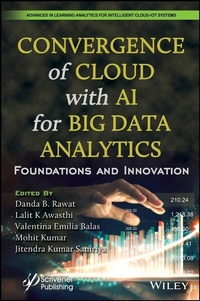
Convergence of Cloud with AI for Big Data Analytics
Description

This book covers the foundations and applications of cloud computing, AI, and Big Data and analyses their convergence for improved development and services.
The 17 chapters of the book masterfully and comprehensively cover the intertwining concepts of artificial intelligence, cloud computing, and big data, all of which have recently emerged as the next-generation paradigms. There has been rigorous growth in their applications and the hybrid blend of AI Cloud and IoT (Ambient-intelligence technology) also relies on input from wireless devices. Despite the multitude of applications and advancements, there are still some limitations and challenges to overcome, such as security, latency, energy consumption, service allocation, healthcare services, network lifetime, etc. Convergence of Cloud with AI for Big Data Analytics: Foundations and Innovation details all these technologies and how they are related to state-of-the-art applications, and provides a comprehensive overview for readers interested in advanced technologies, identifying the challenges, proposed solutions, as well as how to enhance the framework.
Audience
Researchers and post-graduate students in computing as well as engineers and practitioners in software engineering, electrical engineers, data analysts, and cyber security professionals.
More details
Other editions
Additional editions
Persons
Danda B Rawat, PhD, is a Full Professor in the Department of Electrical Engineering & Computer Science (EECS), Founder and Director of the Howard University Data Science and Cybersecurity Center, Director of DoD Center of Excellence in Artificial Intelligence & Machine Learning, Director of Cyber-security and Wireless Networking Innovations Research Lab, Graduate Program Director of Howard CS Graduate Programs, and Director of Graduate Cybersecurity Certificate Program at Howard University, Washington, DC, USA. Dr. Rawat has published more than 250 scientific/technical articles and 11 books.
Lalit K Awasthi, PhD, is the Director of Dr. B. R. Ambedkar National Institute of Technology Jalandhar, India). He received his PhD degree from the Indian Institute of Technology Roorkee in computer science and engineering. He has published more than 150 research papers in various journals and conferences of international repute and guided many PhDs in these areas.
Valentina E Ballas, PhD, is a Full Professor in the Department of Automatics and Applied Software at the Faculty of Engineering, "Aurel Vlaicu" University of Arad, Romania. Dr. Ballas is the author of more than 280 research papers in refereed journals and international conferences. She is the Editor-in-Chief of International Journal of Advanced Intelligence Paradigms and International Journal of Computational Systems Engineering.
Mohit Kumar, PhD, is an assistant professor in the Department of Information Technology at Dr. B R Ambedkar National Institute of Technology, Jalandhar, India. He received his PhD degree from the Indian Institute of Technology Roorkee in the field of cloud computing in 2018. His research topics cover the areas of cloud computing, fog computing, edge computing, Internet of Things, soft computing, and blockchain. He has published more than 25 research articles in international journals and conferences.
Jitendra Kumar Samriya, PhD, has a faculty position in the Department of Information Technology, Dr. B.R. Ambedkar National Institute of Technology, Jalandhar. His research interest is cloud computing, artificial intelligence, and multi-objective evolutionary optimization techniques. He has published 15 research articles in international journals and has published five Indian and international patents.
Content
Preface xv
1 Integration of Artificial Intelligence, Big Data, and Cloud Computing with Internet of Things 1
Jaydip Kumar
1.1 Introduction 2
1.2 Roll of Artificial Intelligence, Big Data and Cloud Computing in IoT 3
1.3 Integration of Artificial Intelligence with the Internet of Things Devices 4
1.4 Integration of Big Data with the Internet of Things 6
1.5 Integration of Cloud Computing with the Internet of Things 6
1.6 Security of Internet of Things 8
1.7 Conclusion 10
References 10
2 Cloud Computing and Virtualization 13
Sudheer Mangalampalli, Pokkuluri Kiran Sree, Sangram K. Swain and Ganesh Reddy Karri
2.1 Introduction to Cloud Computing 14
2.1.1 Need of Cloud Computing 14
2.1.2 History of Cloud Computing 14
2.1.3 Definition of Cloud Computing 15
2.1.4 Different Architectures of Cloud Computing 16
2.1.4.1 Generic Architecture of Cloud Computing 16
2.1.4.2 Market Oriented Architecture of Cloud Computing 17
2.1.5 Applications of Cloud Computing in Different Domains 18
2.1.5.1 Cloud Computing in Healthcare 18
2.5.1.2 Cloud Computing in Education 19
2.5.1.3 Cloud Computing in Entertainment Services 19
2.5.1.4 Cloud Computing in Government Services 19
2.1.6 Service Models in Cloud Computing 19
2.1.7 Deployment Models in Cloud Computing 21
2.2 Virtualization 22
2.2.1 Need of Virtualization in Cloud Computing 22
2.2.2 Architecture of a Virtual Machine 23
2.2.3 Advantages of Virtualization 24
2.2.4 Different Implementation Levels of Virtualization 25
2.2.4.1 Instruction Set Architecture Level 25
2.2.4.2 Hardware Level 26
2.2.4.3 Operating System Level 26
2.2.4.4 Library Level 26
2.2.4.5 Application Level 26
2.2.5 Server Consolidation Using Virtualization 26
2.2.6 Task Scheduling in Cloud Computing 27
2.2.7 Proposed System Architecture 31
2.2.8 Mathematical Modeling of Proposed Task Scheduling Algorithm 31
2.2.9 Multi Objective Optimization 34
2.2.10 Chaotic Social Spider Algorithm 34
2.2.11 Proposed Task Scheduling Algorithm 35
2.2.12 Simulation and Results 36
2.2.12.1 Calculation of Makespan 36
2.2.12.2 Calculation of Energy Consumption 37
2.3 Conclusion 37
References 38
3 Time and Cost-Effective Multi-Objective Scheduling Technique for Cloud Computing Environment 41
Aida A. Nasr, Kalka Dubey, Nirmeen El-Bahnasawy, Gamal Attiya and Ayman El-Sayed
3.1 Introduction 42
3.2 Literature Survey 44
3.3 Cloud Computing and Cloudlet Scheduling Problem 46
3.4 Problem Formulation 47
3.5 Cloudlet Scheduling Techniques 49
3.5.1 Heuristic Methods 50
3.5.2 Meta-Heuristic Methods 51
3.6 Cloudlet Scheduling Approach (CSA) 52
3.6.1 Proposed CSA 52
3.6.2 Time Complexity 53
3.6.3 Case Study 54
3.7 Simulation Results 56
3.7.1 Simulation Environment 56
3.7.2 Evaluation Metrics 56
3.7.2.1 Performance Evaluation with Small Number of Cloudlets 57
3.7.2.2 Performance Evaluation with Large Number of Cloudlets 57
3.8 Conclusion 64
References 64
4 Cloud-Based Architecture for Effective Surveillance and Diagnosis of COVID- 19 69
Shweta Singh, Aditya Bhardwaj, Ishan Budhiraja, Umesh Gupta and Indrajeet Gupta
4.1 Introduction 70
4.2 Related Work 71
4.2.1 Proposed Cloud-Based Network for Management of COVID- 19 73
4.3 Research Methodology 75
4.3.1 Sample Size and Target 76
4.3.1.1 Sampling Procedures 77
4.3.1.2 Response Rate 77
4.3.1.3 Instrument and Measures 77
4.3.2 Reliability and Validity Test 78
4.3.3 Exploratory Factor Analysis 78
4.4 Survey Findings 80
4.4.1 Outcomes of the Proposed Scenario 82
4.4.1.1 Online Monitoring 82
4.4.1.2 Location Tracking 82
4.4.1.3 Alarm Linkage 82
4.4.1.4 Command and Control 82
4.4.1.5 Plan Management 82
4.4.1.6 Security Privacy 83
4.4.1.7 Remote Maintenance 83
4.4.1.8 Online Upgrade 83
4.4.1.9 Command Management 83
4.4.1.10 Statistical Decision 83
4.4.2 Experimental Setup 83
4.5 Conclusion and Future Scope 85
References 86
5 Smart Agriculture Applications Using Cloud and IoT 89
Keshav Kaushik
5.1 Role of IoT and Cloud in Smart Agriculture 89
5.2 Applications of IoT and Cloud in Smart Agriculture 94
5.3 Security Challenges in Smart Agriculture 97
5.4 Open Research Challenges for IoT and Cloud in Smart Agriculture 100
5.5 Conclusion 103
References 103
6 Applications of Federated Learning in Computing Technologies 107
Sambit Kumar Mishra, Kotipalli Sindhu, Mogaparthi Surya Teja, Vutukuri Akhil, Ravella Hari Krishna, Pakalapati Praveen and Tapas Kumar Mishra
6.1 Introduction 108
6.1.1 Federated Learning in Cloud Computing 108
6.1.1.1 Cloud-Mobile Edge Computing 109
6.1.1.2 Cloud Edge Computing 111
6.1.2 Federated Learning in Edge Computing 112
6.1.2.1 Vehicular Edge Computing 113
6.1.2.2 Intelligent Recommendation 113
6.1.3 Federated Learning in IoT (Internet of Things) 114
6.1.3.1 Federated Learning for Wireless Edge Intelligence 114
6.1.3.2 Federated Learning for Privacy Protected Information 115
6.1.4 Federated Learning in Medical Computing Field 116
6.1.4.1 Federated Learning in Medical Healthcare 117
6.1.4.2 Data Privacy in Healthcare 117
6.1.5 Federated Learning in Blockchain 118
6.1.5.1 Blockchain-Based Federated Learning Against End-Point Adversarial Data 118
6.2 Advantages of Federated Learning 119
6.3 Conclusion 119
References 119
7 Analyzing the Application of Edge Computing in Smart Healthcare 121
Parul Verma and Umesh Kumar
7.1 Internet of Things (IoT) 122
7.1.1 IoT Communication Models 122
7.1.2 IoT Architecture 124
7.1.3 Protocols for IoT 125
7.1.3.1 Physical/Data Link Layer Protocols 125
7.1.3.2 Network Layer Protocols 127
7.1.3.3 Transport Layer Protocols 128
7.1.3.4 Application Layer Protocols 129
7.1.4 IoT Applications 130
7.1.5 IoT Challenges 132
7.2 Edge Computing 133
7.2.1 Cloud vs. Fog vs. Edge 134
7.2.2 Existing Edge Computing Reference Architecture 135
7.2.2.1 FAR-EDGE Reference Architecture 135
7.2.2.2 Intel-SAP Joint Reference Architecture (RA) 135
7.2.3 Integrated Architecture for IoT and Edge 136
7.2.4 Benefits of Edge Computing Based IoT Architecture 138
7.3 Edge Computing and Real Time Analytics in Healthcare 140
7.4 Edge Computing Use Cases in Healthcare 148
7.5 Future of Healthcare and Edge Computing 151
7.6 Conclusion 151
References 152
8 Fog-IoT Assistance-Based Smart Agriculture Application 157
Pawan Whig, Arun Velu and Rahul Reddy Nadikattu
8.1 Introduction 158
8.1.1 Difference Between Fog and Edge Computing 159
8.1.1.1 Bandwidth 163
8.1.1.2 Confidence 164
8.1.1.3 Agility 164
8.1.2 Relation of Fog with IoT 165
8.1.3 Fog Computing in Agriculture 167
8.1.4 Fog Computing in Smart Cities 169
8.1.5 Fog Computing in Education 170
8.1.6 Case Study 171
Conclusion and Future Scope 173
References 173
9 Internet of Things in the Global Impacts of COVID-19: A Systematic Study 177
Shalini Sharma Goel, Anubhav Goel, Mohit Kumar and Sachin Sharma
9.1 Introduction 178
9.2 COVID-19 - Misconceptions 181
9.3 Global Impacts of COVID-19 and Significant Contributions of IoT in Respective Domains to Counter the Pandemic 183
9.3.1 Impact on Healthcare and Major Contributions of IoT 183
9.3.2 Social Impacts of COVID-19 and Role of IoT 187
9.3.3 Financial and Economic Impact and How IoT Can Help to Shape Businesses 188
9.3.4 Impact on Education and Part Played by IoT 191
9.3.5 Impact on Climate and Environment and Indoor Air Quality Monitoring Using IoT 194
9.3.6 Impact on Travel and Tourism and Aviation Industry and How IoT is Shaping its Future 197
9.4 Conclusions 198
References 198
10 An Efficient Solar Energy Management Using IoT-Enabled Arduino-Based MPPT Techniques 205
Rita Banik and Ankur Biswas
List of Symbols 206
10.1 Introduction 206
10.2 Impact of Irradiance on PV Efficiency 210
10.2.1 PV Reliability and Irradiance Optimization 211
10.2.1.1 PV System Level Reliability 211
10.2.1.2 PV Output with Varying Irradiance 211
10.2.1.3 PV Output with Varying Tilt 212
10.3 Design and Implementation 212
10.3.1 The DC to DC Buck Converter 215
10.3.2 The Arduino Microcontroller 217
10.3.3 Dynamic Response 219
10.4 Result and Discussions 220
10.5 Conclusions 223
References 224
11 Axiomatic Analysis of Pre-Processing Methodologies Using Machine Learning in Text Mining: A Social Media Perspective in Internet of Things 229
Tajinder Singh, Madhu Kumari, Daya Sagar Gupta and Nikolai Siniak
11.1 Introduction 230
11.2 Text Pre-Processing - Role and Characteristics 232
11.3 Modern Pre-Processing Methodologies and Their Scope 234
11.4 Text Stream and Role of Clustering in Social Text Stream 241
11.5 Social Text Stream Event Analysis 242
11.6 Embedding 244
11.6.1 Type of Embeddings 244
11.7 Description of Twitter Text Stream 250
11.8 Experiment and Result 251
11.9 Applications of Machine Learning in IoT (Internet of Things) 251
11.10 Conclusion 252
References 252
12 APP-Based Agriculture Information System for Rural Farmers in India 257
Ashwini Kumar, Dilip Kumar Choubey, Manish Kumar and Santosh Kumar
12.1 Introduction 258
12.2 Motivation 259
12.3 Related Work 260
12.4 Proposed Methodology and Experimental Results Discussion 262
12.4.1 Mobile Cloud Computing 266
12.4.2 XML Parsing and Computation Offloading 266
12.4.3 Energy Analysis for Computation Offloading 267
12.4.4 Virtual Database 269
12.4.5 App Engine 270
12.4.6 User Interface 272
12.4.7 Securing Data 273
12.5 Conclusion and Future Work 274
References 274
13 SSAMH - A Systematic Survey on AI-Enabled Cyber Physical Systems in Healthcare 277
Kamalpreet Kaur, Renu Dhir and Mariya Ouaissa
13.1 Introduction 278
13.2 The Architecture of Medical Cyber-Physical Systems 278
13.3 Artificial Intelligence-Driven Medical Devices 282
13.3.1 Monitoring Devices 282
13.3.2 Delivery Devices 283
13.3.3 Network Medical Device Systems 283
13.3.4 IT-Based Medical Device Systems 284
13.3.5 Wireless Sensor Network-Based Medical Driven Systems 285
13.4 Certification and Regulation Issues 285
13.5 Big Data Platform for Medical Cyber-Physical Systems 286
13.6 The Emergence of New Trends in Medical Cyber-Physical Systems 288
13.7 Eminence Attributes and Challenges 289
13.8 High-Confidence Expansion of a Medical Cyber-Physical Expansion 290
13.9 Role of the Software Platform in the Interoperability of Medical Devices 291
13.10 Clinical Acceptable Decision Support Systems 291
13.11 Prevalent Attacks in the Medical Cyber-Physical Systems 292
13.12 A Suggested Framework for Medical Cyber-Physical System 294
13.13 Conclusion 295
References 296
14 ANN-Aware Methanol Detection Approach with CuO-Doped SnO 2 in Gas Sensor 299
Jitendra K. Srivastava, Deepak Kumar Verma, Bholey Nath Prasad and Chayan Kumar Mishra
14.1 Introduction 300
14.1.1 Basic ANN Model 300
14.1.2 ANN Data Pre- and Post-Processing 303
14.1.2.1 Activation Function 304
14.2 Network Architectures 305
14.2.1 Feed Forward ANNs 305
14.2.2 Recurrent ANNs Topologies 307
14.2.3 Learning Processes 308
14.2.3.1 Supervised Learning 308
14.2.3.2 Unsupervised Learning 308
14.2.4 ANN Methodology 309
14.2.5 1%CuO-Doped SnO 2 Sensor for Methanol 309
14.2.6 Experimental Result 311
References 327
15 Detecting Heart Arrhythmias Using Deep Learning Algorithms 331
Dilip Kumar Choubey, Chandan Kumar Jha, Niraj Kumar, Neha Kumari and Vaibhav Soni
15.1 Introduction 332
15.1.1 Deep Learning 333
15.2 Motivation 334
15.3 Literature Review 334
15.4 Proposed Approach 366
15.4.1 Dataset Descriptions 367
15.4.2 Algorithms Description 369
15.4.2.1 Dense Neural Network 369
15.4.2.2 Convolutional Neural Network 370
15.4.2.3 Long Short-Term Memory 372
15.5 Experimental Results of Proposed Approach 376
15.6 Conclusion and Future Scope 379
References 380
16 Artificial Intelligence Approach for Signature Detection 387
Amar Shukla, Rajeev Tiwari, Saurav Raghuvanshi, Shivam Sharma and Shridhar Avinash
16.1 Introduction 387
16.2 Literature Review 390
16.3 Problem Definition 392
16.4 Methodology 392
16.4.1 Data Flow Process 394
16.4.2 Algorithm 395
16.5 Result Analysis 397
16.6 Conclusion 399
References 399
17 Comparison of Various Classification Models Using Machine Learning to Predict Mobile Phones Price Range 401
Chinu Singla and Chirag Jindal
17.1 Introduction 402
17.2 Materials and Methods 403
17.2.1 Dataset 403
17.2.2 Decision Tree 403
17.2.2.1 Basic Algorithm 404
17.2.3 Gaussian Naive Bayes (GNB) 404
17.2.3.1 Basic Algorithm 405
17.2.4 Support Vector Machine 405
17.2.4.1 Basic Algorithm 406
17.2.5 Logistic Regression (LR) 407
17.2.5.1 Basic Algorithm 407
17.2.6 K-Nearest Neighbor 408
17.2.6.1 Basic Algorithm 409
17.2.7 Evaluation Metrics 409
17.3 Application of the Model 410
17.3.1 Decision Tree (DT) 411
17.3.2 Gaussian Naive Bayes 411
17.3.3 Support Vector Machine 412
17.3.4 Logistic Regression 412
17.3.5 K Nearest Neighbor 413
17.4 Results and Comparison 413
17.5 Conclusion and Future Scope 418
References 418
Index 421
1
Integration of Artificial Intelligence, Big Data, and Cloud Computing with Internet of Things
Jaydip Kumar
Department of Computer Science, Babasaheb Bhimrao Ambedkar University, Lucknow (UP), India
Abstract
The Internet of Things (IoT) provides to the client an effective technique for communicating with the Web world through ubiquitary object enabled networks. The rapid progress in IoT connected devices creates a huge amount of data in a second from personal and industrial devices. This information should be utilized to help business and functional objectives. Thus, there is an urgent requirement for adopting cloud computing, big data, and artificial intelligence techniques to enable storage, analytics, and decision making. In this article, we focused our consideration to integrate Cloud Computing, Big data and Artificial Intelligence technique with the Internet of Things devices. Cloud computing, Big Data, Artificial Intelligence, and IoT are different techniques that are already part of our life. Their adoption and uses are expected to make them more comprehensive and make them essential components of the future Internet. The Internet of Things (IoT) is a system of interconnected gadgets, digital or mechanical machines that are given exceptional identifiers and the capacity to move information over an organization without expecting human-to-human or human-to-pc collaboration.
Keywords: Artificial intelligence, big data, cloud computing, Internet of Things
1.1 Introduction
With the wide-spread discovery of techniques in the current digital era, increasing physical entities are interconnected to the Internet of Things (IoT) devices. In recent years IoT technologies are applied with different techniques such as Artificial Intelligence, Big Data, and Cloud Computing. Artificial Intelligence (AI) is a technique which has the ability to compute a huge amount of task that is usually done by a human. Artificial Intelligence uses different learning techniques to facilitate automatic rules and regulations for decision making. Artificial intelligence is divided into two different modules such as learning module and predicate module [1]. The learning module is used for effective data collection, training, and data modeling. And the predicate module is used to take action on the current situation. The flow and storage of exponentially increasing data are easily managed by Artificial Intelligence (AI). The integration of cloud computing and IoT are also two different technologies that assume a vital part in our daily life. Cloud computing and the Internet of Things are merged together is expected to break both current and future internet which we called as new paradigm CloudIoT [2]. In the era of the internet which plays a fundamental role in cloud computing, it seems to be represented as a medium or the platform through which many different cloud computing services are accessible or delivered its services. If you are thinking that the internet as a virtual "space" for connecting users from over the globe, it is like a cloud, sharing information by using the internet. Cloud computing is the trending technology in the daily life of everyone which provides on-demand web services such as networking devices, data storage, servers, and applications. It provides higher flexibility and cost efficiency while users try to use cloud computing resources and applications. The different number of connected devices has already exceeded the number of users on the earth. This is due to exponential increase of connected devices rapidly increasing huge amount of data as well. The storage of data locally and temporarily will not be possible to access different devices which are connected to each other. There is a need to be centrally storage space which is provided by cloud storage [3]. And the intense invention in the Internet of Things (IoT) technologies, the Big Data technique has critical data analytics tools which bring the knowledge within the IoT devices to make the better purpose of IoT systems and support critical decision making. Big Data has been divided into five fundamental bases such as volume, variety, velocity, veracity, and value. The volume indicates the size of the data. And the different types of data from different sources are known as variety. The real-time data collection is known as velocity, and veracity is the uncertainty of data and the value which shows the benefits of different industrial and academic fields [4]. The combination of IoT and Big Data has created opportunities to develop complex systems for different industries such as healthcare, smart city, military and agriculture, education, etc. The flow diagram of AI, Big data, and cloud computing integrated with the Internet of Things is given below in Figure 1.1.
Figure 1.1 Flow diagram of AI, big data, and cloud computing integrated with Internet of Things.
1.2 Roll of Artificial Intelligence, Big Data and Cloud Computing in IoT
Internet of Things (IoT) is an interconnection of various devices which are connected to each other through the internet and exchange information. These IoT devices generate a huge amount of information [5]. Artificial Intelligence (AI) uses the decision-making support system to provide data flow and storage in IoT networks. The integration of artificial intelligence (AI) with the Internet of Things (IoT) techniques will generate extraordinary value-creation opportunities. The IoT devices with AI enabled the rise of a "factory of the future" [6]. This increases the efficiency, turnaround, and waiting time and reduces the cost. The IoT with AI is used in different fields such as 3D printing, Robotics, the food industry, manufacturing, logistics, and supply chain management. These fields create lots of information in a regular mode which is centrally stored in cloud computing. It can be said that the cloud with IoT will be the future of the next generation of the internet. However, the cloud computing services are fully dependent on cloud service providers but IoT technologies are based on diversity [7]. Cloud computing reduces the cost of the use of applications and their services for users. It also simplifies the flow of Internet of Things data capturing and processing and also provides fast and cheapest cost integration, installation, and deployment. And without Big Data analytic applications, the huge amount of data generated by the IoT devices creates an overhead for any business. Due to this any organization must know how to handle this massive amount of data that is collected by the IoT devices. Fetching accurate data is not a problem for any organization; the challenge is to get the necessary skills in the analytical analysis field to deal with big data [8].
1.3 Integration of Artificial Intelligence with the Internet of Things Devices
For addressing any problem AI needs to two-step process which is shown in Figure 1.2. A set of AI models has been created in the first stage. The models are created by the machine learning algorithm with a set of training data. These trained data are processed by the natural language documents or by the encoding of human expertise [14]. The models are invented in different categories like neural networks, decision trees, and inference rules. The models use the inferences from the Internet of Things sensor's input data and guide the operations of the system [9, 18]. There are lots of work have been completed with the integration of Artificial intelligence and Internet of Things. We have mainly surveyed previous works on the personal and industrial applications such as attendance monitoring system, human activity and presence in hospitality, agricultural applications, hospital, human stress monitoring [15, 21]. The short review of IoT applications domains are given below Table 1.1 and the difference between the AI and IoT are given below in Table 1.2.
Figure 1.2 Integration architecture of AI in IoT.
Table 1.1 Recent Artificial Intelligence based Internet of Things applications.
Problem Techniques Data Wearable devices Decision tree, logistic regression Health data Human attendance system Random forest, decision tree etc. Images Smart meter operation Bayesian network, naïve Bayes, decision tree, random forest Meter reading data Parking space detection Clustering algorithms Camera data Human stress detection SVM, logistic regression Pulse waveformTable 1.2 Table of differences between the internet of things and artificial intelligence.
Based on Internet of things Artificial intelligence Connection type A set of interconnecting devices over the network Interconnection and machine independent is not needed Capability Capabilities of the devices are known prior The capabilities never be predicted of machine Interaction Interaction of human between the devices is needed Interaction...